House Bill 2140 would authorize the Arizona State Treasurer to invest up to ten percent of state trust and treasury monies in physical gold and silver bullion, stored in a U.S.-based commercial depository meeting industry standards for secure storage, insurance, independent audits, and physical segregation.
The bill passed the House 31-24 on March 10 and has since cleared the Senate Finance Committee (4-2-1), the Senate Rules Committee, and received Do Pass recommendations from both the Senate majority and minority caucuses.
It does not create a new government agency. It does not require the Treasurer to buy a single ounce. It permits the state to do what the world’s central banks have been doing aggressively for over a decade: hold physical gold as a component of sound reserves management.
The case for that permission starts with the stock market. The S&P 500 is supposed to represent the broad American economy. Seven companies (Nvidia, Apple, Microsoft, Amazon, Alphabet, Meta, and Tesla) now make up roughly a third of the entire index and accounted for a majority of its total annual return in each of the past three years.
All seven are leveraged to the same artificial intelligence thesis, and by two widely tracked valuation measures the market sits at levels seen only once before: immediately preceding the dot-com crash. When the financial health of a state’s reserves depends on a single narrative playing out as planned, prudence demands diversification.
The traditional alternatives, such as private equity and hedge funds, offer little comfort; during Warren Buffett’s famous ten-year wager, a simple index fund returned 7.1% annually while top hedge funds managed 2.2%, with managers retaining roughly 64 cents of every dollar of profit.
Gold tells a different story. Over 25 years, gold has returned more than 1,000% (a compound annual rate exceeding 10%), outpacing the S&P 500 Total Return Index, and was positive in eight of the nine years since 1971 when equities posted losses. Central banks have acted accordingly: global gold purchases have exceeded 1,000 tonnes annually since 2022, roughly double the prior decade’s average.
A 2025 World Gold Council survey found that 95% of central bank reserve managers expect holdings to increase further, and gold now constitutes a larger share of central bank reserves worldwide than U.S. Treasury securities for the first time since 1996.
The AI concentration that dominates equity markets also carries labor market consequences that are already visible in the data. Challenger, Gray & Christmas tracked nearly 55,000 U.S. layoffs directly attributed to AI in 2025, part of over 91,000 AI-cited cuts since tracking began in 2023. January 2026 saw 108,000 total planned layoffs (the highest for that month since 2009) against just 5,300 new hiring announcements (the lowest January on record). The firms spending the most on AI are simultaneously cutting the workforce that buys their products.
Arizona’s demographics sharpen the fiscal stakes. Nearly one in five residents is 65 or older, a share projected to reach 22% by 2035 in the nation’s second most popular retirement destination. An aging population draws more heavily on state services and reserve funds. A modest bullion allocation to an asset that has outperformed equities during every major downturn since 1971 is precisely the kind of prudent stewardship that trajectory demands.
Other states are already moving. Texas established its Bullion Depository in 2015; the facility holds over $400 million at zero cost to taxpayers. Wyoming has a $10 million gold reserve. Tennessee is pursuing one exceeding $60 million. Arizona already exempts bullion from state sales and capital gains taxes. HB 2140 is the logical next step.
In time, a full state-administered bullion depository offering secure storage to Arizona residents and local governments may warrant legislative consideration. For now, HB 2140 gives the Treasurer authority to hold a portion of the state’s reserves in the one asset class that has preserved purchasing power across every major financial disruption of the modern era. The Senate should pass it, and the Governor must sign it to secure taxpayer money.
Arman Sidhu is a lifelong Arizona resident and educator. He is a doctoral student in education at Arizona State University’s Mary Lou Fulton Teachers College. His opinions are entirely his own.
Just two years after voters approved a $161 million bond in 2023, the Kyrene Elementary School District has unveiled a deeply unpopular, albeit long overdue, austerity plan to shutter nine of its 25 schools. Final decisions on which campuses will close remain in flux until December.
This should alarm not only Kyrene residents but also taxpayers in neighboring East Valley districts such as Chandler, Gilbert, and Mesa, which have likewise postponed needed consolidations despite data showing the urgency for school districts to “rightsize” to avoid future financial shocks.
Kyrene’s predicament shows what happens when district leaders, aided by special-interest boosters, ignore demographic realities and lean too heavily on bonds and overrides to prop up aging, half-empty facilities. Beyond the loss of schools and public trust, Kyrene’s crisis is a cautionary case study in how long districts can keep kicking the can on closures and restructuring before the math catches up.
For decades Kyrene ESD has fiercely defended its autonomy, resisting consolidation with Tempe Elementary School District, most notably in 2008, when Tempe voters approved a merger that Kyrene voters rejected by a 2-to-1 margin. The district has also resisted unifying with Tempe Union High School District, which serves most Tempe and Kyrene graduates. The result: three separate, duplicative bureaucracies servicing the same boundary zones of attendance.
That independence once seemed justified. By the 1980s and 1990s, Kyrene’s fortunes soared with population growth and rising property values following Phoenix’s annexation of Ahwatukee. A building boom beginning in the 1970s relieved Kyrene’s historic reliance on drawing students from outside its boundaries. That same appetite in housing translated to Kyrene’s expansion of schools, fueled by voter-approved bonds and overrides. Like many East Valley districts, Kyrene’s bond and override measures have passed easily, and typically without organized opposition.
Those glory days are long gone. Enrollment has fallen from 20,000 students in 2001 to roughly 12,000 today. That represents a 40 percent drop while the district continues operating 26 schools, a daunting figure considering it only serves grades K-8. Demographers project another 1,000-student decline within five years, equating to roughly $7 million less in state funding. Eight Kyrene campuses are less than half full, and three others are barely above that mark, culminating in the present restructuring effort.
Although Kyrene does have an override measure on the ballot for 2025, it remains to be seen if the drastic restructuring plan will have any impact on voter sentiment in the area for future bond requests. Given that Kyrene has spent millions from the recent bond request on schools now marked for closure, governing board members would be hard-pressed to make their case to residents for additional funding. Taxpayers who were told in 2023 by Superintendent Laura Toenjes that the bond would be “one more example of Kyrene’s commitment to fiscal responsibility” are right to demand answers about the gap between two decades of declining enrollment and the district’s continued inaction.
Kyrene is hardly alone. Large systems such as Chandler Unified remain locked in a perpetual bond-and-override cycle, masking structural enrollment declines with new debt and vague promises of an enrollment recovery effort that grows less plausible each year.
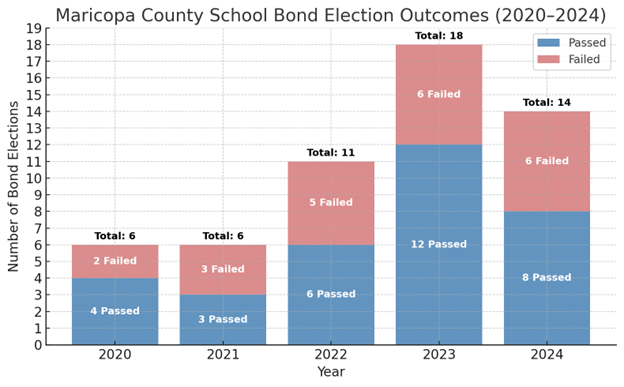
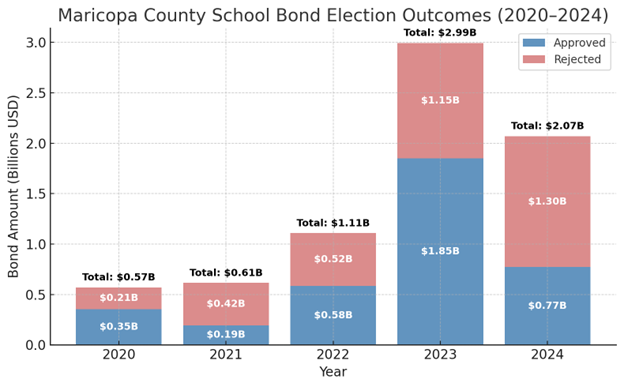
As seen in the chart below between 2020 and 2024, bond requests across Maricopa County have ballooned as pandemic stimulus dollars expired and districts turned back to property-tax financing. The pace of school bond elections far exceeds municipal ones, and the total amounts sought have surged as seen in the 2nd chart below. Inflation alone doesn’t explain the escalation, though it is often erroneously cited as the root cause of this growth.
The lesson isn’t that districts should never seek voter support, but that leaders must confront an uncomfortable truth: demand for traditional district schools is shrinking. Some causes, like rising housing costs and lower birth rates, are beyond their control. Others, like families choosing charters or ESAs, are the direct result of competition and consumer preference. Pretending otherwise guarantees more sudden, painful closures down the road, along with wasted opportunities adding up to hundreds of millions in taxpayer funds.
Kyrene’s crisis is neither the first nor the last domino of overbuilt school districts. Every district that keeps chasing bonds to prop up half-empty schools is writing the same ending. The can has been kicked far enough. It’s time to stop borrowing from tomorrow to preserve yesterday’s mistakes.
Arman Sidhu is a lifelong Arizona resident and educator who has served as a teacher and principal in both traditional public and charter schools. He is a doctoral student in education at Arizona State University’s Mary Lou Fulton Teachers College. His opinions are entirely his own.
In the evolving landscape of Arizona high school sports, one organization stands as a relic of a bygone era, clinging to monopolistic control and outdated practices: the Arizona Interscholastic Association (AIA).
The origins of the AIA are important to note due to the group’s strong initial connection with three of the most pervasive forces for the center-left in Arizona K-12 politics: The Arizona School Administrators, the Arizona School Board Association, and the Arizona Educators Association, the local teachers’ union affiliate. In addition to sharing space, it is apparent that the AIA shares similar views as these three organizations in the protection of its monopoly of Arizona high school sports.
Like its original policy partners, the AIA has become synonymous with overreach, authoritarianism, and a childlike resistance to change. As more Arizona athletes and their families opt for alternatives such as Canyon Athletic Association (CAA) schools and independent prep schools, the AIA increasingly finds itself at an existential crossroads.
Its response? Double down on draconian policies that dash the dreams of student-athletes and undermine the dedication of coaches who are often underpaid and overworked. The systemic problem of AIA overreach in the decisions of Arizona families is bad enough that there are lawyers in our state that specialize in AIA conflict and dispute resolution, a troubling realization for an organization that claims to work on behalf of Arizona kids.
A Culture of Overreach and Punishment
The AIA’s authoritarian style is most evident in its relentless enforcement of rules that punish rather than promote the best interests of student-athletes. Consider the tragic case of Desert Edge High School in Goodyear, where the football and track programs were placed on probation due to a social media post by a successful coach who dared to advocate for his school’s athletic and academic quality when asked by a parent that was already seeking a transfer for their child.
The incident led to a harsh punishment that barred Desert Edge from playoff participation in both football and track. It took two hard working and dedicated coaches to fall on their sword to assuage the feckless AIA amid complaints from neighboring schools, who embrace a robust and shameful snitch culture to make up for the inadequacies of their own teams.
Why should the coaches that pour their souls into their athletic programs be barred from advocating for their schools? What harm is done by high school coaches explaining to prospective student-athletes and families the benefits of their program and school amid a generational shift that poses a long-term threat to public school enrollment in Arizona?
This decision not only penalized the coaches and players who had worked tirelessly to excel but also showcased the AIA’s ruthlessness in quashing any perceived challenge to its control. It is the duty of the AIA and its senior leadership to explain what they are so afraid of when parents and student-athletes vote with their feet and elect to make moves in their best interests, as opposed to the members that make up the AIA’s Soviet-style politburo, who would prefer to handcuff each and every kid to their assigned school to preserve its membership base and grow its payroll with additional bureaucrats.
The AIA’s overreach was most recently witnessed in its unfair and controversial decision regarding the Williams Field High School boys’ volleyball team, which had its state championship vacated after the AIA deemed the team ineligible due to an unsanctioned scrimmage shortly before playoffs commenced.
Never mind the fact that these young men were challenging themselves by taking the time out of their day to train against a better team in preparation for the playoffs, the AIA’s Stalinist approach takes precedence. Even though Williams Field High School self-reported the incident, it still took a legal battle by parents to allow the players to compete.
By allowing Williams Field to play, the AIA wasn’t exhibiting any kindness. Instead they did so as a legal strategy, before ultimately deciding to strip the team of its well-deserved title and expunge the team’s participation from the record books. If that isn’t reminiscent of Stalin, what is?
Valley Christian High School has also found itself in the AIA’s crosshairs, with investigations into alleged bylaw violations concerning student-athlete participation in non-AIA activities. The school’s basketball and baseball programs were subject to scrutiny simply for engaging in activities that promote player development and community service, which included a single Valley Christian basketball player living his dream to try out for the Italian national team and the audacity of the young men of Valley Christian’s baseball program who dared to engage in community service during a mission trip to the Dominican Republic, where the AIA struck down the chance for the team to scrimmage against Dominicans. Unless you happen to be privy to the inside baseball of the AIA’s autocrats, the logic and transparency behind such decisions is sorely lacking.
What the examples of Desert Edge, Williams Field, and Valley Christian cumulatively demonstrate is the fact that if the AIA can’t put their fingerprints all over an event and milk it for money while offering their papal-like blessing, then we have evidently reached the Armageddon of amateur athletics.
A Monopoly Built on Exploitation
Beyond punitive actions, the AIA has exploited its position to secure financial gain at the expense of Arizona families and student-athletes. One glaring example is the AIA’s concessionary monopoly on photography at state tournaments, where it has barred local newspaper photographers from prime locations, instead reserving these spots for a single private company to dig deeper into the pockets of Arizona families. This coming from the same organization that dragged its feet for two years at the idea of children retaining the rights to their Name, Image, and Likeness (NIL), a concept that should be automatically ubiquitous for all Americans of all ages without exception.
The association’s lack of care for student welfare was also evident in a 2012 lawsuit brought against the AIA under the Americans with Disabilities Act (ADA). The lawsuit alleged that the AIA discriminated against a student-athlete with a disability by refusing to allow a sign language interpreter during tennis matches. The case was settled, with the AIA agreeing to policy changes and training to ensure compliance with the ADA. However, the incident underscores the AIA’s long history of prioritizing its rigid rules over the needs of individual students, even for common sense rights like the right of a deaf student-athlete to have access to a sign language interpreter.
With evidently little to do other than riding the coattails of the real legwork done by coaches and school athletic directors, the AIA generates its own work by targeting and investigating children and their families for making the best available choices to them. Is such an organization worthy of the voluntary participation of most Arizona schools?
The AIA has repeatedly targeted families and students who exercise their right to choose the best educational and athletic opportunities available. Longtime AIA Executive Director David Hines has been at the forefront of this campaign, having advocated for policies that would make student-athletes who dare to transfer schools ineligible for postseason play—a clear attempt to deter families from seeking better options for their children. Such policies punish students for seeking opportunities that align with their aspirations, while further entrenching the AIA’s fear-driven monopoly over high school sports in the state.
The AIA’s thirst for crony capitalism extends to its launch of AZPreps365, a news service it manages as part of its public relations strategy, as well as shady long-term partnerships it has entered with private entities. The fact that the AIA employs a Business Development Officer, in addition to a Chief Technology Officer, a General Manager of AIA Sports Properties, a Director of Media Services, an Account Executive, and 3 senior-level directors in the Executive Office tells Arizonans all we need to know about the “no-show job” racket that is the AIA.
A Monopoly on the Brink of Collapse
The AIA’s authoritarian grip on Arizona high school sports is not unbreakable. As more families and school districts explore alternatives, the organization risks becoming increasingly irrelevant. The growth of the Canyon Athletic Association is but one bright spot. The emergence of private, independent prep schools and specialized sports academies, particularly in soccer and basketball, offers a free-market alternative that prioritizes student-athlete development over bureaucratic control. Even football is not immune from a challenge by entrepreneurial Arizonans seeking to do right by kids instead of the system.
Indeed, the AIA’s monopoly could crumble with the exit of one major school district or a coalition of competitive districts seeking greener pastures. The defection of districts like Chandler, Mesa, Tempe, Scottsdale, which frequently dominate in terms of their playoff appearances and championships in the AIA’s top-tier divisions, would suffice on its own to force the AIA to do an about-face. The departure of East Valley powerhouse districts from the AIA would reorient a significant amount of the talent outside of the scope of the AIA, rendering it less and less relevant for NCAA recruiting and hitting the organization’s purse strings directly.
The time is ripe for a new era in Arizona high school sports—one that values competition, opportunity, and the well-being of student-athletes over the preservation of an outdated and authoritarian institution.
As families continue to seek alternatives, the AIA must either reform or face obsolescence. Parents of AIA schools would be justified in contacting their school board members to contest their district’s future participation in a league that frequently puts the dictums of adults over the dreams of student-athletes.
Arman Sidhu is a lifelong Arizonan and is a former Student-Athlete, Teacher, Coach, Athletic Director, and Principal. His views are solely his own.
As Arizona’s largest public school district, Mesa Unified School District is a critical case study for the future of K-12 funding, particularly in a state that champions competition and choice for its families. Despite headlines boasting of population growth across the state, the nationwide decline in childbirths and cost-of-living increases will weigh heavily on district enrollment and balance sheets for years to come.
While solving these policy issues is admittedly outside the scope of superintendents and governing boards, how districts adjust to these changes remains within their control. In the case of Mesa USD, the district faces an existential crisis in enrollment that will almost certainly require consolidation and closure among its 78 schools over the next 10-20 years. Furthermore, the district’s statewide assessment performance leaves much to be desired, with just 38% and 31% of Mesa USD students achieving proficiency in English Language Arts and Math, respectively.
Next month, Mesa taxpayers will have an opportunity to make their voices heard and rein in the district’s spendthrift ways by rejecting a $500 million bond and an override continuation that, if passed, would allow the already overstretched district to exceed its revenue control limit by 15% for another seven years.
When voters last approved a bond for Mesa USD in 2018, they did so with a margin of <1% and at a cost of $300 million to taxpayers. A year later, the district was beset with allegations of financial impropriety and steep administrative costs, leading to the resignation of the district’s superintendent. The poor transparency on the part of the school board in communicating the issue to the public further underscores the lack of taxpayer accountability. Furthermore, over the last three years, Mesa USD received over $245 million in federal pandemic relief funds, with hundreds of millions still unspent.
Nevertheless, Mesa USD’s pitch to taxpayers remains unchanged, and approval of the bond and continuation of the override will result in little more than throwing away hundreds of millions of dollars in costly capital projects for underutilized campuses and unsustainable personnel costs.
Demography Is Destiny
In the early 2000s, Mesa boasted a population of over 400,000 residents. During the same period, Mesa USD reached its peak enrollment at over 87,000 students during the 2002-2003 school year. Today, the city is home to nearly 510,000 people, yet the city’s population growth over the last 20 years never trickled down to Mesa USD’s enrollment. Today, the district serves fewer students than it did in 1990 when Mesa had just 290,000 residents.
An additional cause for alarm comes from the pronounced decline in Mesa USD’s Kindergarten-6th grade enrollment. For large, comprehensive school districts like Mesa, enrollment in feeder schools is an important signal of a district’s future headcount. Over the last 20 years, 16 of Mesa USD’s elementary schools have lost over 40% of their students. In the same period, the district’s junior high schools saw an average decline of 50% of their enrollment.
Source: Mesa Public Schools – Demographics Report 2021-2022
As another signal of its unpopularity, Mesa USD is one of the state’s largest sources of ESA students, which has its most substantial adoption rates in the elementary grade levels. Given the expansion of ESAs and charter schools, Mesa USD will continue competing for a depleting student pool. In turn, a decline in enrollment necessitates a reduction in operational expenses, which Mesa USD has rebuffed in favor of taxpayer-funded bailouts.
Around 77% of school districts in Maricopa County have one or more overrides in effect. While East Valley voters have typically displayed enthusiasm for K-12 bonds and overrides in the past, the powerful impact of free market principles via ESAs makes the decision different today. With nearly 70,000 Arizona families using ESAs today, enthusiasm for the program has made it larger than any school district in the state, with the additional benefit of not requiring bonds or overrides.
To realize the substantial cost savings from ESAs, a corresponding change is required from public schools in rightsizing their districts by adjusting their property and personnel costs. In preparing for the inevitable, Mesa USD must take steps now to address under-capacity and explore the sale of its real estate before requesting additional funds from taxpayers. In rejecting this bond and override, Mesa voters sidestep a lousy deal and send a clear message about taxpayer accountability.
Arman Sidhu is a lifelong Arizona resident and previously worked in K-12 education as a principal and teacher. He currently leads a nonprofit microschool.
Amid the passage of historic school choice legislation in Arizona, the educational opportunities available to students and families today are unparalleled with the state’s universal ESA program. In addition to providing Arizona families with voice, choice, and agency in their child’s education, the ESA program has the potential to save Arizona taxpayers considerable funds from future school district bond and override measures.
However, to realize these savings, a long overdue conversation about rightsizing Arizona’s public schools is necessary. Despite significant population growth within Arizona, the enrollment forecasts for most school districts anticipate a period of long-term decline due to lower childbirths, affordability, and alternative options. This demonstrates a pressing need to review the budgets and assets of public school districts and align them with future enrollment projections.
Given the significant competition from the rise in homeschooling, as well as charter and private schools, public schools are no longer the only game in town. As a result, greater scrutiny from local taxpayers is needed in holding school districts fiscally accountable by questioning their need for additional funds through bonds and overrides.
What Are School Bonds & Overrides?
School bonds are loans that school districts sell to investors, who are repaid through the district’s future property taxes. These bond funds have specific limitations on their use and cannot be used to increase staff salaries. In most instances, these funds are leveraged for infrastructure projects involving the construction of new facilities or upgrades to existing ones. In contrast, overrides go directly to school districts and can be used for staff salaries and various programs outlined by the district requesting the override.
This November, a total of 23 school districts in Maricopa County will have bond and/or override measures on the ballot. Among these 23 districts, at least 4—Kyrene Elementary School District, Mesa Unified School District, Gilbert Unified School District, Scottsdale Unified School District—are in dire need of rightsizing before requesting additional funds from taxpayers based on their pronounced decline in enrollment.
In particular, Mesa USD, the state’s largest school district, enrolls fewer students today than it did in the fall of 1990. Yet, the district’s real estate portfolio somehow contains 78 schools, in addition to various non-instructional facilities and offices throughout the city. Mesa USD, as well as surrounding districts in similar positions, need to do right by taxpayers in exploring the sale of underutilized real estate before passing the buck to taxpayers.
As seen in the table below, only Gilbert USD has shown an increase in enrollment since the fall of 2000, and none of the districts can report an increase in enrollment in the last 10 years. Given the growth in ESA adoption and charter school enrollment, the pragmatic move is to respond to these declines now by rightsizing these districts, pursuing the sale of district assets, and removing administrative bloat.
Among the clearest signs of waste and inefficiency can be found in the amount of unspent federal pandemic relief funds provided to schools around the country. In the case of the 4 school districts requesting additional funds from taxpayers, they collectively still have access to tens of millions in unspent, flexible funds that are set to expire in a year.
What this experiment in “helicopter money” confirms is that the problem ailing local school districts is not a lack of funds, but rather their inability to direct funds efficiently. In the absence of a public monopoly, this decline in public school enrollment will continue to eat into taxpayers’ wallets with the additional forces of demographic shifts, affordability, and competition from the growing number of viable and efficient alternatives in the form of charter schools, private schools, microschools, and homeschool co-ops.
In adjusting to this historic era of school choice, the need for fiscal accountability remains essential on behalf of public school districts that have been reluctant to change and control their costs. To avoid perpetually funding buildings and bureaucracy, local taxpayers and residents must ensure their voices are heard.
Arman Sidhu is a lifelong Arizona resident and previously worked in K-12 education as a principal and teacher. He currently leads a nonprofit microschool.