By Ethan Faverino |
Americans preparing for Thanksgiving will face higher costs for a traditional holiday meal this year, with the average cost of a traditional holiday dinner for 10 people increasing by more than 6% compared to 2025, according to the American Farm Bureau Federation (AFBF).
The AFBF’s 41st annual Thanksgiving Dinner Cost Survey found that the average cost of a Thanksgiving meal reached $58.63, an increase of $3.45, or approximately 6.3%, from last year’s average of $55.18.
The increase marks the first annual rise in Thanksgiving dinner costs since 2022, ending three consecutive years of declining prices. Despite the increase, this year’s average remains approximately 8.5% below the record high of $64.05 recorded in 2022.
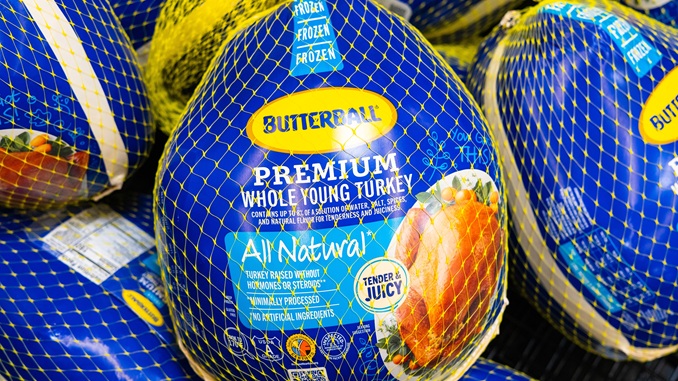
Turkey prices accounted for a significant portion of the increase, with the average cost of a 16-pound frozen turkey reaching $23.68, up approximately 10.1% from $21.50 in 2025.
Other Thanksgiving staples also experienced price increases, including whole milk, which rose 8.6% to $4.05 per gallon, fresh cranberries, which increased 8.8% to $2.48 per 12-ounce package, and dinner rolls, which climbed 7% to $3.81 per dozen. Sweet potatoes increased 5% to $4.20 for three pounds, while a 14-ounce package of stuffing mix rose 5.4% to $3.91.
However, several ingredients became less expensive.
A vegetable tray containing carrots and celery recorded the largest percentage decrease among surveyed items, declining 3.7%, while frozen pie crusts, whipping cream, and frozen peas also experienced modest price reductions.
The survey’s regional analysis revealed significant differences in Thanksgiving grocery expenses across the country.
Households in the Northeast face the highest average cost at $61.57 for a traditional 10-person dinner, approximately 5% above the national average. The West follows at $58.74, slightly above the national average, while the Midwest averages $56.89.
The South remains the most affordable region for Thanksgiving dinner, with an average cost of $54.33, approximately 7.3% below the national average.
The $7.24 difference between the Northeast and South means Northeastern households can expect to spend approximately 13.3% more for the same traditional holiday meal.
Regional prices also shifted considerably from 2025. The West, which recorded the highest Thanksgiving dinner costs last year at $61.75, experienced a decline of approximately 4.9% in 2026.
For households preparing a larger holiday meal, the AFBF also examined an expanded Thanksgiving menu that includes boneless ham, russet potatoes, and frozen green beans.
Under the expanded menu, the Northeast again ranked as the most expensive region at $86.62, followed by the West at $81.75 and the Midwest at $79.68. The South remained the least expensive at $76.91.
Beyond regional differences, the AFBF cited elevated production and supply chain expense as factors continuing to higher food prices, including fuel, fertilizer, labor, transportation, rent, and electricity.
The organization noted that higher retail food prices do not necessarily translate into increased profits for American farmers and ranchers, who continue to face elevated operating expenses.
According to the AFBF, estimates from the U.S. Department of Agriculture’s Food Dollar Series indicate that less than six cents of every dollar spent on food goes back to the farm, with the remaining share distributed across other stages of the food supply chain.
The survey provides a yearly comparison of Thanksgiving food costs and highlights how changes in agricultural production, consumer demand, and regional market conditions affect the price of a traditional American holiday meal.
Ethan Faverino is a reporter for AZ Free News. You can send him news tips using this link.