By Matthew Holloway |
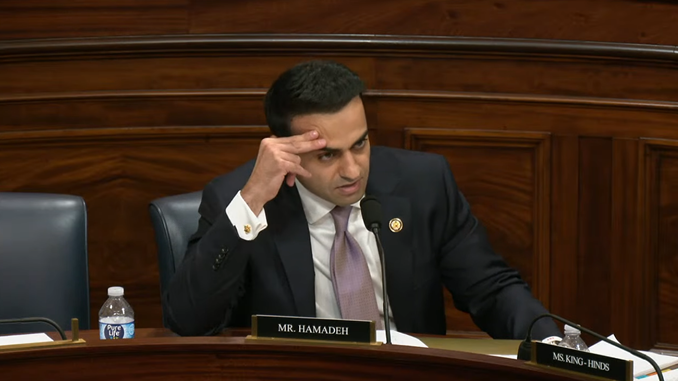
Congressman Abe Hamadeh (R-AZ-08) called for a halt to further funding for the Department of Veterans Affairs’ (VA) electronic health record contract with Oracle. He wants the company and the VA to produce a reliable cost estimate, a fixed schedule for installing the system, and an accounting of how much money has been wasted. Hamadeh delivered the remarks to Oracle CEO Mike Sicilia Thursday during a House Veterans’ Affairs Committee oversight hearing.
“What the hell has happened? Software for $27 billion? You all should be ashamed,” Hamadeh said. “It’s unacceptable. And I refuse to be complicit in that.”
“I am just shocked because over the past year, we’ve seen in Minnesota all this fraud, the Somali fraud,” Hamadeh told Sicilia. “This is equivalent to this. This is corporate corruption. I usually don’t get animated in meetings like this. I am deeply offended. I’m a veteran myself. Seventeen billion dollars in addition to ten billion dollars, 27 billion dollars for software that has only been implemented at 19 centers over ten years? What the hell are we doing?”
“It cost a billion dollars to build the Empire State Building, and it took one year,” he continued. “What you could do with 27 billion dollars is permanently house every single homeless veteran. 27 billion dollars. You can build 100,000 American homes. You could erase over three million Americans’ student loan debt for 27 billion dollars.”
“I’m truly— I’m appalled,” Hamadeh said. “You know, there’s an old saying, there’s an old adage that pigs get fat, and hogs get slaughtered. I have no idea why the VA continues to invest in this program and to continue to waste money in this program, because there’s nothing to show for it.”
The VA raised the maximum value of its contract with Oracle from approximately $10 billion to $27 billion in August. The department originally awarded the contract to Cerner in 2018. Oracle acquired the company in 2022 and assumed responsibility for its work. The revised ceiling sets the upper limit on what the VA can order under the contract.
Hamadeh, an Army veteran, questioned how the VA could justify the $17 billion increase when the system had reached 19 medical centers. He said he had heard neither an apology nor an adequate explanation for the increase. He also objected to the circumstances of Sicilia’s appearance. In September, the committee voted 19–0 to subpoena Sicilia and Oracle Chairman Larry Ellison after hearing from VA officials about the project.
“I was elected to defend the American public, and that’s exactly what I intend to do, because our veterans, they deserve the best care. They don’t deserve this. They’re sitting at home looking, seeing this corporation, $27 billion with nothing to show for it. It’s unacceptable.”
Hamadeh closed his time with three conditions for further funding. “No further money should move until Oracle and the VA produce a GAO-accepted cost estimate, a fixed deployment schedule, and a clear accounting of what has already been wasted,” he said, adding, “I have no questions for you because you’ve answered them all over 10 years. Over 10 years. It’s embarrassing.”
Hamadeh said he understood that $800 million remained available to draw on and argued that amount should be sufficient to meet his request.
“Oracle must justify every single dollar it is charging the VA, must justify every single dollar it’s approving. There’s no more free passes. My duty as a congressman and as a member of this committee is to protect our veterans and also punish the corrupt. And I assure you this is just the beginning.”
Sicilia addressed the change in price in his written testimony to the House committee. In 2022, about a month after Oracle acquired Cerner, he told Congress the company was prepared to absorb cost overruns on work covered by the existing contract. Sicilia said Thursday that the commitment still applied to work the VA had ordered at a fixed price within the original scope. He attributed the higher ceiling to changes in the VA’s requirements, the volume of work, and the length of the rollout.
Sicilia cited one change that affected how VA employees used the system. Some employees had to switch between different user roles to complete a task. He said Oracle consolidated those roles, revised access permissions, and tested how the changes affected billing and scheduling. Sicilia told the committee that Oracle believed the revised ceiling would cover the nationwide rollout by 2031 if the scope and schedule held.
The Government Accountability Office (GAO) reported Wednesday that the VA brought the system online at all 13 medical centers scheduled for 2026. Those installations took six months. The first six sites began using the system between October 2020 and March 2024. The VA paused further deployments in 2023 to address staff concerns and patient safety. Bost said the October launches in Cleveland and Anchorage brought the number of veterans served by the system to more than 780,000.
The VA plans to bring another 26 medical centers online in 2027, beginning in January. Ahead of that expansion, the GAO found that the department still lacked a detailed schedule covering all the work required to finish the project. Auditors also found that the VA had yet to fully implement 11 of the 18 recommendations the GAO made in five reports issued between 2020 and 2025. The agency said a complete schedule would help Congress and the VA assess what it will take to meet the department’s goal of 170 deployments by 2031.
Matthew Holloway is a senior reporter for AZ Free News. Follow him on X for his latest stories, or email tips to Matthew@azfreenews.com.