One Arizona Republican Senator continues to hold the Biden administration accountable over the recent closure of a port of entry at the border.
On Wednesday, State Senator T.J. Shope, reacted to news of the Lukeville Port of Entry reopening, calling the initial move to close the vital border crossing “irresponsible and reckless.”
In his statement, Shope said, “Not only did this create financial turmoil for border communities within Arizona who rely on the tourism traffic to and from Rocky Point to support their families, but the closure of the Lukeville Port of Entry also put unnecessary stress and strain on our citizens and commerce who depend on a safe and direct route to this popular destination.”
Over the past few months, the border crisis has deteriorated considerably, forcing the Biden administration to take rather unprecedented measures in a frenzied attempt to mitigate public perception of the massive influx of illegal immigrants into the country. One of those actions was the closure of the Lukeville Port of Entry, which is the main thoroughfare to the popular tourist destination of Rocky Point, forcing families or commerce operators to detour hours to the east or west. A local business owner recently told an Arizona outlet that, in the aftermath of the closure, Rocky Point “was like a little ghost town,” noting that “local business, restaurants, hotels, rentals, everything has declined.”
Shope continued to address the situation in southern Arizona in his lengthy statement, blasting the Biden administration for a severe lack of border security. He said, “While I’m glad Lukeville is reopening on Thursday, the official statement from the federal government includes an absurd claim that ‘CBP will continue to prioritize our border security mission as necessary in response to this evolving situation,’ which is a blatant lie. The American people aren’t dumb. Nothing has changed at the border to prompt the opening of Lukeville. Thousands of illegals, many of which are criminals and terrorists, continue to pour into our state on a daily basis, overwhelming our brave law enforcement personnel. This was purely a political move after Republican lawmakers put immense pressure on the Biden administration to open this critical artery for commerce and legal traffic.”
The lawmaker promised to persist in holding the president accountable to his responsibility to secure the border and to refrain from closing American ports of entry.
Though the border crisis appears to be worsening by the day, legislative Republicans have effectively made the point that the reality for Arizonans could be more daunting if not for their check on the Democrats in the state – especially Governor Katie Hobbs. When Hobbs signed the state budget compromise in May, Senate President Petersen highlighted that his members “prevented the Governor and Democrat Legislators from advancing their extremist agenda…we’re not getting rid of state funded border security resources to keep our communities safe.” In the upcoming session, starting next week, expect Republicans to continue to introduce bills and policies that would give the Grand Canyon State more ability and resources to combat the many scourges of the border crisis.
Daniel Stefanski is a reporter for AZ Free News. You can send him news tips using this link.
Many Arizona officials sent tributes for the passing of an inspirational leader of the state and nation.
Last week, former U.S. Supreme Court Associate Justice Sandra Day O’Connor died at the age of 93. O’Connor grew up in Arizona and paved a way for women in the highest levels of government as she served in the Arizona Legislature and as a Judge on the Maricopa County Superior Court. Following this already historic rise, former President Ronald Reagan nominated O’Connor to the nation’s high court, where she would become the first female Justice on the bench.
“Sandra Day O’Connor was an impactful conservative and a trailblazer who displayed the epitome of a hardworking public servant, a dedicated mother, and inspired many women to pursue leadership roles within the legislative and judicial branches of government,” said Senate President Warren Petersen. “She broke barriers throughout her career, becoming the first woman to serve as Majority Leader for Republicans at the Arizona State Senate and setting the stage for others to follow in her footsteps. The example she set on civil discourse is to be admired. We’re saddened by the loss of this icon, and our hearts go out to O’Connor’s family, but we take comfort in knowing she’ll have lasting positive impacts on our state and nation for generations to come.”
FOR IMMEDIATE RELEASE: Senate Republicans Express Condolences on the Passing of Former U.S. Supreme Court Justice and Arizona State Senate Majority Leader Sandra Day O'Connor@votewarrenpic.twitter.com/q5epm9DyED
Senate Pro Tempore T.J. Shope added, “Very saddened to hear the news about fmr. United States Supreme Court Justice Sandra Day O’Connor today. Before President Reagan nominated her to became the first woman to serve on the U.S. Supreme Court, this legendary Arizonan was our state’s first female Senate Majority Leader, in charge of the State Senate’s Republican Caucus for two terms. I was honored to meet her on several occasions but the most recent was about a handful of years ago on the Floor of the AZ House of Representatives. We offer her family our condolences during this time.”
Very saddened to hear the news about fmr. United States Supreme Court Justice Sandra Day O’Connor today. Before President Reagan nominated her to became the first woman to serve on the U.S. Supreme Court, this legendary Arizonan was our state’s first female Senate Majority… pic.twitter.com/vQh5myo1rg
Governor Katie Hobbs communicated her own sentiments, writing, “Throughout her entire career, as an Arizona legislator, judge, and Supreme Court Justice, Justice Sandra Day O’Connor embodied the humility and civility that is at the core of what it means to be a public servant. Justice O’Connor first broke barriers when she was elected the Arizona Senate Majority Leader, becoming the first woman to ever serve in that role in the United States. Her trailblazing career continued when she became the first woman to ever serve on the Supreme Court, where she was the decisive vote in some of the most critical court cases in our nation’s history. Justice O’Connor’s impact continued far beyond the bench, with a lifelong commitment to civic engagement and civil discourse, which is more important than ever. Her legacy will forever be ingrained in the fibers of our state and nation’s history. The hearts of every Arizonan are with her and her family today as we mourn the loss of a true trailblazer.”
Justice Sandra Day O’Connor put people above all else and created an eternal legacy that will forever be ingrained in the fibers of our state and nation’s history.
On behalf of the State of Arizona, I send my deepest sympathies to her family, loved ones & everyone touched by her…
Attorney General Kris Mayes stated, “I am deeply saddened to hear of the passing of Justice Sandra Day O’Connor. She set a powerful example of leadership for so many to follow. Even before her appointment to the Supreme Court, Justice O’Connor’s trailblazing leadership here in Arizona cemented her place in the history of our state. Her humble beginnings on the Lazy B Ranch near Duncan, Arizona was just the start. It was something I always admired about her: how she went from my own beloved rural Arizona, to the marbled halls of the Supreme Court. Justice O’Connor exemplified service leadership throughout her career: Arizona Assistant Attorney General, first woman State Senate majority leader in the country, Maricopa County Superior Court judge, Arizona Court of Appeals judge, and first woman Supreme Court Justice. An icon. My thoughts are with Justice O’Connor’s family and loved ones during this time.”
I am deeply saddened to hear of the passing of Justice Sandra Day O'Connor. She set a powerful example of leadership for so many to follow. 1/
Treasurer Kimberly Yee, who followed in O’Connor’s footsteps as a state senate majority leader, said, “Sandra Day O’Connor was the 1st female Senate Majority Leader in Arizona in 1973. I became the 2nd female Senate Majority Leader 44 years later. She was a trailblazer, worked across the aisle and believed in civil discourse. She was an inspiration to me and women around the world.”
Sandra Day O'Connor was the 1st female Senate Majority Leader in Arizona in 1973. I became the 2nd female Senate Majority Leader 44 years later.She was a trailblazer, worked across the aisle and believed in civil discourse. She was an inspiration to me and women around the world. pic.twitter.com/WE561xK8vG
A controversial post on social media from southern Arizona Democrats was deleted after attracting significant outrage from around the country.
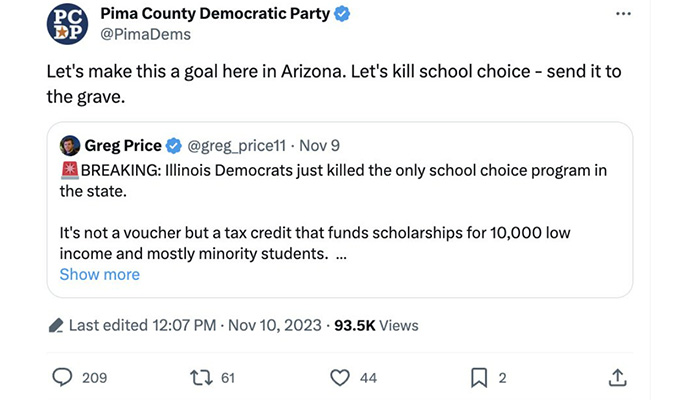
Last week, the Pima County Democratic Party responded to a post on the platform “X,” calling for the end of school choice in Arizona.
The post that the Pima County Democrats chose to react to was from Greg Price, who, according to his bio, is involved with communications with the State Freedom Caucus Network. Price was alerting his more than 326,000 followers about the news out of the Illinois Legislature, where the state house there adjourned without extending the Invest in Kids program, which gives scholarship tax credits to almost 10,000 low-income children.
Pima County Democrats wrote, “Let’s make this a goal here in Arizona. Let’s kill school choice – send it to the grave.”
People were quick to respond to the post. Senate President Pro Tempore T.J. Shope stated, “Let’s be clear about what this tweet means. School Choice in AZ really blossomed in the 1990s and times prior in AZ. @PimaDems want to end school choice options like Open Enrollment within a school district, charter schools, abolish private schools, eliminate home schooling. Basically have the government tell families what to do with their kids cuz the government knows best. Nope. Not gonna happen as long as I represent Pima County!”
Let’s be clear about what this tweet means. School Choice in AZ really blossomed in the 1990s and times prior in AZ. @PimaDems want to end school choice options like Open Enrollment within a school district, charter schools, abolish private schools, eliminate home schooling.… https://t.co/LSjDM3YaVy
Arizona House Speaker Ben Toma weighed in, saying, “The Democrats’ desparate attacks on school choice do nothing but reveal their own desire to indoctrinate children with their radical leftist ideologies. They couldn’t stop charter schools or other school choice programs despite decades of trying. School choice is here to stay.”
Even a journalist from the Arizona Republic, Laurie Roberts, added her thoughts about the post. Roberts said, “Pima County Democrats want to kill charter schools, as well as universal ESAs? Genius plan if your goal is to remain the minority party at the Legislature.”
Pima County Democrats want to kill charter schools, as well as universal ESAs? Genius plan if your goal is to remain the minority party at the Legislature. https://t.co/UwnqQJHbVG
Despite the pushback on their post and the subsequent deletion of it, the county party continued to attack school choice over the weekend, focusing its ire on the state’s universal ESA program. The southern Arizona Democrats wrote, “Did you know that even though Arizona private and charter schools are fueled by our ESA/Voucher tax dollars, they can turn away kids for any reason they want. School choice isn’t your choice, it’s the school’s choice. 92% of AZ kids attend public schools. Fund them.”
Did you know that even though Arizona private and charter schools are fueled by our ESA/Voucher tax dollars, they can turn away kids for any reason they want. School choice isn't your choice, it's the school's choice. 92% of AZ kids attend public schools. Fund them. pic.twitter.com/GD4WVBxA8D
Their account added, “Private schools and Charter Schools are virtually non-existent in rural Arizona. The ESA and Voucher scam, robs rural public schools of their already dire funding, and gives it to parents in wealthy Scottsdale zip codes. It’s a scam folks.”
Private schools and Charter Schools are virtually non-existent in rural Arizona. The ESA and Voucher scam, robs rural public schools of their already dire funding, and gives it to parents in wealthy Scottsdale zip codes. It's a scam folks.
With the start of the Arizona legislative session just two months away, these sentiments from Democrats in the state’s second-largest county are instructive to ascertain how party activists will attempt to steer the policy movements on school choice issues. In the 2023 session, Democrat Governor Katie Hobbs failed to achieve any cuts or increased regulations on ESAs, angering members of her base who felt that she abandoned her campaign promises. After signing the budget she negotiated with Republican legislators, however, Hobbs turned up the dial on her attacks on the ESA program, attempting to smooth over the frustrations of Democrats around the state. The uptick in political bickering with ESAs will be a factor in navigating critical boxes to check, including the completion of the next fiscal year budget.
Daniel Stefanski is a reporter for AZ Free News. You can send him news tips using this link.
Two Arizona legislators are proposing changes to the state’s hospital.
Last week, Senators Catherine Miranda and T.J. Shope wrote an opinion piece for the Arizona Republic with their legislative recommendations to improve the Arizona State Hospital over the next session.
The bipartisan duo revealed that their thoughts stem from concerns “about shortcomings in Arizona’s behavioral health system, especially the system of care for folks with a serious mental illness.” There were three areas that the lawmakers identified for change, which were “better oversight and governance of the Arizona State Hospital, improved community reintegration resources, and more secure residential treatment options.”
In their article, Miranda and Shope telegraphed their legislative proposals for all three areas. For ‘oversight,’ the two made the case that the setup for the Arizona Department of Health Services (ADHS) running and regulating the state hospital is “flawed, and that the Legislature should split up the two to improve the oversight and care for patients. The senators hope to make this happen by ensuring that “the superintendent of the facility would report to an independent, appointed governing body composed of people with experience overseeing complex psychiatric facilities.”
For ‘reintegration,’ Miranda and Shope proposed the development of “a small ‘community reintegration’ unit to serve as a transitional unit for patients who are approaching discharge from the state hospital but who still need structured care.” This proposal was already identified as a “critical gap” by the state’s hospital in its Clinical Improvement Plan.
For ‘facilities,’ Miranda and Shope discussed the need for “persons with serious mental illnesses” to have “safe places to receive treatment with more structure and better qualified staff than are available in existing residential behavioral health group homes.” The senators asserted that former-Governor Doug Ducey’s final budget “included funds to build three such secure residential treatment facilities, including funding to staff them,” but that “those funds were swept out of the current budget.”
Senators Miranda and Shope won’t have to wait long to start the engine on their recommendations to change the Arizona State Hospital with the first day of the new legislative session around two months away.
Daniel Stefanski is a reporter for AZ Free News. You can send him news tips using this link.
The 2023 Super Bowl may be long over, but political fallout is continuing into the start of the next football season.
On Thursday night, veteran Arizona reporter Dennis Welch and one of his colleagues released a story that “according to public records, the Arizona Office of Tourism gifted the Governor’s Office twelve tickets (to the Super Bowl)” and that “members of Hobbs’ staff used the remaining half dozen… worth tens of thousands of dollars.”
Two of the six Hobbs’ staffers who reportedly received tickets to the Super Bowl in Glendale, Arizona are no longer with the office, having departed earlier this year.
The Arizona’s Family journalists shared the existence of A.R.S. 41-1232.08, which bars “elected officials and public servants from accepting (the free tickets).” The statute reads, “A state officer or state employee shall not accept an expenditure or single expenditure for entertainment from a principal, designated lobbyist, authorized lobbyist, lobbyist for compensation, public body, designated public lobbyist or authorized public lobbyist or any other person acting on that person’s behalf.”
Republican legislators were quick to react to the breaking news, The Arizona Freedom Caucus posted, “Corruption in Governor Hobbs’ administration! Katie Hobbs’ staff accepted free Super Bowl tickets estimated to cost $7,000 per ticket. AZ has laws that make it ILLEGAL for Public Servants and Elected Officials to accept gifts over $25.00 in value. This is flat out corruption.”
Senate President Pro Tempore T.J. Shope wrote, “I purchased my nosebleed seats and these folks go for free in I’m sure way better seats than what I paid for? Cool scam for them eh Dennis Welch? Rules for thee and none for me is the mantra of the Governor Hobbs’ Administration I suppose…”
I purchased my nosebleed seats and these folks go for free in I’m sure way better seats than what I paid for? Cool scam for them eh @dennis_welch? Rules for thee and none for me is the mantra of the @GovernorHobbs Administration I suppose… https://t.co/vIeyFt2MdF
Shope also responded to an account that had attempted to argue that the Governor’s Office reported actions were “perks of being in a high office,” saying, “Huh breaking the law is NOT ‘one of the perks’ of being in high office, nor should it be. Why would I want to break the law when I can pay for them honestly. I’m sure that’s difficult to understand for some but being ethical is something three generations of elected Shope’s have had in common. These are the people educating your kids folks…people who think people in high office have a right to break the law.”
Huh breaking the law is NOT “one of the perks” of being in high office, nor should it be. Why would I want to break the law when I can pay for them honestly. I’m sure that’s difficult to understand for some but being ethical is something three generations of elected Shope’s have… https://t.co/PYkUR6Z4bI
In their report, the journalists revealed that “the previous Governor, Doug Ducey, received twenty tickets to the 2015 Super Bowl in Glendale,” and that they were told “Ducey paid face value for his ticket and distributed the remaining tickets to veterans groups.” The journalists added that “at the time, Ducey prohibited his staff from taking free tickets over concerns it was against the law.”
Daniel Stefanski is a reporter for AZ Free News. You can send him news tips using this link.