by Daniel Stefanski | Mar 22, 2024 | News
By Daniel Stefanski |
Arizona’s Democrat Governor and Republican legislators are engaged in an escalating political battle over the future of the state’s groundwater.
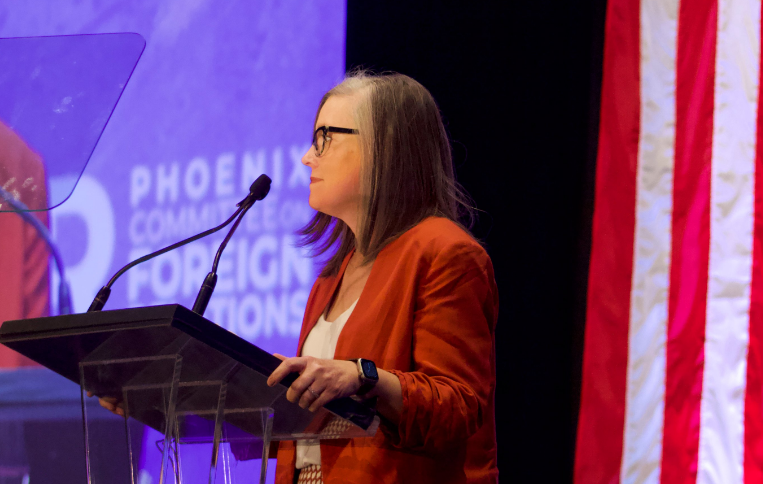
Last week, Arizona Governor Katie Hobbs took aim at a Republican-led solution to the state’s groundwater supply. Speaking at a conference in Tucson, Hobbs said, “I’m willing to work with any sponsors to pass legislation that’s real, effective and protects water supplies in rural areas. But should the bill remain unchanged it will not get my signature. The bill will silence rural communities and create a convoluted process that will make it nearly impossible for our communities to manage groundwater. It leaves us with the status quo where out of state corporate farmers come from around the world to take advantage of our aquifers, and small communities have their water pumped from beneath them. This is beyond unacceptable.”
The bill Hobbs attacked was SB 1221, which is sponsored by Senator Sine Kerr. The proposal would “establish a process for the designation of a basin management area (BMA) and an active BMA in any location not included in an active management area (AMA), to be initiated by petition to the Director of the Arizona Department of Water Resources, [and] outlines the goals of an active BMA, active BMA council makeup, rights to water, reporting requirements, and requirements for the continuation or termination of an active BMA” – according to the purpose provided by the Senate.
Senator Kerr responded to the Governor’s remarks, writing, “From the start, I’ve been proactive in spearheading meetings for collaboration from the Governor and her office on SB 1221, which would safeguard Arizona’s groundwater resources for generations to come. My goal has and will continue to be to reach a compromise on a solution that won’t hurt rural Arizonans’ livelihoods, their local economies, or their groundwater supply. Yet this week, Hobbs said she would veto the bill and recklessly called it a convoluted process that won’t protect our groundwater. That comment is merely a red herring meant to justify her proposal of big government overreach to regulate groundwater.”
At the conference, Governor Hobbs expressed an interest in working across the aisle to reach a compromise on the vital issue for her state. She said, “We in the state have many shared values: the desire to protect rural Arizona, protect rural water users and slow unmitigated depletion of our rural aquifers. We can and must find common ground to find a solution that works and puts politics aside.”
Kerr, who is the Senate’s Majority Whip and the Chair of the Committee on Natural Resources, clearly did not think that a Hobbs-endorsed proposal would meet the expectations or needs of her constituents and other stakeholders around the state. She added, “Energy and Water Rural Arizonans know what will and won’t benefit their local economies. I wholeheartedly support this proposal because I’ve listened and met with farmers, ranchers, and every other person, industry and organization across AZ who felt they were being alienated from the conversation. I believe in true collaboration, and will continue to work to reach a solution.”
This week, the Arizona House Committee on Natural Resources, Energy & Water considered the legislation and gave the bill its stamp of approval with a 6-4 party-line vote. Republican State Representative Austin Smith said, “The government picking winners and losers is bad policy. Rural Arizona in my district and across the state are facing the brunt of Hobbs draconian water restrictions. SB 1221 provides the tools necessary for everyone to be treated fairly. Thank you Senator Sine Kerr.”
House Democrats on the committee echoed the governor’s thinking on the featured bill before their panel, calling for another bipartisan piece of legislation to address their collective concerns.
Daniel Stefanski is a reporter for AZ Free News. You can send him news tips using this link.
by Daniel Stefanski | Apr 17, 2023 | News
By Daniel Stefanski |
Days after an AZ Free News report about Arizona’s largest county possibly taking steps toward compliance with extremely onerous environmental measures from the federal government, Republicans in the State Legislature announced their own move to counter these – and other – actions.
On Friday, the Arizona Senate and House Leadership teams announced the launch of “a study committee to examine recent local efforts attempting compliance with air quality standards set forth by the federal government.”
The committee, entitled the Joint Legislative Ad Hoc Committee on Air Quality and Energy, will meet to “gather information from experts and the public about local recommendations on rulemaking determinations by the Environmental Protection Agency (EPA) on ozone nonattainment.” Per the press release from the Legislature, the committee “will hear testimony and consider evidence on every angle, from sources of ozone and efforts to mitigate such sources, to the impacts of these mandates on Arizona families, workers, industries, consumer products and the economy, as well as the practicality of achieving recommended proposals and a variety of other issues deemed relevant to the investigation.”
Senate President Warren Petersen and House Speaker Ben Toma will each appoint five members to the committee. Two members have already been selected as the committee’s co-chairs: Senator Sine Kerr and Representative Gail Griffin, who are also chairs of the Senate and House Committees on Natural Resources, Energy and Water.
The two co-chairs of the committee issued comments in conjunction with Friday’s announcement. Senator Kerr stated: “While we strive to be proactive in protecting our environment, we certainly won’t blindly implement air quality policy dictated by the federal government without thorough investigation. We want to make sure the EPA’s requirements are realistic and won’t cause hardships for our residents, for our economy, or infringe on freedoms, as with what has so far transpired in California.”
And Representative Griffin said, “Arizona has natural occurrences of ozone such as from native vegetation and wildfires that we have absolutely no control over. We also receive significant ozone transports from Mexico and other states that need to be accounted for in federal models. We all want clean air, and I am looking forward to working with everyone on solutions.”
As AZ Free News reported on April 6, The Maricopa Association of Governments (MAG) recently contracted with a California-based consulting firm to “identify and evaluate new and available ozone precursor control measures that could be implemented within the nonattainment area” – which is an “eight-hour ozone boundary for the 2015 ozone standard (2015 National Ambient Air Quality Standard),” following a little-discussed published rule from the EPA in fall 2022, which moved “the region up the severity ladder for ozone pollution, reclassifying the region from ‘marginal’ to ‘moderate’ nonattainment for the ozone pollution standard.”
The consultant’s Final Report this spring suggested “approximately 50% reduction in nonattainment area anthropogenic NOx and VOC emissions” in order to bring the region into compliance with the EPA’s standard by an August 3, 2024, deadline.
To meet this deadline, suggested measures were included to reduce ozone in the Maricopa Nonattainment Area to meet Clean Air Act requirements related to the 2015 ozone standard. Some of the suggested measures include adopting standards similar to California like banning the internal combustion engine, banning gas appliances, and a host of regulations on various business activities.
There is a tight turnaround for approval of these drastic measures to cut emissions in Maricopa County. Before the end of April, the “MAG Regional Council may approve the Draft Suggested List of Measures” after receiving recommendations from the MAG Management Committee. Then, over this summer, “implementing entities provide commitments to implement measures, or reasoned justification for non-implementation, to MAG for inclusion in a nonattainment area state implementation plan submission to EPA.”
Daniel Stefanski is a reporter for AZ Free News. You can send him news tips using this link.