by Dr. Thomas Patterson | Mar 29, 2025 | Opinion
By Dr. Thomas Patterson |
President Trump, by his own declaration, loves tariffs. In fact, tariff is his “favorite word.” Tariffs purportedly produce funds, “billions and billions, more than anybody has ever seen before,” which can be used for essential spending or to reduce taxes and meanwhile will “bring back jobs.”
The president is all in on his enthusiasms. As matters now stand, he is imposing both universal baseline as well as country-specific tariffs, affecting more than $1 trillion of imports. This compares to the mere $380 billion in tariffs passed in 2018 and 2019 by the first Trump administration but will rise to $1.4 trillion when/if the temporary exemptions for Mexico and Canada expire in April.
There is a logic to tariffs which appeals to those with a protectionist bent. If foreign producers are selling in your country and taking profits which could otherwise be earned by domestic enterprises, why not make the cost of doing business higher for them and keep the profits at home?
Yet the history of tariffs is, to put it kindly, dismal. The 1930 Smoot-Harley tariff is America’s best known and most instructive experience with protectionism. In 1929, the League of Nations passed a resolution declaring that tariffs were destructive and should be ended by all. When Smoot-Hawley was introduced, Franklin Roosevelt campaigned against it. After the bill passed, 1,028 economists and even some business leaders like Henry Ford urged a veto.
President Hoover termed the measure “vicious, extortionate and obnoxious.” He signed it anyway at the urging of his advisors. Americans, especially the agricultural sector, were facing a perceived problem with overproduction, mainly due to electrification and other laborsaving innovations. Republicans generally agreed that prices were too low, and it would help pull us out of our economic slump if American producers were shielded from foreign competition.
Big mistake. Trading partners had warned of retaliation and indeed boycotts and reciprocal trading restrictions soon broke out. Canada, our most loyal trading partner, imposed tariffs on 30% of our products and formed closer economic ties to the British empire. France, Britain, and Germany all formed new trading alliances.
Yet initially, the medicine seemed to be working. Factory payrolls, construction contracts, and industrial production all profited from the reduced market competition.
But the loss of the inherent advantages of trading soon became clear. From 1929 to 1933, U.S. imports fell 66% and exports decreased 61%. World trade nearly ground to a halt, falling by two-thirds from 1929 to 1934.
Unemployment was about 8% when Smoot-Harley was enacted, but the promises to lower it further never panned out. The rate jumped to 16% in 1931 and 25% in 1932-33, falling back to pre-depression levels only during World War II.
Tariffs didn’t cause the Great Depression, but they clearly deepened and prolonged it. Without Smoot-Hawley, it might have just been another temporary recession, not much worse than many other economic downturns in our history.
The take-home message is that free trade is a voluntary interaction that reliably promotes prosperity, both in theory and in practice. It is a classic win-win for participants, in contrast to protectionism which is based on the principle that the stronger party wins by defeating the weaker one.
The 2018-19 tariffs imposed by Trump and expanded by the Biden administration proved the point once again, by reducing long-term GDP by 0.2% and resulting in the loss of 142,000 full-time equivalent jobs.
Still, Trump favors strength and domination, based on negotiations where he “holds the cards.” The lack of success last time has not dissuaded him from unleashing a barrage of tariffs with impositions, pauses, increases, suspensions, and escalations that have left producers around the world desperately scrambling to protect their businesses by anticipating his next move.
Trump is playing with fire here. If he does ignite a trade war that results in another downturn, he may find that the American economy is not as resilient as it once was. Decades of uncontrolled deficit spending have left us deeply in debt and without the reserves necessary to withstand much more fiscal abuse.
The lessons of history and the laws of economics are clear. Tariffs don’t work. Proceed with caution.
Dr. Thomas Patterson, former Chairman of the Goldwater Institute, is a retired emergency physician. He served as an Arizona State senator for 10 years in the 1990s, and as Majority Leader from 93-96. He is the author of Arizona’s original charter schools bill.
by Dr. Thomas Patterson | Jun 11, 2024 | Opinion
By Dr. Thomas Patterson |
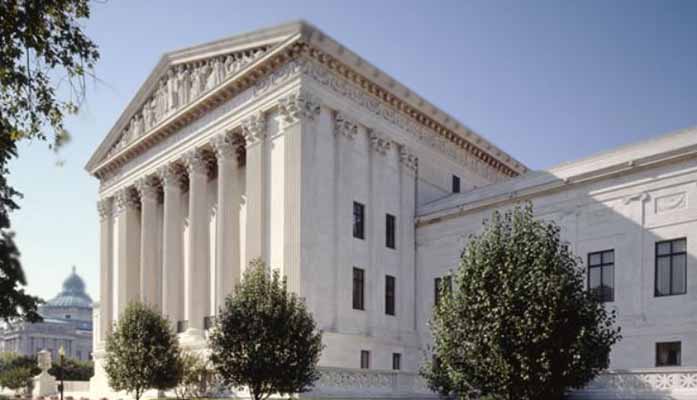
When the Supreme Court was debating the landmark Dobbs abortion case, Senate Majority Leader Chuck Schumer shouted threats (“you will reap the whirlwind…”) at them from the courthouse steps. Thus, the last doubt was obliterated that the unquestioned authority of the Court was under serious attack.
An independent judiciary is the key to maintaining our constitutional republic. It is the reckoning mechanism which keeps us on track, muting the potential excesses of popular democracy. Americans once understood this and valued our judiciary, even when it sometimes worked against their individual interests.
But the times, they are a’changin. Americans have now divided into warring classes who believe that in the pursuit of power and short-term goals, a conscientious judiciary is often in the way.
At least until recently, school children were taught that our founders, in order to dilute the power of centralized government, created three branches. The legislative makes the laws, the executive branch enforces the laws, and the judiciary ensures that laws are enforced in accordance with statutes and the Constitution.
In the 1930s, Franklin Roosevelt clashed with the Supreme Court when their rulings thwarted his plans to assert federal control over wide swaths of the American economy. The Justices could not find in the Constitution’s list of enumerated powers any which authorized the New Deal legislative barrage.
They were right, but Roosevelt’s response was to propose “packing the court,” expanding the number of Justices, and increasing his power. Roosevelt’s view of the court as an obstacle rather than a necessary guard rail shocked many Americans of the day. The plan eventually failed, although most of the New Deal was enacted anyway.
Yet the status of the judiciary branch in our federal system is showing deterioration today. Leftist ideologues conduct protests of court decisions in front of Justices’ residences when they render unpopular decisions. That’s clearly contrary to federal law yet they suffer no repercussions. The Biden Department of Justice simply ignores them.
Justices are personally harassed by activists. Angry partisans confront them and their families in restaurants and public spaces. The Justices, particularly those of the pro-Constitution persuasion, are faced with spurious charges of ethical violations and demands for recusal. That’s especially ironic in the case of Justice Clarence Thomas, who has a well-deserved reputation for willingness to vote against his own political positions.
The Arizona Supreme Court also passed down a controversial abortion decision, ruling that the Arizona legislature, following the reversal of Roe, had effectively reinstated a restrictive Civil War era law. In response, a special interest group known as “Vote Them Out” is attempting to remove justices Clint Bolick and Kathryn King for failing to support their pro-abortion policy agenda.
In Arizona, Supreme Court Justices and most lower court judges are not elected but appointed and then undergo periodic retention elections which are intended to weed out incompetent or corrupt judges. Although few judges are not retained, the system works to depoliticize the judicial selection process and give voters input into keeping judges.
It is this retention system itself which Vote Them Out is attacking by forcing Bolick and King to, in effect, run for their own seats in a political style campaign. There are no credible arguments that either Justice is incompetent or corrupt or that they didn’t provide constitutional authority for their rulings. The issue, again, is simply that their decision was unpopular, at least with Vote Them Out.
As Justice Bolick pointed out in an Arizona Republic op-ed, judges in a merit system are handicapped in a politics-based election. They can’t personally raise funds or seek endorsements. They have strict ethical limits on what they can discuss. Their opponents have no such restraints.
It’s telling that justices at all levels are commonly referred to as “liberal” or “conservative.” Such political labels should only matter if justices are policymakers, which they are not. The critical descriptor which matters for justices is “pro-Constitution” versus “pro-some interest group’s opinion.”
Americans seem to have little regard for the values and institutions which are the foundations of our own national greatness. Our independent judiciary distinguishes us from corrupt autocracies everywhere and throughout time. We disrespect it at our own peril.
Dr. Thomas Patterson, former Chairman of the Goldwater Institute, is a retired emergency physician. He served as an Arizona State senator for 10 years in the 1990s, and as Majority Leader from 93-96. He is the author of Arizona’s original charter schools bill.