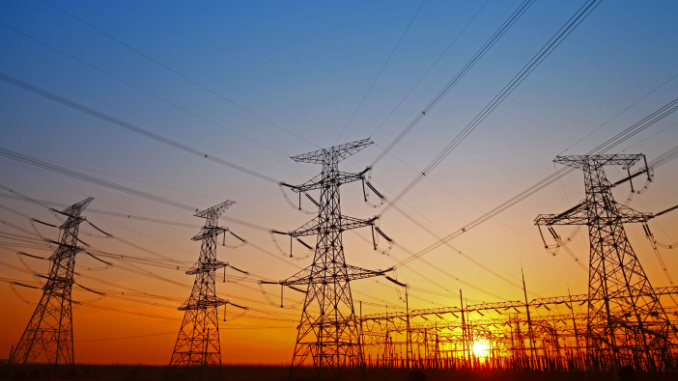
Energy Secretary Chris Wright says high electricity costs are a political choice in the United States today. The evidence at hand indicates the Secretary isn’t wrong.
“If you have expensive energy in your state…it’s because politicians and regulators chose to do that,” Wright said in a recent interview with the Wall Street Journal. “It is not bad luck, it is not marketplace…there is no reason to have these rapid increases in electricity prices – no reason, but politics.”
This is correct, and the disparity that exists in electricity bills in red states and blue states can be easily seen in a national map published by the U.S. Energy Information Agency (EIA), along with its supporting data.
EIA’s data shows the states with the highest rates include Democratic strongholds like California, New York, Hawaii, and the New England states. Meanwhile, the states with the lowest utility bills include the reddest of red states like Louisiana, Arkansas, Oklahoma, Texas, Nebraska, Wyoming, Idaho, North Dakota, and Iowa. This all ties directly in with the findings in a recent study by the Institute for Energy Research that I wrote about in January.
There is no real mystery here: Democrats seek to exploit the “affordability” issue in the upcoming midterm elections, but the truth is their policies created that issue to begin with. In his interview, Wright provides the proof points:
Electricity prices were up 6.7% year over year in December, nearly 40% since 2020. That is due to the United States adopting “UK-style” energy policies under the Biden and Obama presidencies, like forcing coal plant closures and wind/solar mandates.
Utility rates rose two times the rate of inflation in Democrat-governed states over the last five years, in GOP states, only half the inflation rate.
States with Renewable Portfolio Standards (RPS) have 50% higher prices than those without; 28 states enforce them, driving costs up.
Biden’s $5 trillion stimulus (for a $1.5T GDP gap) fueled inflation across the board but is now fixable via policy reversals like the ones Wright and other Trump officials are now pursuing.
“We’ve had a tailwind of these things to drive up our own energy prices,” Wright says, “And so that’s a battleship we’re stopping and turning back.”
Turning a policy battleship in the middle of an ocean takes time, but Wright’s efforts produced results during the recent major winter storm. In several regions, coal-fired power plants for which Wright acted to delay scheduled premature retirements generated needed baseload power to avoid blackout conditions as wind and solar failed to perform. Keeping many of those coal plants – and natural gas plants also scheduled for premature retirements under absurd RPS mandates – running will be crucial to maintaining integrity and reliability on grids from coast to coast in the years to come.
The good news for Americans is that this country enjoys an incredible abundance of all the natural resources and raw materials needed to restore sanity and reliability to our power grid. All that’s really needed is the political will to get it done while keeping electricity bills affordable.
Wright and the red states on EIA’s map have shown us the way. That’s true even in Texas, one of the few red states that maintains an RPS of its own. There, policymakers fell asleep at the wheel about the need to maintain a needed fleet of dispatchable reserve capacity, a mistake for which Texans dearly paid during 2021’s Winter Storm Uri.
But, in contrast to their peers in many blue states, Texas policymakers showed a capacity to learn from their mistakes, enacting a series of effective reforms over the last five years that vastly improved grid reliability.
In the recent Winter Storm Fern, the ERCOT-managed Texas grid, which proved to be the national poster child for grid failure in 2021, came through as a shining object lesson on how to fix past mistakes while remaining one of the 10 states with the lowest utility rates.
If you live in a state where power bills are too high, that is a choice your political leaders have made for you to endure. You should factor that reality into your thinking next time those politicians are up for re-election.
David Blackmon is a contributor to The Daily Caller News Foundation, an energy writer, and consultant based in Texas. He spent 40 years in the oil and gas business, where he specialized in public policy and communications.
Things are just not going well for the leftwing activist groups, billionaire-funded NGOs and trial lawyer firms who have recruited a growing number of state and local government entities to sue U.S. oil and gas companies involving specious claims for damages caused by climate change. In recent months, the lawfare campaign, coordinated mainly from the offices of one San Francisco-based firm, has suffered a series of adverse judicial decisions in what appears to be a rising consensus in the nation’s courts.
Just two weeks after suffering a major setback in a decision involving Anne Arundel County, Maryland, the pushers and funders of this lawfare campaign were tossed out in a case targeting ExxonMobil, Chevron and additional defendants in New Jersey. There, Superior Court Judge Douglas H. Hurd dismissed the Garden State’s lawsuit with prejudice based on the same federal primacy arguments which prevailed in recent decisions in New York City and Baltimore, as well as in the Anne Arundel case.
In seeking damages, New Jersey adopted similar tactics adopted in the other cases that make up this lawfare campaign, claiming they’ve been harmed by “climate change” impacts allegedly caused by the emissions by oil companies, but attempting to couch the damages as violations of state laws unrelated to air pollution. But Hurd was having none of it.
“Despite the artful pleading by the Plaintiffs in this case,” the judge says in his decision, “this court finds that Plaintiffs’ complaint, even under the most indulgent reading, is entirely about addressing the injuries of global climate change and seeking damages for such alleged injuries.”
The problem for the states, cities and counties who have signed up for this lawfare campaign in the hopes of grabbing some big bucks from Big Oil is that their arguments inevitably amount to a local effort to de facto regulate air quality, an area of regulation in which the federal government has always asserted its primacy. There’s a very good reason for this: If every city, county and state in America were allowed to regulate air quality, the economy would soon grind to a halt as it becomes impossible to do business in this country.
Like the judges in the other cases decided thus far, Hurd conceded to that reality in dismissing the New Jersey case, saying, “As Defendants state in their moving brief, ‘the federal system does not permit a State to apply its laws to claims seeking redress for injuries allegedly caused by interstate or worldwide emissions,’” adding, “In conclusion, only federal law can govern Plaintiffs’ interstate and international emissions claims because ‘the basic scheme of the Constitution so demands.’”
The decision in the New Jersey case no doubt comes as a real disappointment for the billionaire-funded foundations and NGOs who spent years pushing for the state attorney general’s office to bring a case. In 2023, Energy Policy Advocates obtained emails detailing tactics employed by the Rockefeller-funded Center for Climate Integrity (CCI) to convince various cities and counties in the state to sign onto the lawfare campaign.
Those emails revealed close coordination between CCI and New Jersey officials, even to the extent of CCI funding an “Accountability University” to educate lawfare participants about the best tactics and talking points to deploy in their big money grab efforts.
CCI even offered to “ghost write” opinion pieces for public officials and “serve as an extra set of hands,” adding, “…there are absolutely no legal obligations. Since we are a 501 c3, there is no pledge or legal sign on’ required. Rather, we view ourselves as an extra set of hands to help public officials…”
So, what’s the point of all this, you might ask? Well, the point is that when you see one of these lawsuits brought by a city, county or state government, just know that none of this is happening organically. Also know that this big money grab costs these companies millions to defend themselves, and we all end up paying for it at the gas pump and in our home utility bills. Maybe it’s time we all demand these billionaires and trial lawyers find more productive ways to spend their time and money.
David Blackmon is a contributor to The Daily Caller News Foundation, an energy writer, and consultant based in Texas. He spent 40 years in the oil and gas business, where he specialized in public policy and communications.
As Christmas approaches, Americans are making a list and checking it twice — not to determine who’s been naughty or nice, but to determine what they can afford this Christmas. For all too many of them, the answer is, not much, and certainly not as much as before Joe Biden became president.
That creates a political problem for the president, because even as he’s spent the better part of the past six months touting the benefits of “Bidenomics” (suggesting the word connotes a rising standard of living for the majority), the American people have come to a different far different conclusion. For them, “Bidenomics” means, “I can’t afford it.”
A recent Bloomberg News analysis shows why: A basket of goods for the average family that cost $100 before the COVID-19 emergency costs $119.27 today. “Since early 2020,” says the piece, “prices have risen about as much as they had in the full 10 years preceding the health emergency.”
Electricity is up 25% since January 2020, and groceries the same. A pound of ground beef is up from $3.29 to $5.23; two pounds of chicken breast have risen from $6.12 to $8.44; and coffee has gone from $4.17 to $6.18.
You won’t save any money going out to eat — restaurant food is up 24%.
And getting there isn’t any less expensive, either. After peaking around $5 per gallon last year, gasoline has dropped somewhat, but gasoline prices today are still 60% higher than they were on the day Joe Biden took office.
Because of Biden’s bad energy policies (read: shutting down pipelines; stricter EV regulations; no leases for drilling; and new taxes on coal, oil, and natural gas, among others), energy prices have gone up overall by 30% in less than three years — electricity is up 25%, propane gas is up 23%, natural gas is up 25%, and diesel fuel is up 47%.
Housing, too, is far more expensive, and nearing unaffordable. In January 2021, the monthly mortgage payment on a median-priced home was $989. Today, that number has more than doubled, to $2,041. Mortgage rates have more than doubled since Biden took office, pricing many families out of the market – and forcing sellers to pull back and sit on properties they’d prefer to sell, but cannot.
Not surprisingly, American families have turned to their credit cards just to make ends meet. The result: Americans now hold more than $1 trillion in credit card debt. That’s a record high.
It’s no wonder Biden’s approval ratings, and, specifically, his approval rating on his handling of the economy, are down. In this recent survey, he’s at 40% approve, 49% disapprove on his overall job rating, and 36% approve, 61% disapprove on his handling of the economy. A full 76 percent said the economy was either “not so good” or “poor” when asked to rate economic conditions right now. Just 26% of the survey respondents said Biden’s economic policies had helped the economy “a lot” or “somewhat,” while 48 percent said his policies had hurt the economy “somewhat” or “a lot.”
And in this poll’s version of the killer question Ronald Reagan posed in his one debate with Jimmy Carter in October of 1980 – “Are you better off today than you were four years ago?” – just 4% say they are “much better off” and 10 percent say they are “somewhat better off” when asked how they have fared since Joe Biden became president.
Policies have consequences, and Americans are suffering under the real-world consequences of Joe Biden’s policies.
It’s bad enough that Americans have to suffer under the consequences of Biden’s bad policies. What makes it worse is that Biden and his administration are doubling down on their bad policies. They refuse to learn from the real-world experience of seeing the results of their policies; instead, they continue to act as if those consequences are not visible to anyone, let alone everyone.
Biden and his Democrat allies know they want more government spending, more government programs, more government regulation, more government power and control over our lives.
Meanwhile, Rudolph goes hungry, because Santa can’t afford to feed his reindeer.
Radical Leftists and solar panel companies are freaking out over the upcoming Arizona Corporation Commission meeting on Wednesday, October 11 at 10:00am! But, based on the available public comments, they are the only ones who have contacted the Corporation Commission to express their desired actions regarding what’s on the agenda.
Currently, Arizona regulations force utility companies in the state to buy the extra solar power each solar customer puts into the grid. The Arizona Corporation Commission sets the rates that utility companies pay those customers.
On Wednesday, the Corporation Commission could vote to change the amount utility companies pay to match the break-even cost of the companies. This would reduce the vast majority of Arizonans’ energy bills.
In 2007, the Corporation Commission implemented a policy that required utility companies to pay retail price of solar power to their customers who put solar power back into the grid.
Those customers are still getting that rate today, even though the price of solar power has decreased tremendously over time. The customers are locked into that amazing deal for 20 years from the date of installation.
The 2007 policy ended in 2016 when the Corporation Commission decided utility companies should pay wholesale pricing to customers. However, there was a “great negotiation” between those who wanted the policy to remain in place—the Radical Left & solar power companies—and the Corporation Commission. The new policy implemented allowed for a maximum of only a 10% reduction in the price utility companies pay these customers every year. Since 2016, customers are locked into the rate they are paid for 10 years from the date of installation. Oh, and yes, those customers who installed solar panels between 2007-2016 are still locked in to get paid retail pricing for 20 years from the date of installation.
Because the maximum reduction of the rate utility companies pay to solar power customers who give to the grid is only 10% per year, there is still a huge discrepancy between the true wholesale solar power price and the rate utility companies are forced to pay these customers.
APS calculates their “Avoided Cost” at almost $0.05. This means APS would nearly break even on paying five cents per kWh to solar panel customers giving power to the grid. However, APS is forced to pay nearly $0.09 per kWh. For ten years, APS has to pay this rate to every solar panel customer who gives power to the grid, even though solar power is more than likely going to continue to fall.
The Arizona Corporation Commission sets the maximum profit rate of utility companies. APS’ is set at 8.7%. Being forced to pay customers more for their energy than the break-even cost causes utility companies to charge customers who do not have solar and are not giving to the grid a higher price for energy to meet profits.
If APS is allowed to truly match wholesale pricing for all solar panel customers giving to the grid and pay each one of them just under five cents per kWh, APS would be forced to cut the cost of energy for all of their customers, use the extra funds left over to reinvest, and/or expand its energy providing capabilities.
That’s why, if you really believe in clean energy or just want cheaper utility bills, it’s important to make your voice heard by speaking up, giving public comments, or submitting written public comments.
Right now, the only folks who have been doing so are those who own solar panels and don’t want their pay to decrease or solar panel companies who may face tougher economic hardship. But all customers deserve a say in our state’s energy prices both now—and in the future.
Jeff Caldwell currently helps with operations at EZAZ.org. He is also a Precinct Captain, State Committeeman, and Precinct Committeeman in Legislative District 2. Jeff is a huge baseball fan who enjoys camping and exploring new, tasty restaurants! You can follow him on X here.
A couple weeks ago, after Mayor Gallego did her interviews and headed home from the City Council meeting on September 6, she posted a photo on X of her pouring milk from a $7 half-gallon carton into an empty bowl next to a knife. (Because what normal person doesn’t enjoy eating cereal with a knife?)
While Gallego says she is not banning meat, there is no meat in the photo.
There’s been a lot of false info about my work to make PHX more sustainable.
What I’m not doing: ❌ banning meat or milk
What I am doing: ✅ increasing housing options ✅ improving walkability and transit ✅ reducing emissions and energy bills ✅ enjoying cereal pic.twitter.com/ZzViZ3bT0O
What made her post this image with these self-righteous campaign slogans under her Official X account?
The power of Public Comment.
Earlier that day, about a dozen Grassroots citizens attended the Phoenix City Council meeting and told the mayor they do not support policies banning meat.
A constant factor was brought up by multiple public speakers: Gallego is the Vice-Chair of the C40 Cities. According to the C40 Cities website, “C40 is a global network of mayors of the world’s leading cities that are united in action to confront the climate crisis.” C40 has many documents outlining the organization’s desire to reduce and abolish the consumption of meat.
And the citizens don’t want it!
The troubling fact is, on March 4, 2020, Gallego and the Council passed the 2025 Phoenix Food Action Plan. In Strategy 2, under Goal 1, the fifth “Progress on Action” creates a new policy for the Office of Environmental Programs (OEP) at the City of Phoenix to enter a contract with Arizona State University to “establish an AgriFood Tech Incubator in 2023 to accelerate ventures in sustainable food systems…”
But this is nothing new. The City of Phoenix has multiple policies for sustainable food systems in the 2020 Greenhouse Gas Emissions Inventory report conducted by ASU. And Gallego also has many policies tied to ASU. In fact, she is funding and has teamed up with the college for multiple environmental and sustainable projects. What type of environmentally sustainable policies does ASU believe in?
Let’s check out their degrees in “Sustainable Food Systems.” The Bachelor of Science degree states, “Students become effective agents of change” and “Students are engaged in an active community collectively working to achieve the 2030 United Nations Sustainable Development Goals.” The degree for Online Master of Science in Sustainable Food Systems lists Kathleen Merrigan as the leader of the degree program.
According to ASU’s biography page for Merrigan, she is the Kelly and Brian Swette Professor in the School of Sustainability and executive director of the Swette Center for Sustainable Food Systems. She was listed as one of Time magazine’s Top 100 Most Influential People in the World in 2010. And she is a partner in Astanor Ventures along with being an advisor to S2G Ventures—two firms investing in ag-tech innovation. Merrigan also holds a PhD in Public Policy and Environmental Planning from Massachusetts Institute of Technology.
In an article titled, “In Light of Climate Change Debates, ASU Continues Sustainability Efforts,” Merrigan is quoted as saying, “Get rid of the plastic water bottles, eat less meat…” to make ASU more sustainable. Furthermore, ASU has a research program that is teamed up with Merrigan and the Swette Center for Sustainable Food Systems. The program states it is ASU’s desire to find out how to implement “dietary shifts towards plant-based diets” through “interventions.” Peoples’ eating habits in reaction to COVID-19 lockdowns, a major intervention on society, are listed in this document.
Now, consider one major food intervention taken by Mayor Gallego. Just two weeks after passing the 2025 Phoenix Food Action Plan, she decided to lock Phoenix down due to COVID. After the lockdown began, the Medical Director for Disease Control with the Maricopa County Department of Public Health, Dr. Sunenshine, gave public testimony at the March 23, 2020 Phoenix City Council meeting. Dr Sunenshine stated that the Mayor shut the city down without reaching out to her office first. Dr. Sunenshine also said she would have recommended staying open.
Locking down the city implemented the most direct intervention on eating habits we have seen in our lifetime. Shutting down restaurants cut off 50% of our food supply because the government prevents restaurant food from being sold in grocery stores. The lockdown drastically constrained supply, damaged the supply chain for food, and helped lead to the astronomical food prices we see today.
While Gallego is able to say she is not literally banning meat, she is implementing policies that make meat more expensive and will lead to major reductions of meat consumption in the future. Dare I suggest by 2030?
Just to demonstrate that Gallego is implementing an ideology and that this is not isolated to only Phoenix, consider this. On April 24, 2023, Gallego posted a video with Mayor Quinton Lucas from Kansas City celebrating his “first fully-autonomous ride with Waymo.” Does Kansas City have a plan to reduce meat consumption?
Of course, they do! Under Lucas, Kansas City passed its Climate Action Plan in September 2022. Kansas City’s Climate Action Plan Food section in each division of Kansas City lists promoting plant-based diets!
Another city recently popped up in the news cycle. Chicago is possibly going to open city-owned grocery stores, so I looked up their action plans. In 2021, Chicago began reducing red meat from its schools, juvenile detention center, and Chicago Park District menus. The same document identifying Chicago reducing meat claims Chicago wants “to foster more racially and socially equitable supply chains across the region.” They are saying the quiet part out loud! They want to disrupt the supply chain to reduce meat consumption. Now, if Chicago does end up opening city-owned grocery stores, do you think they will sell meat? Absolutely not!
But let’s get back to Mayor Gallego’s post from a little over a week ago. Her claim of reducing energy costs is another bold-faced lie. Gallego teamed up with the “Climate Mayors” from across the country to release an op-ed on September 10, 2023 claiming the implementation of green energy plans have reduced the cost of energy!
But mayors cannot claim they are reducing energy costs! The cost of energy is set by Corporation Commissions with utilities providers. Mayors have nothing to do with the cost of energy.
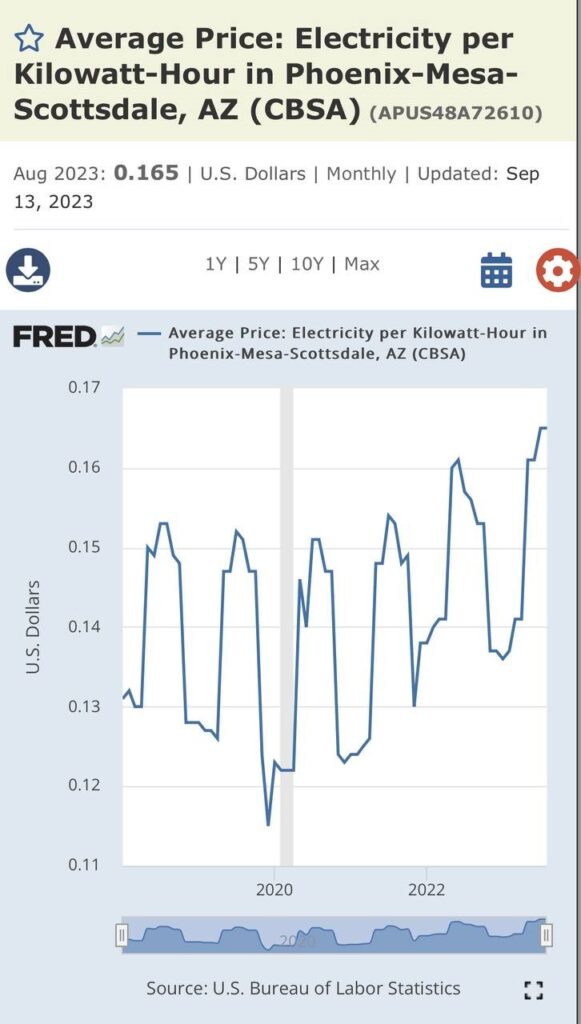
But let’s pretend they do. The Federal Reserve states that the cost of energy for the Greater Phoenix Area is skyrocketing! It’s higher than any point over the past five years!
The policies Mayor Gallego is implementing are detrimental to our well-being and set to a radical left agenda. They should not be accepted, and they should not be tolerated.
That’s why it’s critical for the people of Phoenix to stand up, speak up, give public comments, and more. It’s the best way to stop these radical policies that price people out of being able to afford meat, interrupt the supply chain of meat, and make energy costs skyrocket.
Jeff Caldwell currently helps with operations at EZAZ.org. He is also a Precinct Captain, State Committeeman, and Precinct Committeeman in Legislative District 2. Jeff is a huge baseball fan who enjoys camping and exploring new, tasty restaurants! You can follow him on X here.