For months, we have documented the pattern of errors, distortions, and outright fabrications that characterize the coverage of Arizona’s Empowerment Scholarship Account program by Channel 12’s political reporter Craig Harris. Each new episode—the fabricated 20% fraud claim, the defiance in the face of correction by the Arizona Department of Education itself, the constant shifting of goalposts as each of his claims is debunked—seemed like it might result in Channel 12 taking appropriate corrective action.
But they never did.
Last week, at the Arizona Legislature’s final stretch of its 2026 session, the mask came off entirely.
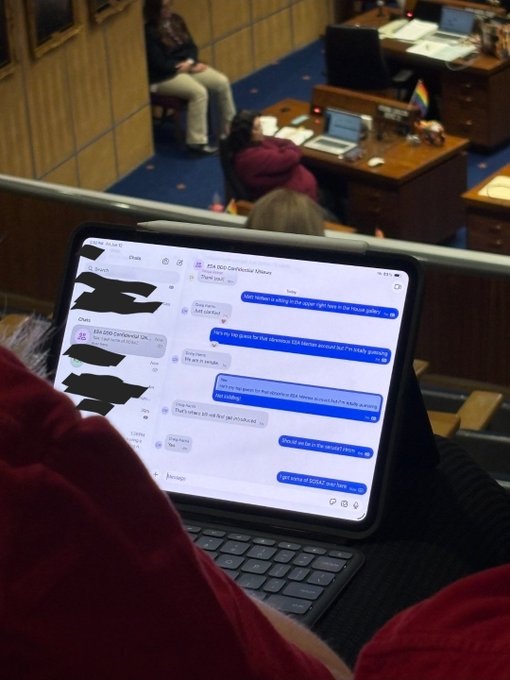
While lawmakers debated a series of consequential ESA-related bills and resolutions on Thursday and Friday—including a constitutional amendment to protect military family scholarships—Harris was captured on camera doing something that no journalist who takes the job title seriously can explain away: coordinating, via text message, with members of Save Our Schools Arizona, the anti-school-choice advocacy group that is a principal sponsor of the Protect Education Now ballot initiative, about where they should position themselves inside the Capitol building for maximum political impact.
Text message conversation between Channel 12’s Craig Harris and anti-school choice activists.
Let that sink in. A reporter on the education beat, covering legislation in real time, was not observing the advocacy groups in the building. He was directing them.
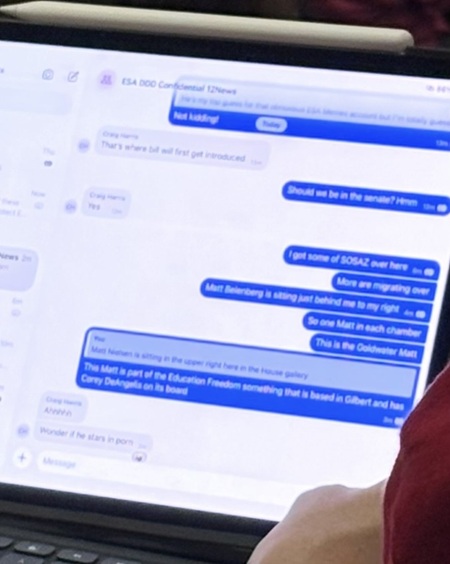
The text exchange was visible on the screen of a Save Our Schools activist—readable thanks to a conspicuously large font and no privacy screen—and was flagged by our Heritage Foundation colleague Corey DeAngelis, who shared images of the messages on social media after receiving them from a local activist. Harris subsequently confirmed on X that the images of the group chat, named “ESA DDD Confidential 12News,” were real.
After Harris told the activist that he was in the state senate chamber as that is “where [the] bill will first get introduced,” Save Our Schools board member Kathy Boltz asked Harris for advice regarding where their team of activists should place themselves in the capitol building. “Should we be in the senate? Hmm,” she asked. Within a minute, Harris answered in the affirmative.
This is not ambiguous. This is not a misunderstanding. This is a journalist using his knowledge of the Arizona Legislature’s political process to provide tactical advice to an advocacy group that has a direct political stake in the legislation he is supposed to be covering neutrally.
Harris was no longer covering the news. He was helping to manufacture it.
But that wasn’t the worst of it.
The same captured text conversation revealed Harris mocking a local school choice supporter, asking whether the individual “stars in porn.”
This derision was not just a lapse in professionalism. This was contempt—contempt for the families, advocates, and ordinary citizens who show up at the Capitol to make the case for educational freedom, expressed in a private conversation with advocates on the other side of the issue.
Text message conversation between Channel 12’s Craig Harris and anti-school choice activists.
Multiple Arizona politicos were quick to call out the behavior publicly. State Senator Jake Hoffman called for Channel 12 to fire Harris and called on the station to “open an investigation into every story he was involved in and retract any instance of undisclosed coordination.” Hoffman observed that this coordination with activists is “precisely the kind of unethical behavior that has caused the majority of Americans to deeply distrust the media.”
Arizona Republic columnist and former State Senator Paul Boyer called it “a really bad look” for Channel 12 to have their reporter, “who is also reporting on these same groups” to be discovered “coordinating with them at the legislature to defeat the same type of legislation he’s myopically focused on.” Similarly, J.P. Twist, executive director of Citizens for Free Enterprise, called out Harris for “literally strategizing with a partisan union to undermine parents’ rights.”
The parent company of Channel 12 publishes a “Principles of Ethical Journalism” statement committing its journalists to the values of truth, independence, public interest, fair play, and integrity. It’s hard to see how coordinating with one group of political activists and crudely mocking the other side comports with those standards.
Sadly, Harris’s breach of journalistic ethics does not end there.
Later that night, in a hearing on legislation to protect military family scholarships, Harris took to social media to characterize two of the three supporting witnesses who testified as people “making money off ESAs,” implying their support was financially motivated rather than principled.
One of those witnesses was Kevin Biesty, spokesperson for the Arizona Christian Education Coalition. As Biesty detailed on X, he reached out to Harris privately and asked him to correct or remove the post. Harris declined. As Biesty observed, the logic Harris applied to him — that representing clients who are affected by ESA policy makes one a financially conflicted advocate — is never applied to the other side. The staff and lobbyists of Save Our Schools Arizona and the teachers unions, who are paid to oppose the ESA program, are never characterized by Harris as people “making money off” the issue.
Harris also claimed that no military family spoke at the hearing. That too was false. Biesty had personally presented a written statement from a military mother who could not remain for the late-night session, and referenced letters from other military families — all of this while Harris was in the room. At no point did Harris ask Biesty for that mother’s contact information or seek to include her perspective in his coverage. He was, however, apparently attentive enough to the gallery to communicate with his Save Our Schools contact — the same ESA mother and SOS board member who, Biesty observed, is never identified as such in Harris’s stories — while sitting at the press desk on the floor.
Indeed, when ESA students and their families share their stories, Harris is quick to dismiss them. Recently, a young ESA student with disabilities named Jordan Visser shared on video about the ways the Protect Education Now initiative would harm students like himself. Harris went on social media to dispute his account, claiming that the initiative would not affect students with special needs—effectively accusing a student with disabilities of lying about the impact of a ballot measure on his own situation.
He was wrong. As the student’s mother, Kathy Visser, and others documented, the text of the initiative itself bore out what the student had said—the ESA funds that the family had saved to continue providing him with services would be seized by the state if the Save Our Schools ballot initiative were adopted.
The irony of Harris’s posture—aggressively checking the credibility of a disabled student while coordinating inside the Capitol with the very advocacy group sponsoring the initiative in question—encapsulates the problem. It is not that Harris is a journalist who occasionally makes mistakes. It is that the mistakes run in one direction, consistently, and that when corrected, he doubles down rather than acknowledging any error. And it is now documented, on camera, that he was coordinating tactics with one side of the debate he was purportedly covering.
Arizona families with children in the ESA program deserve better than a reporter who coordinates with the opposition at the very hearings he is assigned to cover. Arizona viewers deserve better than a news organization that has allowed this pattern to continue unchecked. And the thousands of children—including those with disabilities—who rely on these scholarships deserve a press corps willing to represent their stories honestly.
Channel 12 has not issued a correction or a retraction of the false fraud statistics. It has not yet acknowledged Harris’s coordination with activists or the mockery of a school choice supporter.
Channel 12’s parent company should answer a simple question: Is the behavior documented at the Capitol last week consistent with its Principles of Ethical Journalism? If not, what will it do about it?
Jason Bedrick is a Senior Research Fellow and Matthew Ladner is aSenior Advisor for education policy implementation at The Heritage Foundation’s Center for Education Policy.
This week’s erroneous attack on Arizona’s popular Empowerment Scholarship Accounts (ESAs) is another example of how biased reporting is misleading lawmakers and the public.
When the Arizona Auditor General last week released its Single Audit Report on the state for fiscal year 2024, Craig Harris of Channel 12 News had another fairy tale ready for viewers and readers. The ESA program, he claimed, is “plagued by weak controls, questionable spending, and internal management failures.”
No mention was made of the Arizona Department of Education’s recent finding that only 2% of ESA funds were spent on unallowed items (mostly innocent errors like backpacks and lunch boxes), and only 0.3% of ESA funds were spent fraudulently.
A new Arizona Auditor General report finds the the percentage of misspending in the state's Empowerment Scholarship program was a stunning 34 percent, based on a sample of transactions from July 23-October 25.
The report also is highly critical of @RealTomHorne management….
Both halves of that claim are false. And the falsehoods are not minor.
Start with “random.” The Auditor General’s report describes the relevant sample in unambiguous language: “we judgmentally selected 63 expenditure transactions for review occurring between July 2023 and October 2025 totaling $251,446.” [Emphasis added.]
A footnote on the same page adds, for the benefit of any reader who might be tempted to make the mistake that Harris did: “We selected our audit sample(s) to provide sufficient evidence to support our findings, conclusions, and recommendations. Unless otherwise noted, the results of our testing using these samples were not intended to be projected to the entire population.” [Emphasis added.]
Judgmental sampling and random sampling are not synonyms. They are distinct methodologies with distinct inferential properties. A random sample can be projected to a population; that is its entire purpose. A judgmental sample cannot, which is why auditors use it to probe suspected weaknesses rather than measure their prevalence.
In this case, the auditor general was testing the robustness of the Arizona Department of Education’s review process, not trying to determine the prevalence of misspending in the ESA program.
More responsible journalists, such as Garrett Archer of ABC 15, made sure to clarify that the auditor general’s findings were not generalizable to the entire program.
Note: This is not a program transaction error rate. The Auditor General's focus was on the review process itself.
— The AZ – abc15 – Data Guru (@Garrett_Archer) May 12, 2026
In other words, Harris completely misrepresented the auditor general’s methods and findings. That is sloppy at best, dishonest at worst.
Not only is the “34% misspending” figure not generalizable, it’s also not all misspending.
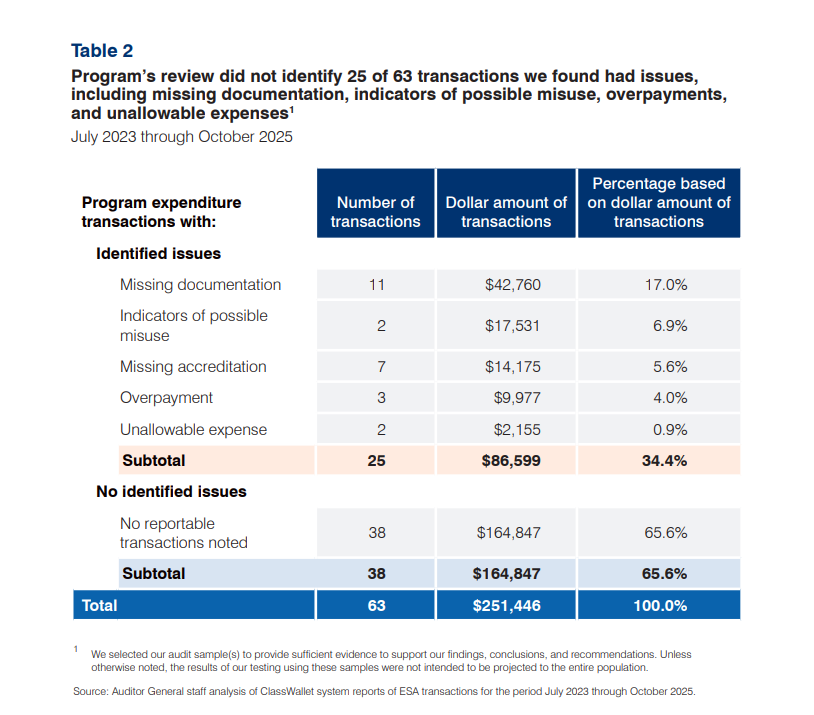
The 34.4% figure comes from dividing $86,599 in flagged transactions by the $251,446 sample. But Table 2 of Finding 2024-04 breaks those flagged transactions into five categories, and only two of them — “unallowable expense” ($2,155) and “overpayment” ($9,977) — involve money the program should not have disbursed.
The other three — missing documentation ($42,760), missing accreditation ($14,175), and “indicators of possible misuse” ($17,531) — are paperwork and compliance gaps. A tutor’s accreditation certificate that wasn’t uploaded is not the same thing as a misspent dollar. The actual confirmed misspending share within the sample (combining 0.9% unallowable expenses plus 4% overpayments) is about 4.9%, not 34%. Moreover, as the report concedes, even the 4.9% figure cannot be projected to the entire program.
In short, Harris conflates paperwork issues with misspending and treats a non-generalizable sample as generalizable, even though the auditor general warned readers not to do exactly that. Then Harris’s manufactured anti-ESA talking points are repeated ad nauseum by politicians and political activists.
Harris built an entire investigative series on a Department of Education internal review that supposedly reported a 20% misuse rate — except the internal review, like the auditors’ sample, was not designed to be projected. Harris projected it anyway.
When the same Department then produced a separate analysis suggesting misuse was minimal, Harris turned around and faulted that study for over-generalizing from its sample. For Harris, non-generalizable findings become generalizable when they damage ESA. Generalizable findings become non-generalizable when they don’t.
The convenient feature of this method is that the error always points the same direction. A reporter who genuinely struggled with the statistics of audit sampling would make mistakes in both directions over time. Harris’s don’t. They cluster.
And they remain uncorrected. Harris’s original 20% claim has never been retracted. The “random sample” language and the 34% framing are now circulating through campaign statements, legislative press releases, and social media posts, citing Harris’s distorted reading of the Auditor General report.
One cannot help but notice that Harris’s manufactured anti-ESA talking points come at a moment when anti-ESA groups are gathering signatures for two ballot initiatives to curb and regulate the ESA program. One also cannot help but wonder whether the downstream political effect is more than incidental to the reporting.
The Auditor General’s findings on ESA are real and worth engaging on their own terms. The program’s risk-based audit methodology is likely better than any other program in the state, but it could still be improved. The auditor has some substantive criticisms, and ADE will have to answer them.
Arizonans deserve honest reporting on those findings, not statistical fictions dressed up as “journalism.”
Jason Bedrick is a Senior Research Fellow and Corey DeAngelis is a Research Fellow at The Heritage Foundation’s Center for Education Policy.
Arizona’s legacy media is at it once again—going after our state’s highly popular Empowerment Scholarship Account (ESA) program, which now sits at over 100,000 enrollments.
Last month, activist reporter Craig Harris, from 12 News, pushed his latest “investigation” claiming that the ESA program had fraud totaling 20 percent. Certainly, if such a level of fraud is accurate, it deserves a full investigation. But it didn’t take long before the truth—and the real data—revealed itself.
According to the Arizona Department of Education (ADE), Harris’s 20 percent fraud claim originated from a risk-based audit, which was not only limited in scope, but also targeted higher-risk participants and accounts. But it did not account for the entire ESA program. Instead, the ADE referred to a study by a Stanford PhD that showed a more accurate assessment of fraud at 0.3 percent. That’s quite a gap between the 12 News report and reality. Perhaps Harris is getting math lessons from his buddies in the teachers’ unions who, as we know, have never exactly been good at counting.
As Harris continued to push his vendetta against school choice on social media this past weekend, he was completely ratioed for his debunked ESA fraud claims. And the best part? He was also unmasked as a partisan liberal with Red for Ed conflicts of interest and a history of publishing defamatory stories that are still being litigated…
The Arizona Department of Education (ADE) accused a major media outlet of misrepresenting the amount of fraud that occurs within the state’s school choice program.
Per ADE, 12News claimed the Empowerment Scholarship Account (ESA) Program had fraud totaling 20 percent. ADE said this figure was false, and that the true fraud rate sits at 0.3 percent.
The 20 percent claim originated from a risk-based audit — an audit of limited scope — which targeted specific higher-risk participants and accounts. It does not account for the entire ESA Program population, says ADE.
ADE presented the 0.3 percent figure from a study by Stanford PhD on a random sample to obtain a more accurate assessment of the entire ESA population. That study, which reviewed 3,000 random ESA orders between July 2025 and February 2026, also concluded that unallowable spending amounted to less than two percent of the total.
ADE Superintendent Tom Horne demanded 12News issue a retraction.
“A ridiculous figure of 20 percent fraud has been circulating concerning ESA purchases which resulted from a total misinterpretation of data provided to Channel 12. The 20 percent figure represented program participants that ADE had selected for risk-based auditing,” said Horne in a press release. “Continued use of the 20% fraud allegation is an outrageous misrepresentation to the public that must stop.”
By comparison, Horne noted, other government programs have higher rates of improper spending: Medicaid totals over seven percent, food stamps total over nine percent, and unemployment insurance totals over 14 percent.
Horne clarified that the unallowable purchases rate doesn’t constitute fraud necessarily. The superintendent said “most” of those purchases were confirmed as “innocent mistakes” such as improper form completions or viewing certain unpermitted educational items as permitted, like backpacks or lunch boxes.
Horne said ADE promptly recovers misspent funds, and has recovered over $1.2 million.
The disputed 20 percent figure was mentioned in multiple articles by 12News, including one of the latest pieces of coverage published on Wednesday.
“According to state records obtained by 12News Investigates, nearly 20% of ESA parents or at least 18,000 ESA account holders, have misused voucher funds,” read Wednesday’s article.
The original 20 percent figure by 12News stemmed from a report on public records reviewed by the outlet which estimated that misspending “could” amount to 20 percent of all purchases in the ESA Program. The report stated that over 18,600 out of the 102,000 ESA account holders had at least one unallowable purchase over the course of a year.
Horne said at the time that the percentage provided wasn’t totally representative of fraud; rather, the superintendent said “most of it” was attributable to mistakes by the parents.
While critics of the program highlight the millions ADE is forced to recover, mainly from misspending and marginally from fraud, supporters of the program highlight the millions saved by children entering the ESA Program rather than their designated public district school system.
Goldwater Institute director of education policy, Matt Beienburg, said in a press release that wrongful spending occurs just as much, if not more, in the public school district system.
“It’s also worth observing that just 52 cents of every dollar sent to Arizona district schools now makes it to classroom instruction according to the state auditor general,” said Beienburg. “Among the many uses of those funds outside the classroom: a $500,000 trip to Las Vegas by a school district that promptly cut bus services for students; a district spending $4,000 per person to send staff to Napa, California for a conference featuring wine tastings, a district spending $18,500 on ‘membership dues and for staff to attend golf tournaments,’ and more.”
AZ Free News is your #1 source for Arizona news and politics. You can send us news tips using this link.
It is said that a lie travels halfway around the world before the truth can get its pants on. But when the truth finally catches up, it tends to arrive with receipts.
In recent weeks, anti-school-choice activists have accused Arizona’s popular Empowerment Scholarship Account (ESA) program of having a ludicrously high rate of misspending. That narrative, repeated endlessly despite being repeatedly debunked, has now collided with an inconvenient reality: the Arizona Department of Education’s own data tell a starkly different story, one that exposes the “unaccountable ESA” myth for what it always was: a misleading talking point masquerading as journalism.
On Thursday, the Arizona Department of Education published the results of a random audit of the ESA program, finding very low rates of misspending relative to other publicly funded programs and even less fraud. Less than 2% of ESA funds were spent on unallowed items, and 0.3% of the funds were spent on items considered “egregious” or fraudulent. The department is in the process of recouping those funds.
The department’s audit has punctured the gross distortions of Phoenix-based journalist Craig Harris of Channel 12, who had misrepresented the ESA program as being rife with fraud. The department called Harris’s claims “ridiculous,” “reckless,” and “a total misinterpretation of data provided by [the department] to Channel 12.”
Harris had claimed that 20% of ESA purchases represented misuse of funds based upon an examination of only a small portion of total ESA purchases—384,478 of the 1.8 million total ESA transactions since December 2024, approximately 20% of the total.
But it was not a random sample. The Arizona Department of Education had selected these purchases under a risk-based audit for additional scrutiny, so it was not a random sample that one could use to extrapolate rates of misuse in the ESA program. Instead, the risk-based pool was far more likely to contain misuse than the average purchase.
In other words, among the 20% of ESA purchases flagged for additional scrutiny, the department found 20% to be misspending. Harris, however, extrapolated the risk-based results on to the entireuniverse of ESA purchases. This represented a blatant distortion because the remaining purchases outside of the risk-based sample were far less likely to involve misspending.
Think of it this way: imagine that a reporter read a study showing that 20% of Americans were obese and that 20% of obese Americans had diabetes, then he ran a story claiming that 20% of all Americans had diabetes. Such a claim would be a complete distortion of the data, a conclusion that is entirely unsupported by the facts.
Harris was warned both publicly and privately that his “analysis” was deeply misleading. Nevertheless, he continued to repeat his “20% misuse” claim on television and social media.
The Arizona Department of Education decided to set the record straight by auditing a random sample of thousands of Arizona ESA purchases. The audit’s conclusion: “About 2% of purchases are unallowable expenses and only 0.3% represent fraud or egregious purchases.”
In short, Harris’s “analysis” on misspending was off by a factor of 10, and his accusations of fraud were off by nearly a factor of 100.
And although Harris made it seem like one in five ESA parents were buying diamond rings, the reality is that egregious purchases represented a vanishingly small percentage of ESA spending. Most of the unallowed items appear to have been innocent mistakes.
The Arizona Department of Education explained the difference between unallowable purchases and egregious purchases/fraud in a press release:
The submission of a purchase that is deemed unallowable does not constitute fraud. Most are innocent mistakes, such as an error in a form that must be resubmitted, or educational items that are not on the allowable list but that the user could have in good faith believed were permitted. Some examples would be backpacks, lunch boxes and water bottles.
A ridiculous figure of 20% fraud has been circulating concerning ESA purchases which resulted from a total misinterpretation of data that we provided to Channel 12.
Cracking down on misspending is important, but so is keeping things in perspective. The rate of improper payments for the Arizona ESA program, at 1.9%, stands far below a variety of programs which ESA opponents support, such as Medicaid (7.4%), food stamps (9.3%), and unemployment insurance (14.4%). Moreover, the Arizona Department of Education actively recovers misspending, and refers serious cases for criminal prosecution to punish criminal activity and to deter fraud.
Indeed, the only reason we know about the miniscule level of unallowed purchases in the ESA program is because it is so transparent—far more transparent than district schools, which do not report transaction-level data to state officials, let alone the public. Given the rash of recentscandals in Arizona’sdistrictschoolsystem, one can only imagine what we would find if given access to information about every purchase that district schools have made, as we have for the ESA program.
In the interests of transparency and accountability, state lawmakers should require the district schools provide the same level of information about purchases as ESA families.
Harris has not yet retracted his false reporting. Instead, he has doubled down on his errors, erroneously claiming that the department’s audit was “largely skewed” and based on “a miniscule sample.” This claim is particularly ironic given that Harris erroneously treated a risk-based sample—which is inherently skewed—as though it was representative of the entire population. A random sample, by contrast, is representative of the whole.
Facts are stubborn things. So too, apparently, are anti-school-choice activists who can’t let go of the false narrative they pushed in the face of overwhelming evidence to the contrary.
Matthew Ladner is a Senior Advisor for education policy implementation and Jason Bedrick is a Senior Research Fellow at the Heritage Foundation’s Center for Education Policy.