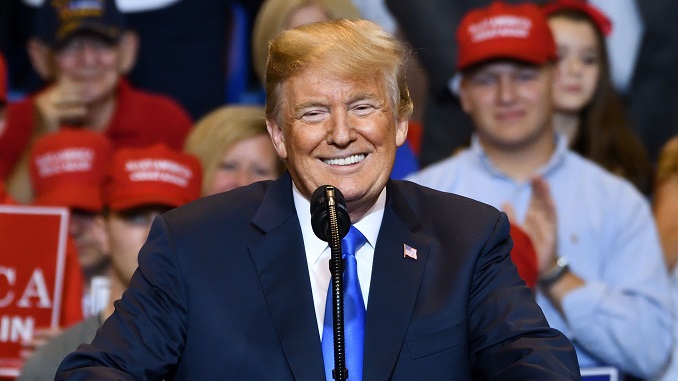
What a difference a year makes. As President Trump highlighted in his speech in Pennsylvania Tuesday, by any number of metrics, the economy is barreling full steam ahead. The sign he stood in front of said it all: “lower prices, bigger paychecks.” And the data backs him up. As he said Tuesday: “Pennsylvania is winning again.” Those words are no hollow rallying cry, they reflect real results.
Just weeks ago, the Bureau of Economic Analysis (BEA) revised its estimates for second-quarter 2025 economic growth, and the results were dramatic. Real gross domestic product surged at an annualized 3.8 percent rate, far stronger than the 3.0 percent estimate given just months earlier. It’s a stunning rebound after the last six months of the Biden era, when growth came in at 3.3 percent for the third quarter of 2024 and a truly anemic 1.9 percent for the fourth quarter.
That isn’t just chump change – that kind of growth doesn’t happen when consumers and businesses are on edge. It happens when Americans are confident, when households are spending, and when businesses are investing. As the BEA itself noted, this uptick came largely from rising consumer spending and a drop in imports (imports are subtracted from GDP).
What’s more, the “real final sales to private domestic purchasers” (which strips out the wild swings from trader and inventories and zeroes in on actual domestic demand) – one of the metrics economists use to compare one quarter to another – rose 2.9 percent in Q2. That’s a full percentage point stronger than previously believed.
This is no small rebound. After a rough start in 2025, with a slight contraction in Q1, the second quarter delivered a burst of energy, and proved that policies set in motion by the Trump administration are working.
You don’t have to stare at macroeconomic spreadsheets to sense the shift. Many Americans are now spending dollars, investing in their kids’ futures, stocking up the pantry, and buying gifts.
The 2025 Black Friday weekend delivered record-breaking numbers. According to Adobe Analytics, which tracks e-commerce, “U.S. consumers spent a record $11.8 billion online … marking a 9.1% jump from last year,” reported the Associated Press. And it wasn’t just Black Friday that set a record – consumers spent $6.4 billion online on Thanksgiving Day itself, another record.
That’s not just digital “click traffic;” that’s real money moving – money that represents families who feel secure enough to spend, businesses stockpiling inventory, and entrepreneurs launching new ventures. That kind of consumer vitality ripples outward.
As President Trump put it Tuesday in Pennsylvania: “We are bringing back real value to the American people.” That resonates – because people across income levels just proved with their wallets that they believe in this comeback.
Beyond holiday shopping and GDP headlines lies another signal of confidence and strength: retirement. Per the latest data from Fidelity Investments, the number of Americans with at least $1 million in their 401(k) accounts just hit a new record. About 654,000 Americans are now 401(k) millionaires – up sharply from 595,000 at the end of June, and up from 544,000 a year ago, representing a 20% surge from the Biden years.
This isn’t just financial fluff for the wealthy – this is a genuine barometer of middle-class Americans putting faith in the markets, stocks, and long-term saving. It means that working people who stashed cash through decades of effort are now seeing those savings efforts rewarded.
The rising number of 401(k) millionaires couldn’t have come at a better time. With traditional pensions disappearing, millions of Americans are forced to rely on defined-contribution retirement plans. The climb in 401(k) balances signals that people are adapting and succeeding.
Put together – the 3.8 percent GDP growth, the Thanksgiving/Black Friday spending splurge, the record-high 401(k) millionaires – and one conclusion becomes clear: the Trump economy is booming.
When families feel confident enough to save, invest, and spend, that’s when you know the recovery has legs. President Trump and his administration have laid the groundwork – lower regulation, pro-growth policies, and a renewed sense of optimism.
Tuesday in Pennsylvania, President Trump didn’t just talk about jobs and tariffs, he talked about restoring American dignity and opportunity. “We’re bringing back real value,” he said. And with the data now piling up, “real value” isn’t just a slogan. It’s a restoration of America’s economic foundation.
At this moment, for Americans across the board, the comeback isn’t merely a promise. It’s happening. And you can feel it, see it, and invest in it.
As retailers gear up for Black Friday and the holiday rush, a new analysis of FBI crime data highlights significant variations in shoplifting risks across the U.S., with Oregon emerging as the state most vulnerable to theft this November.
The study examined shoplifting reports per 100,000 residents in November over the past four years (2021-2024).
“As retailers prepare for Black Friday and the peak winter shopping months, these variations underscore the need for tailored, state-specific strategies,” said CEO of Turvallinen Markus Kanerva, whose company conducted the study. “Stores in high-incident areas may need to increase security personnel, deploy advanced surveillance technology, or implement stricter inventory controls. “
Oregon leads the nation with an average of 59.90 incidents per 100,000 people—a staggering 89.68% above the national average of 31.58.
New Mexico ranks second with 57.85 incidents per 100,000 (+83.19% above the national average), followed by Delaware in third with 48.48 (+53.51%). New York and Arizona round out the top five with scores of 47.47 (+50.32%) and 46.91 (48.54%), respectively, showing elevated risks in the Southwest and Northeast regions.
Vermont (46.72, +47.94%), Pennsylvania (46.27, +46.52%), Virginia (45.60, +44.40%), Maryland (42.76, +35.40%), and Tennessee (39.76, +25.90%) complete the top ten.
On the other side of the list is Idaho, which reports the lowest rate in the nation with 15.45 incidents per 100,000 residents—51.08% below the national average. Following is Rhode Island with 18.72 (-40.72%), Alaska with 19.08 (-39.58%), Hawaii with 19.09 (-39.55%), and Maine with 19.21 (-39.17%).
“Relying on broad, national-level policies is no longer sufficient; the data suggests that nuanced approaches and being responsive to local risk patterns are far more effective in preventing theft,” Kanerva added. “As holiday shopping ramps up, businesses that proactively address local shoplifting trends are likely to be better positioned to navigate one of the busiest retail periods of the year.”
Ethan Faverino is a reporter for AZ Free News. You can send him news tips using this link.
With the National Retail Federation estimating that 2 million more people will do holiday shopping between Thanksgiving Day and Cyber Monday, Arizona’s leading small-business association is reminding shoppers of the upside to reserving some of that money for Small Business Saturday on Nov. 27.
Started by American Express as a post-Thanksgiving, pre-Cyber Monday marketing gimmick in 2010, Small Business Saturday is now officially co-sponsored by the U.S. Small Business Administration. In 2019, Small Business Saturday shoppers at “mom and pop” type independent retailers and restaurants spent nearly $19.6 billion, which was topped last November at $19.8 billion despite ongoing pandemic challenges.
Michigan State University’s Center for Community and Economic Development has reported that of $100 spent at a locally owned business, $73 remained in the local economy in the form of higher wages, re-spending, and an improved tax base.
“Dollars spent at small, locally owned businesses are not sent to some out-of-state corporate parent,” said Chad Heinrich, Arizona state director for the National Federation of Independent Business (NFIB). “Those dollars stay local and support the community.”
Earlier this month NFIB released the latest findings of its special COVID-19 polls showing 62 percent of small-business owners say their supply-chain disruptions are worse than three months ago. And 90 percent of respondents expect the problem to continue for the next five months, if not longer.
Equally troubling, according to Heinrich, is that NFIB’s Small Business Economic Trends report found the percentage of small-business owners expecting better business conditions in the coming months has fallen to its lowest level since November 2012.
That is why getting a large share of the nation’s estimated 158.3 million holiday shoppers to shop local small businesses is important, especially in Arizona where so many businesses continue to struggle post-pandemic.
“Shopping at small businesses helps the Arizona economy,” said Heinrich. “This is a tough time for our mom-and-pop businesses. If Arizonans focus on shopping local, this could be a jolly holiday season for all.”
According to American Express, last year’s Small Business Saturday exceeded expectations despite the pandemic due to small businesses pivoting to online sales and utilizing non-traditional advertising such as social media to stay connected with customers.
“In addition, small business owners rolled out a variety of giveaways and special offerings to consumers, a smart strategy as 43% of consumers reported that they took advantage of special offers or promotions from small businesses on the day,” AMEX reports.