by Corinne Murdock | Dec 27, 2021 | News
By Corinne Murdock |
Cyber Ninjas will be a defendant in an ongoing case to access all records related to the Arizona Senate audit of the 2020 election, according to a court ruling last Wednesday. CEO Doug Logan was called to testify shortly after the ruling; his deposition is scheduled to take place January 5.
Maricopa County Superior Court Judge Michael Kemp asserted that Cyber Ninjas records were a matter of public record and characterized the company as an agent of the Arizona Senate. The plaintiff, American Oversight, had claimed that adequate relief wasn’t possible without adding Cyber Ninjas as a defendant because the company hadn’t turned over records requested.
“Cyber Ninjas possesses certain public records that the Senate Defendants are statutorily obligated to maintain and that the Senate Defendants have been ordered to produce in this matter. The Senate Defendants have made demand on Cyber Ninjas for those public records, but Cyber Ninjas has failed to provide them,” stated American Oversight. “In addition, Cyber Ninjas is properly joined because it is the custodian of certain public records, as was recently held in Cyber Ninjas, Inc. v. Hannah […] ‘Cyber Ninjas was properly joined as a necessary party in PNI’s special action because . . . as an agent of the Senate, it is alleged to be the sole custodian of records pertaining to the audit that are subject to disclosure under the PRL. In other words, joinder of Cyber Ninjas is necessary only because the Senate does not have the public records that are in Cyber Ninjas’ custody.’”
Logan requested to be added onto the case as an amicus party only, which Kemp denied.
American Oversight is an investigative and litigational organization that files open records requests. They first sued the Arizona Senate in May after not receiving their requested records on the election audit.
The latest court developments in American Oversight v. Karen came days after Cyber Ninjas presented additional findings on purported election integrity issues to Pima County. Cyber Ninjas was joined in their presentation by secretary of state candidate and State Representative Mark Finchem (R-Oro Valley).
Finchem read aloud a letter claimed to be from an anonymous Democrat whistleblower. The unidentified individual alleged that fellow Democrats added 35,000 votes to President Joe Biden’s totals in Pima County. The allegation described a secret meeting with the Pima County Democratic Party to embed the votes across the county, detailing spreadsheet plans that would avoid any audit suspicion by keeping fraudulent votes in groups of 1,000 and total votes below the entire voting population.
The Pima County Democratic Party derided the claims as lies and part of a grifting scheme.
Election night reports that Biden won Pima County by nearly ten points: 58.6 to former President Donald Trump’s 39.9 percent.
The current secretary of state, Katie Hobbs, has the complete opposite perspective of Finchem. In addition to dismissing Cyber Ninja’s claims outright — usually calling their audit work a “#fraudit” on Twitter — Hobbs proposed a slew of progressive election reforms in a letter submitted to the state legislature last week.
Corinne Murdock is a reporter for AZ Free News. Follow her latest on Twitter, or email tips to corinne@azfreenews.com.
by Terri Jo Neff | Dec 22, 2021 | News
By Terri Jo Neff |
Citing the importance of growing Arizona’s international presence, House Speaker Rusty Bowers hopes a new Ad Hoc Committee on International Affairs will enhance trade opportunities while also strengthening border security.
“The world is an ever-changing place, and it’s important that the State of Arizona be proactive to attract more commerce, education and culture to this beautiful state,” Bowers said this week in announcing formation of the ad hoc committee.
The committee co-chaired by Tim Dunn (R-LD13) and Rep. Cesar Chavez (D-LD15) will organize visits and joint events in Arizona with international dignitaries, while identifying and working with outside organizations to strengthen Arizona’s international relationships. Committee members will also conduct hearings related to foreign trade, international affairs, and border security.
“Whether it be trade, border security or tourism, this committee will be a key force in making Arizona safer and more prosperous,” said Dunn, an agri-businessman who chairs the House Committee on Land, Agriculture & Rural Affairs.
According to the Observatory of Economic Complexity, Arizona had $1.9 billion in trade exports and $2.38 billion in trade imports in September 2021. Between September 2020 and September 2021, exports increased by $327 million (20.7 percent) while imports increased by $221 million (10.2 percent).
For Chavez, international relationships are critical for growing the state’s business, trade, and education sectors.
“I’ve always believed that Arizona is the State of Opportunity because of what can be accomplished in a bipartisan manner,” Chavez said. “Through the work of this ad-hoc committee, I’m certain that we’ll give Arizona its well-deserved global presence.”
Dunn and Chavez will be joined on the committee by Reps. Regina Cobb (R-LD5), Diego Espinoza (D-LD19), Alma Hernandez (D-LD3), Steve Kaiser (R-LD15), Lorenzo Sierra (D-LD19), and Justin Wilmeth (R-LD15).
by Terri Jo Neff | Dec 14, 2021 | News
By Terri Jo Neff |
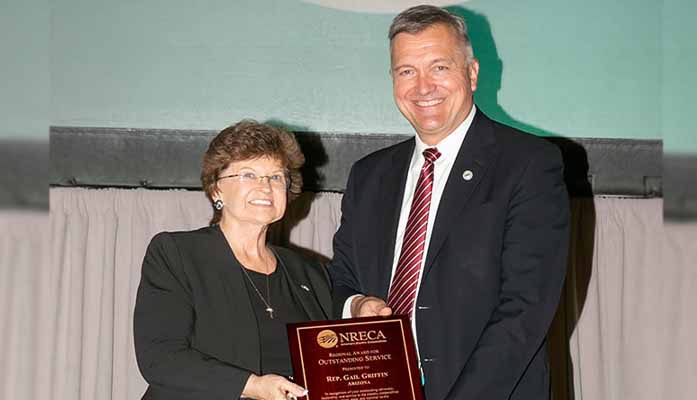
The National Rural Electric Cooperative Association has recognized Arizona State Rep. Gail Griffin with the organization’s 2021 Regional Award for Outstanding Service. The award recognizes outstanding service at the regional or state level to electric cooperatives.
Griffin (R-LD14) serves areas of Cochise, Graham, Greenlee, Graham, and eastern Pima counties. She was nominated for the award by Grand Canyon State Electric Cooperative Association (GCSECA) and Sulphur Springs Valley Electric Cooperative (SSVEC).
In nominating Griffin, SSVEC Chief Executive Officer Creden Huber touted the representative’s myriad efforts to assist Arizona’s Cooperatives, including her protection of the capital credits program, her willingness to work together to solve policy problems, and her understanding of cost and maintenance concerns involving pole attachments by cable and telecommunication companies.
Huber also noted Griffin’s appointment as chair of House Natural Resources, Energy & Water Committee gives her responsibility for ensuring legislation that may negatively impact Cooperatives is addressed in committee. Griffin previously chaired the Senate’s NREW Committee.
“For the past 20 years, your guidance, passion and dedication to the electric co-op family gained you a reputation as a great leader in the electric cooperative program,” NRECA CEO Jim Matheson wrote in the award notification. “Your strong commitment to the seven cooperative principles and work on advocacy, education and training had a profound effect throughout the State of Arizona.”
Griffin takes pride in being a strong proponent of Arizona’s electrical cooperatives throughout her time in the Legislature.
“They are consumer owned, not-for-profit entities that ensure their members are provided with reliable and affordable service,” she said upon receiving the award. “I will continue to champion electrical cooperatives for the vital role they play in strengthening rural Arizona.”
NRECA represents more than 900 consumer-owned, not-for-profit electric cooperatives, public power districts, and public utility districts across America.
by Corinne Murdock | Dec 4, 2021 | Economy, National News, News
By Corinne Murdock
Senator Mark Kelly (D-AZ) claimed that the Biden Administration’s spending plan, the Build Back Better Act that could cost over $4 trillion, wouldn’t raise taxes for the lower and middle classes and would be paid for in full during an interview with Fox10 on Thursday. As written, the spending plan would cost around $2.15 trillion – but if the provisions are made permanent, that would incur an additional cost well over $2 trillion according to the Committee for a Responsible Federal Budget.
“And by the way: this is not going to raise taxes on middle and working class Arizonans,” asserted Kelly. “For folks that make under 400,000 a year – families, their taxes will not go up. And by the way, this is going to be paid for by the wealthiest corporations.”
The sentiment that the spending would be paid for in full didn’t align with the Congressional Budget Office (CBO) assessment released last month. The CBO estimated that the spending would result in a net increase in the country’s deficit by $367 billion over the next ten years. Unadjusted, the spending would add to the country’s deficit by $750 billion over the next five years and $160 billion over the next ten years.
Kelly added that Congress was still working over details of the Build Back Better Act – so the CBO report could be considered a working estimate.
The CBO also included a cost breakdown for each policy within the Build Back Better Act; they estimated:
- $585 billion for family benefits related to affordable child care, paid family and medical leave, and universal pre-K
- $570 billion for climate and infrastructure related to “clean” energy and climate resilience, electric tax credits, “clean” fuel, vehicle tax credits, other climate-related tax benefits, and infrastructure and related tax breaks
- $340 billion for health care related to expanded Medicaid, Affordable Care Act tax credits, and health care workforce investments
- $325 billion collectively for affordable housing, higher education, workforce, and “other spending and investments”
- $280 billion for reducing or delaying the broadening of the 2017 Tax Cuts and Jobs Act (TCJA)
- $215 billion for tax credits and cuts related to children, earned income, and “other tax changes”
- $110 billion for immigration reform
The House passed their version of the Build Back Better Act days before Thanksgiving. The Senate must decide on whether it will accept the bill as is, or modify it. The latter is most likely, considering the sentiments of two senators.
Unlike Kelly, Senator Kyrsten Sinema (D-AZ) has held out her support for the spending plan. Sinema isn’t alone – Senator Joe Manchin (D-WV) also doesn’t support the bill’s price tag. Despite pressure from their party, both senators have insisted that they want the bill reduced drastically in its cost.
Corinne Murdock is a reporter for AZ Free News. Follow her latest on Twitter, or email tips to corinne@azfreenews.com.
by Corinne Murdock | Dec 1, 2021 | News
By Corinne Murdock |
On Tuesday, a federal court issued a preliminary injunction against President Joe Biden’s COVID-19 Centers for Medicare and Medicaid Services (CMS) vaccine mandate for health care workers. Arizona health care workers under CMS jurisdiction via Medicare and Medicaid programs don’t have to adhere to the vaccine mandate. Louisiana Western District Judge Terry Doughty, an appointee of previous President Donald Trump, issued the order.
Arizona Attorney General Mark Brnovich announced the injunction Tuesday afternoon.
“NATIONWIDE INJUNCTION Great news – a federal judge just granted our coalition’s request to STOP the Biden Administration’s overreaching ‘job or jab’ COVID-19 vaccine mandate for health care workers. We will continue to take action to protect Arizona’s health care heroes,” wrote Brnovich.
Brnovich joined a coalition of 13 other states led by Louisiana Attorney General Jeff Landry, a Republican, in response to an emergency order issued by CMS on November 4. Under the CMS mandate, health care workers would’ve had to be fully vaccinated by January 4. That would’ve required individuals receiving vaccines requiring two doses to receive their first injection by December 6 to be fully compliant.
In a memorandum, Doughty wrote that Biden’s attempt to bypass Congress posed a grave threat to our Constitutional order. He emphasized the importance of safeguarding American liberties more so during the pandemic than at any other time.
“If the separation of powers meant anything to the Constitutional framers, it meant that the three necessary ingredients to deprive a person of liberty or property – the power to make rules, to enforce them, and to judge their violations – could never fall into the same hands,” wrote Doughty. “The executive branch is allowed to usurp the power of the legislative branch to make laws, two of the three powers conferred by our Constitution would be in the same hands. If human nature and history teach anything, it is that civil liberties face grave risks when governments proclaim indefinite states of emergency.”
Although Press Secretary Jen Psaki issued a statement on Tuesday emphasizing the importance of vaccinations to combating COVID-19 and the latest variant, Omicron, she didn’t address the ruling as of press time.
Neither did President Joe Biden. Instead, Biden’s remarks for most of Tuesday concerned bills his administration worked to pass such as the infrastructure law, with the school shooting in Oxford, Michigan occupying the remainder of that day.
Reuters noted in their coverage that the White House declined to comment on these legal losses.
This is the latest in a series of legal battles over COVID-19 vaccine mandates that the president has lost. Courts also temporarily halted the federal contractor vaccine mandate, as well as a rule through the Occupational Health and Safety Administration (OSHA) requiring businesses with 100 or more employees to either be vaccinated or tested weekly.
Kentucky Eastern District Judge Gregory Van Tatenhove, a Bush appointee, also issued his order halting the Biden Administration’s requirement that new government contracts require contractor employees to be vaccinated for COVID-19 on Tuesday. Tatenhove’s rationale for imposing the injunction was similar to Doughty’s, citing “serious Constitutional concerns.” Tatenhove didn’t dispute that the COVID-19 vaccine worked, or that the federal government could mandate vaccinations within certain circumstances. Rather, Tatenhove said that the legal question at hand concerned what authorities the president and federal government had.
“Can the president use congressionally delegated authority to manage the federal procurement of goods and services to impose vaccines on the employees of federal contractors and subcontractors? In all likelihood, the answer to that question is no,” wrote Tatenhove. “[T]here is a serious concern that Defendants have stepped into an area traditionally reserved to the States, and this provides an additional reason to temporarily enjoin the vaccine mandate.”
Read Doughty’s full opinion ordering an injunction against the CMS mandate here.
Corinne Murdock is a reporter for AZ Free News. Follow her latest on Twitter, or email tips to corinne@azfreenews.com.