by Jonathan Eberle | May 9, 2025 | News
By Jonathan Eberle |
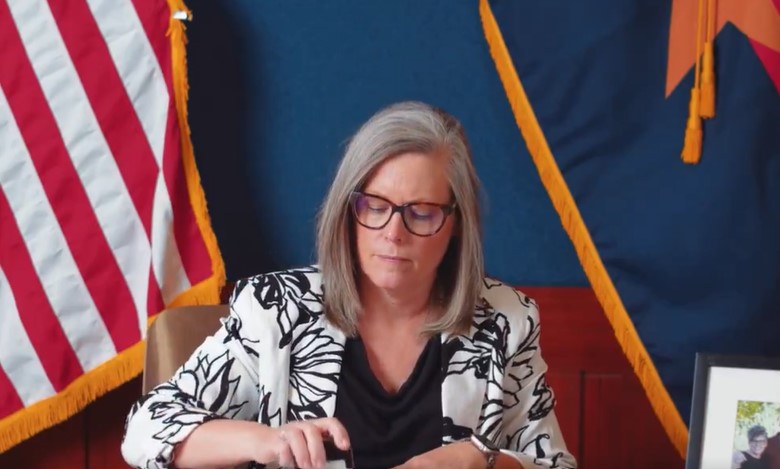
A bill aimed at increasing transparency and accountability in Arizona’s Medicaid contracting process has been vetoed by Governor Katie Hobbs, prompting strong criticism from Republican lawmakers who say the governor is shielding her administration from scrutiny.
The legislation, SB 1612, was sponsored by Senate President Pro Tempore T.J. Shope and would have implemented a series of oversight measures affecting how the Arizona Health Care Cost Containment System (AHCCCS) — the state’s Medicaid agency — awards contracts and handles procurement.
In a statement released late Friday, Hobbs vetoed the bill without an accompanying public explanation, though her office has generally opposed what it characterizes as politically motivated legislation. Shope, however, called the veto “an alarming example of the fox guarding the henhouse.”
“I drafted this legislation in response to potential wrongdoing revealed from a probe on how the Hobbs administration provided an unfair advantage when awarding $15 billion worth of state Medicaid contracts,” Shope said. “She appears to be providing favoritism to her friends, allies, and donors using taxpayer dollars.”
The legislation comes in the wake of a 2023 ruling by an administrative law judge that found AHCCCS had improperly awarded contracts related to the Arizona Long Term Care System (ALTCS), which provides care for roughly 26,000 elderly and disabled Arizonans. The judge cited violations of procurement statutes, flawed bid evaluations, and evidence that contract decisions were made based on the interests of the agency rather than the public. Compounding concerns, a June 2023 local media investigation revealed that Sunshine Residential Homes, a state-licensed group home with a record of deficiencies, received millions in contracts from the Arizona Department of Child Safety (DCS) after making campaign donations to Governor Hobbs and the Arizona Democratic Party.
SB 1612 would have removed a statutory exemption allowing AHCCCS to use its own procurement code, requiring adherence to statewide rules; prohibited destruction of internal documentation during request-for-proposal (RFP) evaluations; and required vendors responding to RFPs or applying for state-administered grants to disclose political donations made to the governor or associated campaign committees.
Critics of Hobbs say these measures were a direct response to growing concerns about transparency in her administration. “Had she signed this bill into law, she would have given the citizens of Arizona greater confidence in state government acting in their best interests — not the best interests of political campaign coffers,” Shope said.
Hobbs’ veto is one of more than 100 since taking office in 2023. With Republicans controlling both chambers of the Arizona Legislature and Democrats holding the governorship, partisan tensions over issues like procurement, immigration, and education have dominated the political landscape.
Supporters of SB 1612 say it was a common-sense effort to address documented problems in contract awards that affect the lives of thousands of vulnerable Arizonans. As scrutiny intensifies over both AHCCCS and DCS procurement decisions, it remains to be seen whether lawmakers will revisit the bill in another form or pursue an independent investigation into the allegations.
Jonathan Eberle is a reporter for AZ Free News. You can send him news tips using this link.
by Daniel Stefanski | Sep 28, 2024 | News
By Daniel Stefanski |
The Hobbs Administration is again under political fire for alleged conflicts of interest.
This week, Arizona State Senator T.J. Shope, the Senate President Pro Tempore, issued a statement to announce the recent conclusion of an administrative law judge that “the Arizona Health Care Cost Containment System (AHCCS) improperly awarded contracts for healthcare services for 26,000 elderly and physically disabled individuals enrolled in the Arizona Long Term Care System.” According to the release from Senator Shope, the “determination was based on several factors, including violations of statutes and rules by AHCCCS, prejudice, a lack of transparency, contract awards based on best interests of the agency and not the state, an arbitrary and flawed ranking system of bid proposals, as well as deceptive criteria provided by AHCCCS to health care companies on the evaluations of their bid proposals.”
Shope revealed that “while the judge recommended cancellation of the procurement and issuance of a new request for bid proposals, AHCCCS announced this month it would not do so, and instead, would delay the transition to the newly awarded health plans by one year, commencing in October of 2025.”
In a statement, Shope said, “I’m deeply disturbed by what’s transpired under the Hobbs Administration, from the Sunshine Residential pay-for-play scheme, to now this procurement scandal. The integrity of state government and its spending practices have been compromised. As chairman of the Senate Health & Human Services Committee, it’s my goal to get to the bottom of these disputes and determine whether in fact preferential treatment is being provided using the tax dollars of hardworking Arizonans, and whether our citizens who rely on these critical services are being protected.”
The Senate Republican leader added, “I will be on a fact-finding mission in the coming months and will determine the best course of action to address these cases, whether through legislation, or other legal avenues.”
Earlier this year, The Arizona Republic broke a story about the Arizona Department of Child Safety “approv[ing] what amounts to a nearly 60% increase in the rate that Sunshine Residential Homes Inc. charges to care for a child for a day.” The alleged action to approve the rate increase for the one organization was made while “DCS has denied pay increases to home operators and cut loose 16 providers during the contract renewal process.” The Republic also asserted that “no other standard group home provider was approved for any rate increase during Hobbs’ tenure.”
After the story ran in the Republic, Shope sent a letter on June 5 to both Attorney General Kris Mayes and Maricopa County Attorney Rachel Mitchell, asking both officials to “examine the facts surrounding the Department of Child Safety’s alleged decision to approve a nearly 60% rate increase for Sunshine Residential Homes and determine if conduct by any of the involved parties warrants a criminal or civil investigation.”
State Representative Matt Gress followed up with a letter on June 6 to Mitchell, letting her know that “the Auditor General’s Office stands ready to partner with you in getting the facts about this troubling matter,” and that the Joint Legislative Audit Committee “will allocate the resources the Auditor General needs to help restore what appears to be a major breach of trust in our government.”
That day (June 7), Mayes fired off two letters to both Mitchell and the Arizona Auditor General, Lindsey Perry, over the investigation. Mayes told County Attorney Mitchell that “it would not be appropriate or in the best interest of the state to conduct parallel investigations into the same matter,” and that “a separate process conducted by the MCAO could jeopardize the integrity of the criminal investigation that my office will now proceed with.”
Mayes similarly told Auditor General Perry that “while [the Auditor General’s] office is statutorily authorized to examine records and conduct audits at the direction of the Joint Legislative Audit Committee, at this time, the assistance of [her] office is not needed by the Attorney General’s Office for our investigation.”
After the letters from Mayes, Arizona State Treasurer Kimberly Yee sent a letter to Maricopa County Attorney Rachel Mitchell, requesting “that [she] investigate the allegations that have occurred in [her] jurisdiction.” Yee also delivered a letter to Arizona Attorney General Kris Mayes, highlighting that the state’s top cop’s assertion that her office had singular control over any investigation “is not appropriate or authorized by law, as those entities have separate jurisdiction to investigate this matter.”
After receiving the letters from Senator T.J. Shope and Gress, County Attorney Mitchell informed them that her office was “contacted by the Arizona Auditor General asking that the Maricopa County Attorney’s Office serve as the prosecution office that will work with them while they conduct an investigation into this matter.”
Daniel Stefanski is a reporter for AZ Free News. You can send him news tips using this link.