by Terri Jo Neff | Jun 28, 2021 | News
By Terri Jo Neff |
CORRECTION: The bill still needs to be considered in the Senate. The “win” is confined only to the House vote as of 9:30 a.m., on June 29.
Back in January, on the second day of the legislative session, Sen. Warren Petersen and 27 other legislators introduced Senate Concurrent Resolution 1003 in hopes of garnering voter support to rein in a governor’s emergency powers.
It took more than five months, but the effort by Petersen (R-LD23) and the co-sponsors of SCR1003 paid off last week. The result – voters will decide in November 2022 whether to approve a constitutional amendment that ensures the legislature has a say after a governor issues a state of emergency.
A governor currently has power to declare a state of emergency for conditions of “disaster or extreme peril to the safety of persons or property within the state caused by air pollution, fire, flood, epidemic, riot, earthquake or other causes that are likely to be beyond the control of any single county or municipality.” Such a declaration is only terminated by proclamation of the governor or a concurrent resolution of the legislature.
The legislature, however, might not be in session when a state of emergency is issued.
SCR1003 would constitutionally require a governor to call the legislature into special session within 10 days of proclaiming a state of emergency. And once assembled, the legislature could determine whether to enact laws or issue legislative orders to terminate or modify the governor’s emergency powers as well as the state of emergency.
Those legislative orders would have the same authority as a governor’s executive orders, according to a provision of SCR1003. Another provision addresses a concern raised during the COVID-19 lockdowns – how to conduct legislative business if lawmakers cannot make it to the floor of their chambers.
Remote voting is currently allowed but the head count conducted for determining a quorum is based on those legislators present in the building. But if SCR1003 is approved by voters, quorums could be counted based on remote-attendance by a lawmaker under certain situations.
That would ensure the legislature can do its constitutionally-mandated duties even if several members are not in the building.
One of the most impassioned SCR1003 floor speeches came from Rep. Jake Hoffman (R-LD12) who advocated during voting on June 25 not only in support of the concurrent resolution but also to end of the COVID-19 public health emergency Gov. Doug Ducey declared more than 15 months ago.
According to Hoffman, Arizona’s state of emergency statutes permit “the most draconian measures out of all the states except for one. That is abhorrent. That is terrible.” He added that current laws allows emergency powers which are “unchecked and out of control.”
SCR1003, Hoffman said, “is measured, it is reasonable, it does not overreach, and it does not eliminate the ability for emergency orders and emergency declaration.”
He also called on Ducey to put on end to Arizona’s COVID-19 public health emergency. “It is time for this emergency order to end, period, stop all. End of story, turn it off,” Hoffman said.
But legislators did more last week that just ensure SCR1003 gets before voters next year.
The House and Senate also passed SB1819 which includes a provision that ends a governor’s public health state of emergency after 120 days unless extended in whole or in part by concurrent resolution of the legislature. That provision of the bill will not apply to a state of emergency issued before Jan. 1, 2023.
Petersen, the bill’s prime sponsor, told AZ Free News both SCR1003 and SB1819 are important given Arizona’s rating as second worst in the nation for the balance of powers between the executive and the legislative branches when it comes to emergency orders.
“SCR1003 and SB1819 are needed to bring Arizona into balance like the rest of the nation,” Petersen explained. “The measure that goes to the voters is important because it brings the legislature into session to consider any emergency orders issued. Meanwhile, SB1819 that we passed is important because it terminates those orders after four months.”
The two measures work hand in hand, Petersen noted.
“One makes sure the legislature has a voice in emergency orders from the start. The second makes sure that they don’t last forever,” he said.
by Terri Jo Neff | Jun 27, 2021 | News
By Terri Jo Neff |
When the State House voted Friday to pass HB2898, the K-12 Education budget bill, it marked the end of a grueling process that resulted in passage of a $12.8 billion budget package for Fiscal Year 2022.
A key provision of HB2898 is the establishment of new academic standards for K-12 students in the area of civics. There was also funding for a number of special programs for students and a variety of new rules for school board and school districts.
But much of the debate about the bill centered on whether more money should have been allocated.
Rep. Aaron Lieberman (D-LD28) acknowledged HB2898 includes “a lot of money,” but he argued it was not enough. Lieberman noted 2,000 classrooms across the state do not have assigned, permanent teachers, something he said could be remedied by spending one-fourth of the state’s $2 billion surplus.
“It’s clear now more than ever we need every dollar,” Lieberman said in voting against the bill.
However, Rep. Bret Roberts (R-LD11) questioned why more focus is not on the decisions of school boards who spend the billions of dollars provided each year through federal funding and from the legislature.
“Why are we not asking the school boards why they’re not giving the money that the legislature sends to the school boards to the teachers?” he asked on the floor. “Why are we not holding the school boards responsible for the money that we send them to give to the teachers? When are the teachers going to hold the school boards responsible?”
Rep. Walt Blackman (R-LD6) expressed similar frustration, noting that many of the chamber’s 24 Democrats who were present Friday complained the funding in HB2898 was too low. So they simply voted against the bill.
Blackman acknowledged K-12 funding in the bill “may not be enough” but said those representatives who vote green -yes- are demonstrating they “support education by action.” Which is why he was disturbed to see so many red -no- votes.
Democrats may give myriad reasons for what is wrong in HB2898 or what could be done differently, he said, “but if we are really dedicated to teaching our children K-12, and that is a non-partisan issue, then why do we have red votes?”
“This can’t be an issue where we are upset and we take our marbles and we go home because we don’t have enough marbles to play,” Blackman said, adding that all of the votes should be green because “nothing is perfect.”
The House K-12 Education bill will now be transmitted to the Senate, which last week passed its own education bill. There is now one significant difference between the bills which will need to be reconciled.
That difference involves a major expansion of the state’s Empowerment Scholarship Accounts (ESAs) which is currently available to about 250,000 students. The Senate’s budget bill added two eligibility criteria which would make ESAs an option to 700,000 students, including children from Title 1 schools where at least 40 percent of the families are considered low-income.
However, three Republicans in the House voted against an amendment which would have included the ESA expansion in HB2898. The amendment died without those votes and the three Republicans also voted against a later attempt to insert the failed amendment into the main bill just prior to final voting.
Sen. Paul Boyer (R-LD20) is a teacher and a major supporter of ESA legislation. He took to Twitter after the House vote to express his disappointment with the ESA decision.
“Meanwhile, minority students are 6 to 12 months behind their white counterparts. This defeat of ESAs for Title I students makes sure those same students never leave the school that’s failing them,” Boyer tweeted.
by B. Hamilton | Jun 27, 2021 | News
By B. Hamilton |
On Friday, a group of Arizona legislators reached out to Governor Doug Ducey with an offer to work with him to address the “omnipresent border crisis.” In a letter to the governor, the legislators also inquire as to the level of funding provided to the Border Strike Force.
Led by Rep. Shawnna Bolick, the lawmakers advised the governor that they hope to work with him to “come up with a concrete plan to further allocate resources to complete portions of the Border wall and ensure Border Strike Force is fully funded.”
The lawmakers accuse the Biden Administration of not making “the public safety or health of Arizonans” a top priority, noting that it “took until today for Vice President Kamala Harris to see the invasion for herself in El Paso.”
“We applaud other governors answering your call for assistance to send some of their law enforcement as back up as the ongoing invasion continues along the southern Border,” write the lawmakers. “The problem is real. We wish you didn’t have to rely on other states to bail us out because the federal government has failed us, but illegal immigration affects every state.”
The lawmakers cite as a source of concern an incident that occurred earlier this year which was “highlighted in the local newspaper that the Department of Public Safety release two confessed human smuggler with just a traffic citation after stopping him along a valley freeway in April with a van full of illegal immigrants.”
“It was rather alarming to read that the illegal immigrants in the van were released into the Phoenix area even though it is a direct violation of state law to be in our state unlawfully. It is noted that the federal agents would not pick up this van full of illegal immigrants if they weren’t violent felons. If the Border Strike Force isn’t identifying traffickers along the southern Border and they are making their way into the Valley, is the Border Strike Force understaffed and underfunded?”
The lawmakers expressed a desire to “work together to further investigate why this human trafficker was let go.”
“We support trade relations with Mexico, but we do not want transnational crime rings bringing further ruin into our state. It is past time to plug the gaping holes on state land that buttress Mexico allowing traffickers to invade our state.”
The lawmakers argue that border security is a states’ rights issue.
Last week, Texas Governor Greg Abbott announced that Texas would build its border wall. Abbotts aid that the state will be soliciting donations from across the country to help fund the wall.
“When I do make the announcement later on this week, I will also be providing a link that you can click on and go to for everybody in the United States — really everybody in the entire world — who wants to help Texas build the border wall, there will be a place on there where they can contribute,” Abbott said on a podcast show called “Ruthless.”
As AZ Free News reported earlier this month, Ducey and Abbott urgently requested all U.S. governors to send available law enforcement resources to their states along the U.S.-Mexico border as illegal border crossings, apprehensions, and unaccompanied migrant children in federal custody increase.
The Customs and Border Protection apprehension numbers for May showed more than 180,000 illegal aliens were apprehended crossing the border over the course of the month, a 674% increase from the 23,237 illegal aliens apprehended at the border in May 2020.
In a joint letter from Ducey and Abbott, fellow governors were told: “In response to the ongoing surge of illegal border crossings, with the accompanying threats to private property and to the safety of our citizens, Governor Abbott has declared a disaster and Governor Ducey has declared an emergency.”
Bolick was joined in the letter by Reps. Becky Nutt, Tim Dunn, Walt Blackman, Brenda Barton, John Kavanaugh, Mark Finchem, Joseph Chaplik, Beverly Pingerelli, Leo Biasiucci, Judy Burgess, Frank Carroll, Quang Nguyen, John Fillmore, Jacqueline Parker, and Steve Kaiser.
by Terri Jo Neff | Jun 26, 2021 | Economy, News
By Terri Jo Neff |
Positive reactions continue to come in from business groups in response to the Arizona Legislature’s passage this week of a Fiscal Year 2022 budget package which includes more than $1.3 billion in tax cuts, $1 billion in payments toward state debt, and a transition of the state’s multi-tied income tax system to a flat rate.
The nonprofit, nonpartisan Arizona Tax Research Association called passage of the FY2022 budget “a watershed moment” for Arizona, while Scot Mussi, president of the Arizona Free Enterprise Club, commended the Legislature for passing what he called “historic” tax cuts.
“Every single taxpayer in Arizona will now get a tax cut,” Mussi said. “This is great news for the future of our great state!”
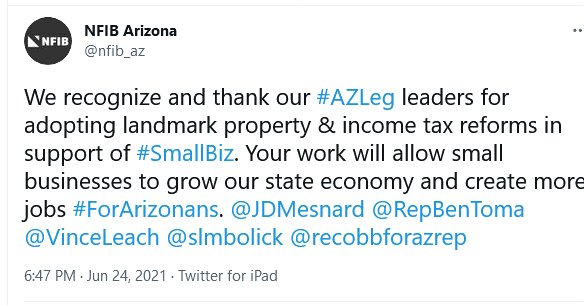
The National Federation of Independent Business, which advocates for small and independent businesses across the country, gave a shout out to the Legislature via Twitter for adopting “landmark property & income tax reforms” which support small businesses. “Your work will allow small businesses to grow our state economy and create more jobs #ForArizonans,” the message said.
On Friday, Gov. Doug Ducey issued a video statement celebrating passage of the 11 bills which make up what he calls the state’s “fiscally conservative, forward-looking budget” that starts July 1.
“Here in Arizona our economy is booming,” said Ducey, thanking House Speaker Rusty Bowers, Senate President Karen Fann, and all the legislators. “New people and businesses are moving here every day. And at the state level that’s resulted in record revenue. With this budget we’re investing those dollars in the things that matter: schools, universities, community colleges, and new roads and bridges, just to name a few.”
Ducey added that “most importantly we’re giving a bulk of the surplus dollars back to the people who earned them.”
A budget signing ceremony must wait until at least Monday when the Senate returns from recess to formally transmit the budget bills to the governor.
Meanwhile, supporters of the voter initiative known as Proposition 208 are promising a court fight over a bill Ducey is also expected to sign next week.
Prop 208 passed last November by a slim margin of 51.75 to 48.25 percent. The purpose of the initiative was to provide additional funding for public and charter school by way of a new 3.5 percent income tax surcharge for many Arizonans.
Among those subject to the new tax surcharge would be thousands of small business owners who currently report business profits on their state personal income tax return. SB1783, however, provides a small business alternate income tax as an option for those who operate as sole proprietors, LLCs, professional partnerships, and S Corporations.
Under the alternate tax, income derived from small business can be reported on a special small business income tax form. This will ensure the income is not added into personal income for purposes of calculating the amount of Prop 208 surcharge a taxpayer owes.
Critics contend SB1783 is a way to unlawfully circumvent the taxation provision of Prop 208. Proponents of the bill point to the many statements made prior to the 2020 General Election which assured business owners that “business income” would not be subject to the surcharge.
by Terri Jo Neff | Jun 25, 2021 | News
By Terri Jo Neff |
The 60-member House stayed on the floor until nearly 11 p.m. Thursday to pass 10 of the 11 bills in the Fiscal Year 2022 budget package, and will return at 9 a.m. Friday to debate and vote on HB2898, which covers K-12 legislation.
The bills which already passed and are being transmitted to the Senate include Gov. Doug Ducey’s long-championed flat rate income tax, a $1.3 billion tax cut, and liability payments to state pension funds. In addition, the bills include key legislation related to COVID-19 vaccine passports and a governor’s use of state of emergency powers.
But getting 90 percent of the bills passed in a single day when there are 60 members was not without controversy. It took the Senate from Tuesday morning to nearly 2:30 a.m. Wednesday to complete its passage of the 11-bill budget package, and that was with only 30 members.
As with the Senate, the House Republican caucus has a two member cushion over Democrats, meaning the Republicans can pass a bill without any “aye” votes from across the aisle. After doing some quick math, House Speaker Rusty Bowers made a last minute motion to change the rules, severely limiting the amount of time each lawmaker had to debate or comment on bills and votes.
One thing the rules could not do, however, was limit the number of amendments Democrats could offer to the bills. And each amendment came with its own process of debate and comment, something the Democrat caucus utilized to the full extent. But in the end, the 10 bills were passed on a 31 to 29 margin. The K-12 bill, however, has some Republican opposition which had not been resolved as of Thursday night.
The Senate was also back at work Thursday to address a few dozen bills members still want to see passed.
Among those are 22 bills which Ducey vetoed on May 28 when he became frustrated with the lack of legislative attention to the budget bills. Instead of propelling legislators into action, the governor’s veto action temporarily polarized some Republican Senators who objected to elements of the budget package, at least until all 16 came on board this week to pass the bills.
The Senate has reintroduced Ducey’s 22 vetoed bills -several of which initially passed with bipartisan support. But in an unexpected move Thursday, 25 senators also successfully voted for a bipartisan override of one of the vetoed bills.
Senators admitted the override vote -only the third in Arizona history and the first since the 1981- was a symbolic message to Ducey and future governors that the state has three equal branches of government. The bill itself however will not be enacted unless the House also overrides the veto by a two-thirds margin.
Sen. Tyler Pace, a Republican like the governor, was one of the supporters of the veto override.
“I stand with the belief that the Legislature has an authority to override, and that authority can be used in times when the Legislature feels that a policy or bill that was otherwise vetoed should become law,” he said in explaining his motivation.
Even Senate President Karen Fann voted for the bipartisan override despite her wish it had been handled differently by her members. “I know where you guys are coming from, I understand your feelings,” Fann said. “This is a very big thing that we are doing right now.”
Speaker Bowers is expected to have his members tackle the issue of the 22 vetoed bills and the possible override once the final budget bill passes. In addition, they need to take up SB1783 to address changes to small business tax legislation in light of the new flat income tax Arizona will have.
by Terri Jo Neff | Jun 25, 2021 | News
By Terri Jo Neff |
The Arizona Supreme Court explained Thursday why it ruled last year that the name of rapper turned presidential candidate Kanye West would not be printed on 2020 General Election ballots in the state.
West announced back on July 4, 2020 that he was running as an Independent candidate for president. His multi-million dollar effort resulted in less than 66,500 votes in the 12 states where his name was on the ballot, along with another 4,000 as write-in votes in a handful of other states.
Questions were later raised as to whether West’s candidacy was simply a publicity endeavor or if he was seeking to draw votes away from Joe Biden in favor of then-President Donald Trump, as the two men had been friends for several years. But in early September, West’s Arizona campaign team submitted 57,892 signatures on nominating petitions to secure a spot on ballots across the state.
A registered voter challenged West’s candidacy in Maricopa County Superior Court where a judge declared the signatures invalid because West’s electors -those voters who would have cast Arizona’s 11 Electoral College votes if West won- never filed required paperwork before the signatures were collected.
The judge also ruled West did not personally qualify to be on ballots in Arizona as an Independent candidate because he was a registered Republican in Wyoming.
West lost his emergency direct appeal to the Arizona Supreme Court, which issued an order at the time enjoining Arizona Secretary of State Katie Hobbs along with the 15 county recorders from listing West and his electors on 2020 General Election ballots. But the public did not learn the legal reasoning behind that decision until Thursday.
“West was required to provide the Secretary (of State) with a letter designating the names of his vice-presidential running mate and his eleven presidential electors, a statement signed by each consenting to their designation, and a nomination paper on behalf of each elector,” Justice Bill Montgomery wrote in the opinion. “Additionally, the electors were required to submit nomination petitions containing the requisite number of signatures to qualify for the ballot.”
The justices, however, determined the Maricopa County judge who heard the case last September erred in ruling that West’s Republican Party affiliation was a factor for keeping his name off the ballot. The statute about party affiliation cited by the judge only applied to the 11 Arizonans who wished to be listed as West’s electors on the ballot, Montgomery wrote.
But that error did not change the fact West was ineligible in Arizona to be on the ballot for president due to failing to secure enough valid nominating petition signatures.
“Given the dispositive effect of West’s electors’ failure to qualify for the ballot, we do not address his other arguments regarding the process for challenging nomination petitions, naming indispensable parties, and the application of laches to plaintiffs,” Montgomery wrote. “We affirm the trial court’s order.”