by Corinne Murdock | Aug 18, 2021 | Education, News
By Corinne Murdock |
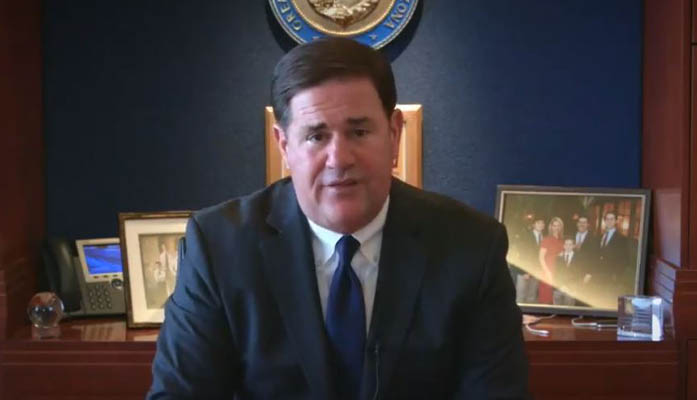
Some of Governor Doug Ducey’s $65 million for learning programs announced Tuesday will fund a controversial educational method: $1.6 million for social-emotional learning (SEL). SEL grapples with emotionally-charged social issues, such as murder or the history of slavery, in order to build social and self-awareness, as well as relational skills. It serves as a vessel for fostering diversity, equity, and inclusion (DEI). Specifically, the $1.6 million investment comes from $20.1 million in American Rescue Plan dollars.
Ducey’s SEL funds will go to Literacy Lab’s Leading Men Fellowship, a spawn of DC Public Schools funded initially by the DC Public Education Fund (DCPEF). The fellowship only recruits male, minority high school graduates. These young men give literacy support to pre-K students for a year in a residency-style program. One of the main goals for this fellowship is “diversifying the teacher pipeline.” This fellowship has some familiar faces for Arizonans – one of DCPEF’s current board members is Everfi Co-Founder and CEO, Tom Davidson.
Everfi has come under fire by Arizonan parents due to its curriculum, which is marketed as a free extracurricular resource, and after it was discovered that Everfi was bribing teachers with $15 Amazon gift cards for referrals to other educators. Amazon CEO Jeff Bezos is one of Everfi’s top donors.
Everfi’s curriculum promotes diversity initiatives: in one survey, Everi asked students private questions about their home life and encouraged them to think critically about their privilege. The company also provides an “Anti-Racism Extension Guide” for teachers, which promotes a book teaching tenets of critical race theory, called “28 Common Racist Attitudes and Behaviors,” and links to the New York Times’ 1619 Project.
Last September, Everfi committed $100 million over the next three years to expanding its curriculum on social injustice and economic disparities. Two main topics that Everfi will develop are exclusively on DEI and SEL.
Arizona is not listed as one of Leading Men Fellowship’s locations as of press time. The fellowship lists activity in the Metro DC area; Central Virginia; Baltimore, Maryland; Kansas City, Missouri; Massachusetts; and Milwaukee, Wisconsin.
Ducey classified the $65 million as program funding for K-12 literacy, adult education, and teacher professional development.
“We’re making targeted investments to connect adult students with jobs, strengthen literacy education in K-12 schools, enhance professional development for teachers, help students learn money management, expand access to high quality education, and much more,” said Ducey. “Students continue to excel in and out of the classroom as they recover from the effects of the pandemic and distance learning, and we will continue to put our resources toward helping them succeed.”
Corinne Murdock is a reporter for AZ Free News. Follow her latest on Twitter, or email tips to corinne@azfreenews.com.
by Corinne Murdock | Aug 18, 2021 | News
By Corinne Murdock |
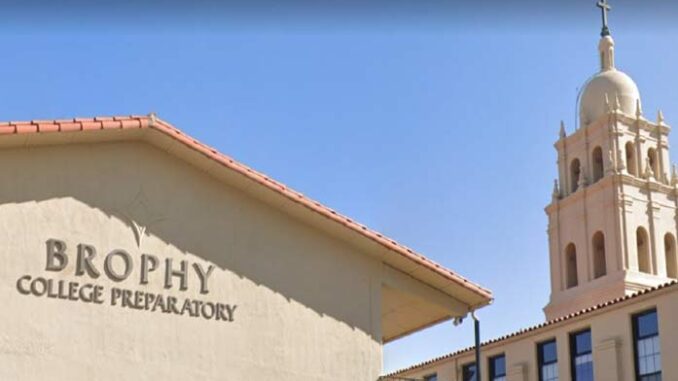
In a response letter issued Tuesday, Brophy College Preparatory (Brophy) Principal Bob Ryan addressed the lengthy critiques of his vaccine mandate issued by hundreds of Brophy parents, alumni, donors, and supporters. That Brophy coalition questioned what they perceived to be fallacies and contradictions posed by the mandate in a letter to Ryan last Friday.
Ryan reiterated multiple times that Brophy was committed to following science, medicine, and data, which he said were “rapidly evolving.” He didn’t engage with some of the questions and requests posed by the Brophy coalition’s letter. Rather, Ryan invited skeptical parents to a vaccine informational webinar on Wednesday featuring pediatric specialist Dr. Jodi Carter, infectious disease specialist Dr. Ana Moran, and epidemiologist Dr. Nick Staab.
In their letter, this Brophy coalition recommended a series of modifications to the mandate, each prefaced with lengthy citations from COVID-19 thought leaders like the CDC and the World Health Organization (WHO). The coalition suggested elimination of asymptomatic testing; testing of vaccinated students if asymptomatic testing remains; allowance for on-campus testing; exemptions included for medical justification, religious objections, natural immunity, and informed refusal; a zero-tolerance policy for any retaliation against families who capitalize on exemptions; no vaccine requirement for overnight activities; and allowance of a negative test in lieu of quarantine for students exposed to COVID-19.
The principal doubled down on the policy that only vaccinated students may embark on overnight trips. He added that vaccinated students would be tested for COVID prior to those trips. Ryan didn’t address parents’ confusion over the logic of allowing testing for vaccinated students and not unvaccinated students, or the logic of barring unvaccinated students from overnight trips with fellow Brophy students but not weekend activities with non-Brophy students.
Ryan also didn’t address the critics’ concerns over the quarantining aspect of the policy. Those critical of the mandate questioned the logic of quarantining unvaccinated students who tested negative for the virus.
Not all concerns were ignored, however. Ryan did concede to offer changes to several aspects of the vaccine mandate policy.
As for natural immunity, Ryan ignored the data provided by the vaccine mandate skeptics. He asserted that Brophy would only look to the CDC for its guidance. Ryan did add that students that tested positive for COVID-19 wouldn’t have to undergo biweekly testing for 90 days, in accordance with current CDC belief that natural immunity lasts 90 days.
Another issue that the Brophy community had with the vaccine mandates concerned the limitation on where unvaccinated students could receive their bi-weekly testing. Originally, Brophy’s vaccine mandate required laboratory or pharmacy tests, and barred on-campus and at-home tests. For that, the Brophy coalition questioned Ryan’s intentions with the mandate. They cited one of his media interviews, in which he insinuated that making the vaccine mandate burdensome was intentional so as to coerce vaccination.
In response, Ryan announced that Brophy will bring on-site vaccinations and testing to campus by September 13. He didn’t address any of the Brophy coalition’s claims about the efficacy of on-campus and at-home tests, or his intentions with the mandate.
Despite the hundreds that made up the Brophy coalition expressing discontent with the vaccine mandate, Ryan characterized the on-campus mood in his letter as “lighthearted” overall.
“Our students are happy to be back in the classroom, to be engaged with their friends and enjoying activities,” wrote Ryan. “It is our goal to keep the enthusiasm high and the daily experience as close to normal as possible, even while we continue to deal with the realities of a pandemic.”
Corinne Murdock is a reporter for AZ Free News. Follow her latest on Twitter, or email tips to corinne@azfreenews.com.
by Terri Jo Neff | Aug 18, 2021 | Education, News
By Terri Jo Neff |
Starting this Friday, low-income families with K-12 students will be able to apply online for up to $7,000 in immediate relief to support educational opportunities which will close the achievement gap and better equip underserved students.
Gov. Doug Ducey announced Tuesday an initial $10 million investment for Arizona’s COVID-19 Educational Recovery Benefit program. The funding – on a first come, first serve basis – will provide choice for families facing financial and educational barriers due to unnecessary closures and school mandates which do not comply with state law.
“Our COVID-19 Educational Recovery Benefit will empower parents to exercise their choice when it comes to their child’s education and COVID-19 mitigation strategies,” Ducey said. “It will also give families in need the opportunity to access educational resources like tutoring, child care, transportation and other needs.”
According to the governor’s office, Ducey has been working for weeks to create an additional program to provide more education options for families.
Eligible families can have a total household income up to 350 percent of the Federal Poverty Level. In addition, applicants must demonstrate the student’s current school is isolating, quarantining, or subjecting children to physical in-school COVID-19 constraints such as mask mandates or preferential treatment of vaccinated students.
“We know that historically disadvantaged communities bear the brunt of excessive and overbearing measures, and we want to ensure these students are protected,” Ducey said.
The COVID-19 Educational Recovery Benefit program has the full support of Senate President Karen Fann and House Speaker Rusty Bowers.
“Educators, families and state leaders are working hard to get students back on track, and the Educational Recovery Benefit program will make sure kids have every opportunity to grow and thrive,” said Fann.
Bowers noted the desire to keep children “safe, healthy, and achieving” during the pandemic, adding that with the new program, “we can do it all at the same time.”
Grant applications can be submitted starting Friday. Additional information is available at https://arizonatogether.org/educationalrecoverybenefit/
by Corinne Murdock | Aug 18, 2021 | News
By Corinne Murdock |
Hundreds of Brophy College Preparatory (Brophy) parents, alumni, and donors urged the private school to overhaul its vaccine mandate in a letter issued Friday. Earlier this month, Brophy imposed a vaccine mandate similar to President Joe Biden’s mandate for federal employees and contractors – if an individual isn’t fully vaccinated, they must adhere to masking restrictions, social distancing measures, and frequent testing, not to mention limits on extracurricular opportunities.
In their letter, this Brophy coalition recommended a series of modifications to the mandate, each prefaced with lengthy citations from COVID-19 thought leaders like the CDC and the World Health Organization (WHO). The coalition suggested elimination of asymptomatic testing; testing of vaccinated students if asymptomatic testing remains; allowance for on-campus testing; exemptions included for medical justification, religious objections, natural immunity, and informed refusal; a zero-tolerance policy for any retaliation against families who capitalize on exemptions; no vaccine requirement for overnight activities; and allowance of a negative test in lieu of quarantine for students exposed to COVID-19.
The letter claimed that the mandate exempting vaccinated students from biweekly testing failed to follow its own rationale of ensuring student safety. It cited a July study from the CDC, which indicated that vaccination doesn’t necessarily reduce viral load or prevent transmission. It also questioned the scientific validity of enforcing quarantines for unvaccinated students, even if they test negative for COVID-19.
Additionally, the letter questioned why biweekly testing was sufficient to rule out COVID-19 cases in unvaccinated students for in-person learning, but not for overnight activities. Brophy currently requires students to be vaccinated for overnight activities and any extracurriculars outside of the Phoenix metropolitan area. It also questioned why the vaccine mandate didn’t address the interactions Brophy students would have with non-Brophy students on the weekends – those that may not be tested regularly or vaccinated – but extended oversight to overnight activities with Brophy students required to be vaccinated or tested.
On the same subject of Brophy’s testing requirements, the letter questioned why at-home and on-campus tests weren’t permissible, but laboratory or pharmacy tests were admissible regardless of their quality. The letter asserted that officials wanted to increase the cost and inconvenience of being unvaccinated. It also noted that no other corporations, schools, or government agencies in the state were subject to such frequent measures of testing, pointing out the WHO’s advice that asymptomatic testing is unnecessary.
The letter accused Brophy Principal Bob Ryan of crafting the vaccine mandate to be so burdensome that students would eventually relent and get vaccinated.
“Principal Ryan admitted to a television reporter, ‘I’ve heard from some of [BCP parents] who’ve said, “You know, this [choice between vaccination and twice-a-week laboratory tests] has kind of been the piece that’s pushed us over the line and so we’re now going to get our kid vaccinated” and we’re hoping for that actually,’” recounted the letter. (original emphasis included)
The letter also questioned why Brophy hadn’t bothered to accommodate for certain students, such as those with pre-existing chronic or genetic conditions, religious objections, natural immunity, and/or those who choose informed refusal.
The 9-page letter had a total of 35 citations, and 11 pages of signatures. A majority of those 11 pages were filled with the names of hundreds of parents, alumni, donors, and community members.
One city councilmember and 27 former and current state legislators also signed onto the letter.
From the Arizona House, State Representatives Brenda Barton (R-Payson), Leo Biasiucci (R-Lake Havasu City), Walt Blackman (R-Snowflake), Shawnna Bolick (R-Phoenix), Judy Burges (R-Prescott), Joseph Chaplik (R-Scottsdale), Regina Cobb (R-Kingman), John Fillmore (R-Apache Junction), Gail Griffin (R-Hereford), Steve Kaiser (R-Phoenix), Quang Nguyen (R-Prescott), Becky Nutt (R-Clifton), Jacqueline Parker (R-Mesa), Kevin Payne (R-Peoria), Bret Roberts (R-Maricopa), Justin Wilmeth (R-Phoenix), Speaker Pro Tempore Travis Grantham (R-Gilbert), and former State Representative Jill Norgaard (R-Phoenix) all signed onto the letter.
State Senators Nancy Barto (R-Phoenix), Sonny Borrelli (R-Lake Havasu City), David Livingston (R-Peoria), J.D. Mesnard (R-Chandler), Warren Petersen (R-Gilbert), Wendy Rogers (R-Flagstaff), Kelly Townsend (R-Mesa), and former State Senators Sylvia Allen (R-Snowflake) and David Farnsworth (R-Mesa) were named in the letter as well.
Only one from the Phoenix City Council, Councilman Sal DiCiccio, signed onto the letter.
Corinne Murdock is a reporter for AZ Free News. Follow her latest on Twitter, or email tips to corinne@azfreenews.com.
by Corinne Murdock | Aug 18, 2021 | Education, News
By Corinne Murdock |
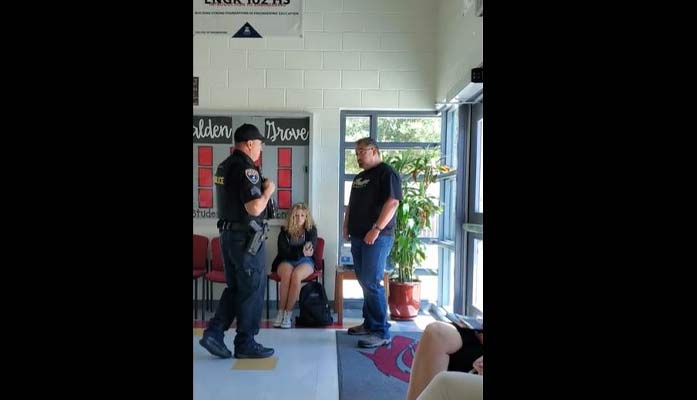
Last Friday, a teenage student and her parents were arrested for trespassing as they advocated for her education. The family was attempting to negotiate their daughter’s forced quarantine with the school principal. According to the parents, Damien and Jennifer Majuta, their daughter was healthy and not proven to be infected. The semester had just begun the previous week.
Sahuarita Unified School District (SUSD) policy requires that individuals potentially exposed to COVID-19 must quarantine for 10 days or until they receive a negative test. Even with a negative test, students must quarantine at least 7 days. Walden Grove High School (WGHS) thereby prohibited the Majutas’ daughter from attending school. Contact tracing indicated that she’d potentially been exposed to an infected individual.
AZ Free News inquired with SUSD about their policies for mitigating learning loss, as well as providing for students who rely on in-person resources such as school meals. SUSD didn’t respond by press time.
Five other adults accompanied the Majutas to contest the apparently-healthy student’s quarantine. When the group of seven wouldn’t leave, Sahuarita Police Department (SPD) responded to the scene. SPD attempted to mediate the situation. Ultimately, they arrested the Majutas for trespassing at WGHS’s insistence. SPD published an account of the incident on Facebook.
Videos captured of the Majutas show them insisting to the officers that they’d broken no laws by bringing their daughter to school.
Jennifer Majuta insisted that trespassing doesn’t apply because her daughter is legally enrolled in the school, and that no laws exist concerning quarantining measures imposed by public schools. Jennifer Majuta pleaded with the officers to understand that their daughter would never get to go to school because of constant quarantines.
“There is no law. They have no justification to remove her from the school. She is legally enrolled in the school. If you want to remove my husband and I – we are her legal guardians, she is an underage minor – you can either arrest her with us, [or] you can leave her here, and we respect you, you can do whatever you need to do, but we will be filming it and we will go peacefully,” said Jennifer Majuta. “You guys are backing somebody – an entity – that is not even based in law.”
An SPD officer responded that the law empowers schools to send home students for any reason. He pleaded with the Majutas to not make them arrest their family. The officer asked if there was anything he could say or do to convince them to leave the campus. Daniel Majuta said that they could allow his daughter the right to receive her education. The officer said he had no control over that.
“The law is – they are asking you to leave, they are asking your daughter to leave,” said the officer.
Damien Majuta emphasized that the arrests needed to be done. He insisted that no other recourse existed. According to the Majutas, they’d attempted to speak with the district and school board on multiple occasions about COVID policy, to no avail.
“People throughout history have [had] to stand up to get things to change,” said Damien Majuta. “The optics are in our favor. The school district is going to get in a lot of trouble for this.”
SPD released the Majutas by citation after photographing and fingerprinting them.
Corinne Murdock is a reporter for AZ Free News. Follow her latest on Twitter, or email tips to corinne@azfreenews.com.
by Terri Jo Neff | Aug 17, 2021 | News
By Terri Jo Neff |
Several Arizonans, Republican state lawmakers, and organizations are joining forces to secure enough signatures so voters can decide during the November 2022 General Election whether to strengthen existing voter ID requirements.
Arizonans for Voter ID is a political committee sponsoring the ballot initiative which seeks to revise existing voter ID laws for in-person voting and vote-by-mail ballots, as well as individuals who return another voter’s ballot.
Paperwork for the “Arizonans for Voter ID Act” initiative was filed Monday with the Arizona Secretary of State’s Office by committee chair Vicki Vaughn and Bill Luhrs, committee treasurer.
House Majority Leader Ben Toma (R-LD22) will join other lawmakers, including Senators Warren Petersen (R-LD12) and J.D. Mesnard (R-LD17), for a press conference Tuesday at 1:45 p.m. on the Senate lawn to formally launch the initiative effort.
“The vast majority of Arizona voters support voter ID because it is a common-sense and critical election integrity practice that is increasingly implemented around the country,” according to Scot Mussi, president of the Arizona Free Enterprise Club. “This initiative will ensure that no matter when you vote, where you vote, or how you vote, identification will be required.”
In addition to Arizona Free Enterprise Club, other coalition members include The Goldwater Institute, Heritage Action for America, Republican Liberty Caucus of Arizona, Foundation for Government Accountability, Arizona Women of Action, AMAC Action, and the Honest Elections Project Action.
“Election experts have always recognized voting by mail as the voting method most susceptible to error and fraud,” said Jason Snead, executive director of Honest Elections Project Action. “Adding objective identification requirements to Arizona’s mail-in ballots builds voter confidence in elections by ensuring only legal votes are accepted and counted.”
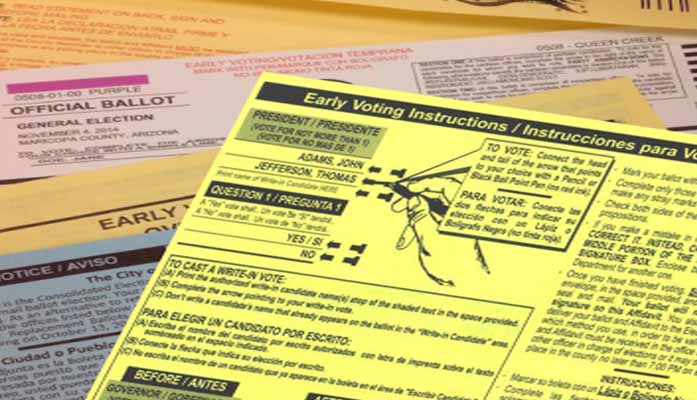
Under the Act, voters who receive their ballot by mail would still sign the voter affidavit section, but would also include their date of birth, In addition, the voter would need to include the last four digits of their social security number, Arizona driver’s license number, or state identification card.
“Arizonans show identification all the time in their daily lives to purchase alcohol, receive unemployment benefits, make major transactions, and board a plane, among others. Requiring identification before casting a ballot is necessary for our elections,” Vaughn said in announcing that the process got underway Monday.
Those interested in more information about the initiative can contact info@azvoterid.com.