by Jonathan Eberle | May 4, 2025 | News
By Jonathan Eberle |
Arizona Senate President Warren Petersen announced Wednesday that the state legislature has joined a coalition of 20 states in support of Idaho’s voter ID law, which prohibits the use of student IDs when registering to vote or casting a ballot. The move comes as the law faces an appeal in federal court.
The coalition, led by Arizona and Montana, filed an amicus brief with the U.S. Court of Appeals for the Ninth Circuit in the case of March for Our Lives Idaho v. Phil McGrane. The brief defends Idaho’s authority to establish its own voter identification requirements under the U.S. Constitution.
The challenged Idaho law, enacted in 2023, was designed to tighten election security by limiting acceptable forms of voter identification. Student IDs from high schools and higher education institutions are no longer valid under the new law. Two advocacy groups, including March for Our Lives, sued to block the measure, arguing it disproportionately impacts young voters. Although a lower court dismissed the case, it is now being appealed.
In their legal brief, the 20-state coalition argues there is no evidence the law violates the 26th Amendment, which prohibits age-based discrimination in voting rights. The states contend that Idaho’s law does not intentionally target young voters and that legislatures have broad constitutional authority to prevent election fraud before it occurs.
“Every state has an absolute right to implement voter ID laws through its legislature,” said Senate President Petersen. “Arizona has been at the forefront of this movement to ensure the integrity of our elections through voter ID requirements. Prevention is better than prosecution.”
Petersen emphasized that states should not be required to wait for fraud to occur before taking preventative steps. He praised Idaho’s approach and affirmed Arizona’s commitment to maintaining strict election standards.
Voter ID laws have been a source of national debate, with supporters saying they protect election integrity and opponents claiming they can disenfranchise voters, particularly younger and marginalized communities. Legal challenges continue to test how far states can go in setting identification rules without violating federal protections.
The Ninth Circuit Court’s decision in the Idaho case could have broader implications for other states with similar laws or those considering tightening voter ID requirements. No date has been set for oral arguments in the appeal.
Jonathan Eberle is a reporter for AZ Free News. You can send him news tips using this link.
by Jonathan Eberle | May 3, 2025 | News
By Jonathan Eberle |
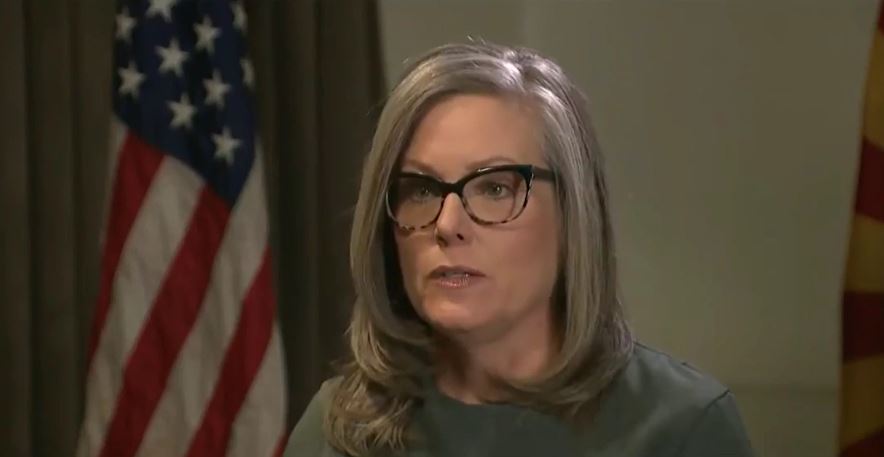
Arizona Governor Katie Hobbs announced Wednesday that two of her top health officials, AHCCCS Director Carmen Heredia and Department of Health Services Director Jennie Cunico, have resigned after it became apparent that the Republican-controlled state Senate would not confirm their appointments.
The resignations come amid a broader struggle between the governor’s office and the state Senate’s Director Nominations Committee, chaired by Republican Senator Jake Hoffman. The committee has become increasingly assertive in vetting Hobbs’ executive agency nominees, and in recent weeks signaled it would reject both Heredia and Cunico. Hobbs’ office said the resignations were necessary due to the Senate Majority’s unwillingness to confirm them.
“Today’s announcement is a testament to the important work being conducted on behalf of the citizens of Arizona by the Senate Committee on Director Nominations. I’m pleased Katie Hobbs saved herself, and AHCCCS Director Nominee Carmen Heredia, from the embarrassment of advancing her through the scheduled hearing this week,” said Senate Director Nominations Committee Chair Jake Hoffman. “Under Heredia’s direction, AHCCCS mismanaged the procurement process and improperly awarded contracts for healthcare services for thousands of elderly and physically disabled individuals enrolled in the Arizona Long Term Care System. A judge described the process as ‘arbitrary and capricious’ and recommended a full reset. Instead of responding to the feedback appropriately, Heredia basically told the judicial system to pound sand and moved forward with the contracts. Her refusal to provide transparency in this matter displayed nothing more than arrogance.”
“What’s even worse, Arizona is in the middle of a monumental Medicaid fraud crisis with a loss of more than $2 billion in taxpayer dollars,” continued Hoffman. “Under Katie Hobbs’ leadership, Heredia’s response has been incredibly disturbing, to say the least. Patients in sober living homes were evicted from facilities overnight after AHCCCS poorly executed suspensions of more than 300 providers. Many of these patients were mid-treatment, detoxing, or severely mentally ill and were dropped off on the streets with no identification or transportation. Legitimate providers were caught up in the mess without AHCCCS providing explanations or due process. Some are still waiting to be reinstated or reimbursed. We are left with a broken system due to Heredia’s mismanagement, and our vulnerable populations are caught up in this collapse.”
“Since its inception, the Committee on Director Nominations has been committed to honestly, thoroughly, and accurately vetting Katie Hobbs’ nominees. We have served as Arizonans’ last line of defense against incompetent, unqualified, and highly partisan picks to lead state agencies. We will continue to do the hard work the citizens of Arizona expect of us and will only approve competent, non-partisan individuals to serve in these critical roles,” stated Hoffman. “We look forward to Katie Hobbs sending us a sensible leader that will be able to rein in the abuse that has occurred at AHCCCS.”
Heredia, who led the Arizona Health Care Cost Containment System (AHCCCS) since early 2023, was credited by Hobbs with implementing sweeping reforms that led to nearly $1 billion in Medicaid fraud recoveries and savings over three years. She expanded access to care for working-class children, oversaw transitions to employer-sponsored insurance, and spearheaded behavioral health initiatives such as the Housing and Health Opportunities program.
However, Heredia’s leadership was the subject of fierce criticism from Senate Republicans. Senator Hoffman accused her of mismanaging Medicaid contracts and overseeing what he called a “broken system” during Arizona’s recent Medicaid fraud crisis. The Senate committee never formally held a confirmation hearing for Heredia, but it became clear she lacked the votes needed.
In her resignation letter, Heredia said, “It has become increasingly difficult to carry out this mission in good faith under the current political climate… Political theater has begun to outweigh sound policy.”
Cunico, a career public servant who transitioned from the Ducey administration also became ensnared in the Senate’s broader dispute over executive appointments. “It is clear to me that there is no path forward to confirmation,” Cunico said in her statement.
The latest resignations reflect a deepening power struggle between the Democratic governor and the Republican-led Legislature. Hobbs condemned what she called an “unprecedented politicization” of the confirmation process, warning that the climate in the Capitol is deterring qualified public servants.
“These resignations were not due to a failure in governance, but a failure in politics,” Hobbs said. “The people of Arizona deserve leaders who are judged by their performance, not their party.”
As the governor seeks replacements for both roles, it remains unclear how future nominees will fare in a process increasingly shaped by ideological divisions.
Jonathan Eberle is a reporter for AZ Free News. You can send him news tips using this link.
by Jonathan Eberle | Apr 30, 2025 | News
By Jonathan Eberle |
Arizona lawmakers have taken new steps to crack down on fraud in the state’s sober living home industry, with legislation sponsored by Senate Majority Whip Frank Carroll officially signed into law recently.
The new measure, SB 1308, strengthens the Department of Health Services’ (DHS) authority over sober living homes — facilities that provide housing for individuals recovering from substance use disorders. Under the law, DHS will now have enhanced powers to license, oversee, inspect, and penalize sober living homes that fail to comply with state and local regulations.
In recent years, Arizona has seen a surge in concerns surrounding sober living homes, many of which have operated without formal state oversight. Advocacy groups, city leaders, and recovery organizations have reported instances of fraud and abuse, raising alarms about the safety and wellbeing of vulnerable residents. Critics have also warned that lax oversight has allowed unscrupulous operators to exploit government-funded health care programs, leading to the misuse of taxpayer dollars.
“At long last, the state of Arizona has taken meaningful action to protect vulnerable individuals seeking refuge and recovery,” Carroll said in a statement following the bill’s signing. “Over the years, there have been many frightening stories about fraud and abuse at these homes thanks to the lack of regulation and licensing. This new law will protect the men and women residing at these homes, put bad actors on notice, and end the gravy train of taxpayer funds to those attempting to exploit the system for financial gain.”
Several cities and towns across Arizona backed the legislation, citing the urgent need for reform. Sober living homes have historically played a crucial role in the broader recovery ecosystem, offering safe, drug-free environments to individuals transitioning out of treatment programs. However, without clear regulatory standards, some facilities have drawn scrutiny for inadequate living conditions, improper billing practices, and even allegations of patient brokering — the illegal practice of referring patients to facilities in exchange for kickbacks.
SB 1308 aims to close regulatory loopholes by setting clear licensing requirements and enforcement mechanisms. Supporters of the legislation argue it will help restore trust in sober living homes and ensure taxpayer resources are used appropriately to support genuine recovery efforts. The new law takes effect later this year.
Jonathan Eberle is a reporter for AZ Free News. You can send him news tips using this link.
by Jonathan Eberle | Apr 29, 2025 | News
By Jonathan Eberle |
Arizona lawmakers have taken swift action to strengthen emergency mental health services for veterans suffering from post-traumatic stress disorder (PTSD). Governor Katie Hobbs signed SB 1163 into law earlier this month, a measure designed to allow U.S. Department of Veterans Affairs (VA) peace officers to directly assist veterans in crisis.
The legislation, sponsored by Senate Military Affairs and Border Security Committee Chairman David Gowan (R-LD19), grants VA peace officers the authority to take veterans into custody if they have probable cause to believe the individual is a danger to themselves or others due to a mental health disorder. Police officers may also apply for written or telephonic emergency admission evaluations, a legal requirement before an individual can be hospitalized for psychiatric care.
“It’s our duty to support the veterans who have served our country, and one way we can do so is by immediately providing the best possible care when they face mental health challenges,” Gowan said in a statement. He emphasized that the new law would help prevent tragedies by allowing veterans to access emergency services more quickly, without delays caused by waiting for civilian emergency personnel or navigating complicated legal processes.
The bill was approved overwhelmingly by both the Arizona Senate and House of Representatives, reflecting bipartisan agreement on the need to improve veteran mental health care. Gowan also credited Cpl. Charles Stalter, a veterans advocate, for bringing the issue to lawmakers’ attention.
According to the U.S. Department of Veterans Affairs, PTSD affects between 11% and 20% of veterans who served in operations such as Iraqi Freedom and Enduring Freedom. Mental health crises among veterans have been a growing concern nationally, with the VA reporting an average of 17 veteran suicides per day in 2021.
Under previous Arizona law, VA peace officers lacked the specific legal authority to initiate emergency mental health holds, even when faced with an obvious crisis. SB 1163 closes that gap, aligning Arizona with several other states that have empowered VA officers to take immediate action in mental health emergencies on VA property.
Supporters say the emergency designation for the bill — allowing it to take effect immediately upon the Governor’s signature — was necessary given the urgency of the mental health needs among the veteran population.
“This commonsense legislation ensures veterans won’t have to wait for help,” Gowan said. “It will save lives.”
The Arizona Department of Health Services and the Department of Veterans’ Services are expected to assist with implementation and coordination with VA facilities statewide.
Jonathan Eberle is a reporter for AZ Free News. You can send him news tips using this link.
by Jonathan Eberle | Apr 29, 2025 | News
By Jonathan Eberle |
In a bipartisan show of gratitude, the Arizona House of Representatives honored Major General Kerry L. Muehlenbeck last week for her decades of service to the state and nation. The ceremony, held on the House floor, also marked a new effort to support Arizona National Guard members currently deployed overseas.
Republican Representative Walt Blackman (R-LD7), a U.S. Army combat veteran and Chairman of the House Government Committee, led the recognition. Lawmakers from both parties signed a tribute to Muehlenbeck, who recently retired after more than 30 years of service, including her tenure as Commanding General of the Arizona National Guard and Director of the Arizona Department of Emergency and Military Affairs.
“Major General Muehlenbeck embodies everything we strive for in public service—courage, integrity, and a relentless commitment to those she leads,” Blackman said during remarks. “We thank her for her service and the legacy she’s leaving behind—a Guard that’s more prepared and more capable than ever.”
Muehlenbeck made history as the first woman to command the Arizona National Guard. House members praised her leadership through key operations such as border security missions, wildfire suppression efforts, and pandemic response initiatives. They also highlighted her parallel career in legal services and education.
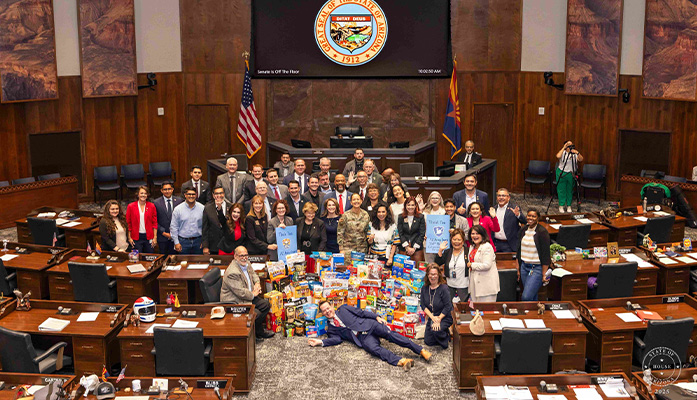
The tribute ceremony was accompanied by a large donation drive to benefit deployed service members. Representative Teresa Martinez (R-LD16) organized the collection of snacks, hygiene items, and personal care products, with contributions coming from House members, staff, and their families.
“We’re grateful to Representative Martinez for organizing this drive to support our men and women in uniform,” said Blackman. “The Guard follows leaders like General Muehlenbeck into some of the toughest assignments. This is one small way for us to send a piece of home to those currently serving abroad.”
Photos posted by the Arizona House GOP on X showed the House members presenting Muehlenbeck with the signed tribute while standing before a large display of care packages. The event drew praise online for its bipartisan spirit and for spotlighting the service and sacrifice of both senior military leaders and rank-and-file troops.
The tribute was signed by Representatives Walt Blackman, Teresa Martinez, Nick Kupper, Dave Marshall, John Gillette, Stacey Travers, Aaron Márquez, and Mae Peshlakai. A copy of the tribute, photos of the ceremony, and images of the donated supplies were made publicly available following the event.
Jonathan Eberle is a reporter for AZ Free News. You can send him news tips using this link.