By Staff Reporter |
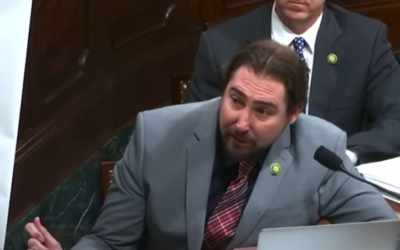
The first bill introduced by Rep. Abe Hamadeh (R-AZ08) following his reelection aims to prohibit federal funding for human euthanasia.
The Protecting Vulnerable Patients, Seniors, and Families Act, H.R. 10982, would prohibit federal funding for hospitals and other medical entities who facilitate the euthanasia administration, whether clinical or self-administered, of lethal drugs intended to end an individual’s life.
Hamadeh explained in a press release that he was moved to introduce the legislation after reading about the case of Brigitte “GG” Stegemann, an 83-year-old Canadian woman who was euthanized through Canada’s assisted suicide program.
Leading up to her death, Stegemann had reportedly rejected medical assistance in dying on the basis of her Christian faith. Brigitte Kranendonk, Stegemann’s granddaughter and power of attorney, maintains that Stegemann, who was in cognitive decline and allegedly unable to advocate for herself, was tricked by medical staff into accepting medical assistance in dying.
Stegemann’s death remains under investigation.
Hamadeh added that he is committed to protecting Americans from a reality where rising healthcare costs would justify “extermination” instead of medical treatment.
“Despite expressing regret about entering Canada’s euthanasia program just prior to her death, Ms. Stegemann was ruthlessly slain by bureaucrats, whose only concern was cutting costs,” said Hamadeh. “As American healthcare costs continue to rise, death should never be an easy go-to alternative for care, treatment, or support.”
The Protecting Vulnerable Patients, Seniors, and Families Act would also prevent taxpayer dollars from supporting assisted suicide; protect patients’ rights to decline medical treatment, including during end-of-life care; and preserve patient autonomy and informed consent in medical decision-making.
Significantly, the bill would preserve the right for states to impose the death penalty by establishing a narrow exception for lawful death sentences imposed for capital crimes.
The practice of medical suicide is known by different names in the U.S. and in other countries, such as medical aid in dying, medical assistance in dying, assisted suicide, physician-assisted suicide, and assisted dying.
13 states and Washington, D.C. permit medical aid in dying: California, Colorado, Delaware, Hawaii, Illinois, Maine, Montana, New Jersey, New Mexico, New York, Oregon, Vermont, and Washington.
Since the first state legalized assisted suicide, more than 14,400 Americans at minimum have died through medical aid in dying according to annual state data collected by Aging with Dignity.
Reports reflect that several states have never released annual data or haven’t released recent years of data on assisted suicide, including Montana, Vermont, and Washington, D.C.
While Arizona has not yet legalized assisted suicide, Arizona Democrats have attempted to change that since 2003. With Democrats controlling the governor’s office and taking over the majority of the House and Senate for the first time in 60 years, assisted suicide may pass the legislature.
The most recent bill to legalize assisted suicide, HB 2569, was introduced earlier this year as cosponsored by the House speaker-elect, Rep. Oscar De Los Santos (LD11), and the House majority leader-elect, Rep. Nancy Gutierrez (LD18).
Another bill to legalize assisted suicide, SB1530, was introduced in 2024 and cosponsored by the Senate president-elect, Sen. Priya Sundareshan (LD18). Sen. Christine Marsh (LD5), Senate majority leader-elect, cosponsored legalization of assisted suicide in 2023 through SB1646.
Gov. Katie Hobbs has been identified as a supporter of assisted suicide, according to the assisted suicide advocacy group Arizona End-of-Life Options.
AZ Free News is your #1 source for Arizona news and politics. You can send us news tips using this link.