By Ethan Faverino |
Congressman Andy Biggs (R-AZ-05) joined dozens of members of Congress in filing an amicus brief with the U.S. Supreme Court in a case involving an Orthodox Jewish man who was ordered by local officials to stop hosting prayer gatherings in his Ohio home without zoning approval.
The brief, filed in Grand v. City of University Heights, supports Daniel Grand in his legal challenge against University Heights, Ohio, and argues that protections under the Religious Land Use and Institutionalized Persons Act of 2000 (RLUIPA) allow individuals to seek relief in federal court once government action substantially burdens their religious exercise.
The dispute dates back to 2021, when Grand sought to host an informal Jewish prayer group at his home. City officials sent Grand a cease-and-desist letter after learning about the gatherings, maintaining that the use required approval under the city’s zoning rules.
Grand applied for a special-use permit but later withdrew the application.
According to Biggs’ office, Grand learned during the process that obtaining approval as a house of worship would require his family to move out of the residence.
Grand subsequently sued the city and several officials, raising claims under RLUIPA and the First and Fourteenth Amendments, among other federal and state claims.
The U.S. Court of Appeals for the Sixth Circuit affirmed the dismissal of several of Grand’s claims as unripe, concluding that he had withdrawn his permit application before the city reached a final decision.
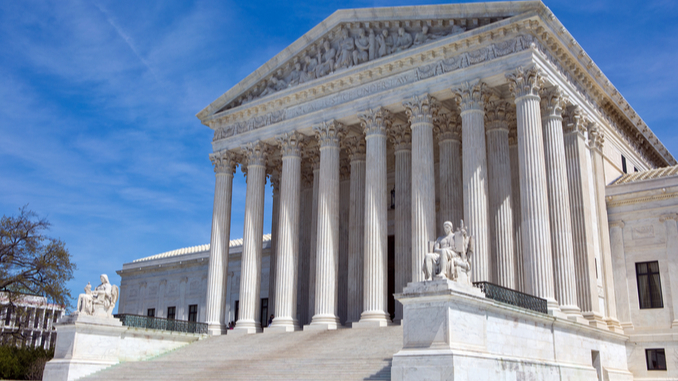
The Supreme Court agreed to hear the case, with oral arguments scheduled for December 9, 2026.
Biggs said the case raises broader questions about constitutional protections for religious exercise and the ability of local governments to regulate religious activity through zoning laws.
“Religious liberty was one of the foundational principles our Founders sought to protect when establishing our constitutional system of government,” stated Biggs. “The First Amendment and subsequent federal laws have protected generations of Americans in the free exercise of their faith without government intrusion or interference.”
“No local government should be permitted to undermine or eliminate that fundamental right,” added Biggs. “I am honored to stand with Daniel Grand in his fight to freely exercise his religion within his own home, just as our Founders intended.”
At the center of the case is RLUIPA, a federal law unanimously passed by Congress in 2000 that provides protections for religious exercise in certain land use and institutional settings.
Among other provisions, the law prohibits governments from imposing or implementing land-use regulations that substantially burden religious exercise unless the government can satisfy the statute’s requirements.
RLUIPA also directs courts to construe the law broadly in favor of protecting religious exercise.
The congressional amicus brief argues that the lower courts imposed an additional requirement not contained in the statute by requiring Grand to obtain a final zoning decision before pursuing his RLUIPA claim.
According to lawmakers, Congress designed RLUIPA to make it easier for individuals and religious organizations to challenge government actions burdening religious exercise, particularly in disputes involving local land-use decisions.
“Congress designed RLUIPA to enhance—not restrict—religious freedom,” the lawmakers wrote. “Courts that impose an atextual finality requirement turn that design on its head.”
The brief traces RLUIPA’s origins to earlier Supreme Court decisions concerning the Free Exercise Clause and Congress’ subsequent attempts to establish stronger statutory protections for religious exercise.
The lawmakers argue that Congress specifically intended the law to address problems involving local zoning decisions affecting churches, synagogues, home prayer meetings, and other forms of religious exercise.
They also contend that requiring individuals to complete potentially lengthy local zoning proceedings before going to federal court can leave them subject to the disputed restrictions for months or years.
The brief cites previous cases involving religious organizations in Michigan and California in which courts required additional local zoning proceedings before federal religious liberty claims could move forward.
The lawmakers maintain that RLUIPA instead permits a claim once a government imposes a substantial burden on religious exercise and the ordinary requirements for federal court jurisdiction are satisfied.
The Supreme Court’s eventual ruling could clarify when a RLUIPA land use dispute is sufficiently developed for a federal court to hear it and whether a claimant must first obtain a final decision from local zoning authorities.
Ethan Faverino is a reporter for AZ Free News. You can send him news tips using this link.