By Ethan Faverino |
Congressman Abraham Hamadeh (R-AZ-08) announced that he has begun work on the BRRRRT Act (Bolstering Recognition, Resurgence, Retention, and Remembrance of the Thunderbolt) to ensure U.S. troops on the front lines continue to receive the most effective and lethal close air support available.
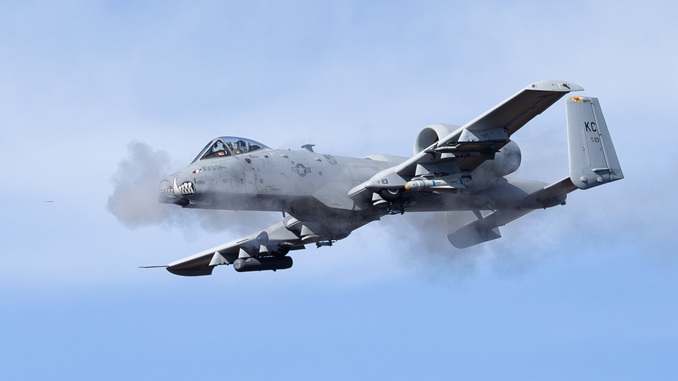
The legislation aims to reinforce the iconic A-10 Thunderbolt II, also known as the “Warthog,” whose distinctive sound has long provided reassurance to ground forces under fire. Hamadeh quoted one soldier, who called it, “One of the most terrifying yet beautiful sounds ever heard.”
Earlier this week, at the request of President Donald Trump and Defense Secretary Pete Hegseth, the Secretary of the Air Force announced that the Air Force will extend the A-10 Thunderbolt II through 2030. The service plans to keep two squadrons flying through that date: one active-duty squadron at Moody Air Force Base and one reserve squadron at Whiteman Air Force Base.
Congressman Hamadeh’s BRRRRT Act would build upon and strengthen this extension by:
- Reinforcing the 2030 timeline and increasing the minimum number of A-10s required in the operational inventory.
- Supporting robust training and sustainment pipelines for the platform.
- Requiring that certain retired A-10s be preserved in rapidly recoverable conditions at the AMARG boneyard in Arizona to enable future surge capacity.
- Directing an evaluation of retaining additional A-10s in Air Force Reserve and Air National Guard wings.
- Examining the feasibility of selling or transferring A-10s to foreign partners, including through shared sustainment arrangements.
The bill would also mandate a comprehensive report to congressional defense committees on the A-10’s combat legacy. The report will cover the aircraft’s employment from Operation Desert Storm through current operations and analyze lessons learned for future close air support doctrine. Topics would include pilot training, weapons integration, battlefield communications, and air-ground integration.
Specifically, the legislation directs the Air Force to assess how elements of the A-10 mission set, command-and-control methods, and operational experience could inform emerging close air support concepts, such as human-machine teaming, autonomous collaborative aircraft, counter-drone operations, AI-enabled mission planning and targeting, digital battlefield communications, and distributed air-ground integration.
“As a former U. S. Army Intelligence officer, I know that the arrival of the A-10 creates the most beautiful sound ever heard by troops under fire on the battlefield,” stated Congressman Hamadeh, who oversees fighter platform programs on the House Armed Services Committee Subcommittee on Tactical Air and Land Forces. “For too long, the military industrial complex has pushed newer, not better, leaving our troops at risk by retiring the great Warthog. The A-10 is proof that newer isn’t always better and price has nothing to do with performance.”
Ethan Faverino is a reporter for AZ Free News. You can send him news tips using this link.