By Matthew Holloway |
Goldwater Institute attorneys urged the Arizona Supreme Court on Tuesday to allow Arizona State University (ASU) professor Owen Anderson to pursue his lawsuit alleging that the school’s “Inclusive Communities” employee training violated state law.
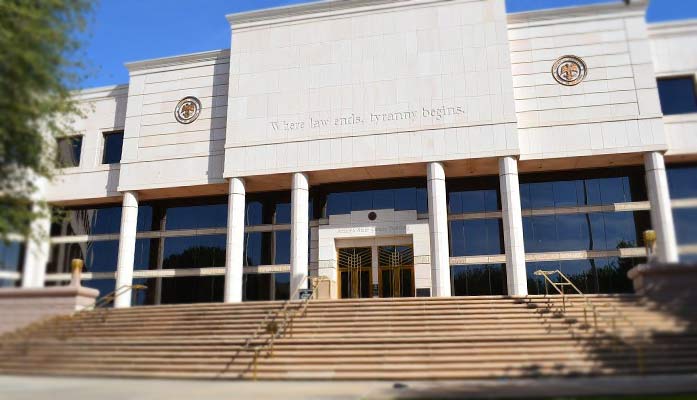
During oral arguments in Arizona Board of Regents v. Anderson, Goldwater Institute Vice President for Litigation Jon Riches argued that the Arizona Court of Appeals applied the wrong legal analysis when it concluded that Anderson had no implied private right to enforce the statute in court.
“Where there is a legal right, there is a legal remedy, is one of the oldest maxims in Anglo-American law,” Riches told the justices. “For decades, this court has applied that principle to find implied causes of action where a statute does not expressly create them. Yet without citing a single one of this court’s cases, the lower court did exactly what this court commanded it not to; it treated legislative silence as dispositive as to whether a statute creates a cause of action. But as this court [has held], legislative silence begins rather than ends the inquiry.”
In a post to X on Tuesday, Anderson invoked the legal maxim in Latin, writing, “‘ubi jus ibi remedium’ if there is a right there is a remedy. A cornerstone principle of common law. Yet @ASU and @AZRegents are asking the @AZCourts to suspend this principle and keep me as an employee from holding them responsible for racist DEI training.”
Anderson also shared a clip from the hearing in which Justice Clint Bolick characterized the right-remedy maxim as “the indispensable common law principle” and invoked Chief Justice John Marshall’s discussion of the principle in the landmark 1803 decision Marbury v. Madison.
Following the hearing, Anderson posted a statement saying, “That was an excellent hearing today before the @AZCourts. Jonathan Riches for @GoldwaterInst presented a solid case. The Justices asked the @AZRegents lawyer questions that exposed the contradiction at the heart of their claims, with their lawyer at one point stumbling so badly as to say, ‘I forgot the question.’ Oops! Now we wait for a decision.”
The Supreme Court limited its review to whether the Court of Appeals failed to apply the factors established in the court’s 1988 Transamerica Financial Corp. v. Superior Court decision before finding that A.R.S. § 41-1494 provides no implied private right of action.
Those factors include the statute’s context and language, its subject matter, its effects and consequences, and the law’s overall purpose. Riches argued that the lower court improperly treated the Legislature’s silence about a private cause of action as conclusive instead of beginning the broader analysis required under Transamerica.
The Arizona Board of Regents asked the justices to uphold the appellate ruling. In its supplemental brief to the Supreme Court, the board argued that courts should begin with the statutory text and consider secondary factors such as legislative history, consequences, and purpose only when the text is ambiguous.
The board maintained that § 41-1494 regulates government conduct without creating a private right or remedy. It also pointed to the statute’s annual compliance-reporting requirement and argued that lawmakers left enforcement to elected officials. The board said nearly all surrounding statutes contain express private rights of action, indicating that the Legislature deliberately omitted one from § 41-1494.
The statute prohibits the state, its agencies, and political subdivisions from requiring employees to undergo training, orientation, or therapy that presents blame or judgment based on race, ethnicity, or sex. It also prohibits the use of public money for such training and directs the Arizona Department of Administration to submit an annual compliance report to the governor and legislative leaders.
Anderson’s case began after ASU informed employees in October 2022 that they were required to complete its “Inclusive Communities” training. Anderson, a philosophy and religious studies professor, filed suit against the Board of Regents in 2024, seeking declaratory and injunctive relief.
Anderson alleges that the training presented prohibited concepts involving race, sex, and identity. His court filings cite training materials discussing “whiteness,” white supremacy, heterosexual privilege, land acknowledgments, and efforts to “decolonize the university.” The accompanying examination identified designated answers concerning systemic bias, transformative justice, and the incorporation of diversity, equity, inclusion, and belonging throughout the university.
A Maricopa County Superior Court judge found that the statute contained no express private cause of action but concluded that it implied one for employees subjected to prohibited training. The Arizona Court of Appeals reversed that decision in December, finding that the statute “unambiguously does not create a private right of action.”
The Court of Appeals left Anderson’s underlying allegations about the training unresolved. The Supreme Court’s current review also concerns the enforcement question rather than whether the content of ASU’s training violated § 41-1494.
The Board of Regents has disputed that the training was mandatory. Anderson said the alleged injury arose from being required to undergo the training.
“Well, I think the hurt is in taking the training, and so I would ask them to consider it from their perspective if they were asked to sit through hours of training that involved racial discrimination against a group they identify with, they would be offended by that and feel hurt,” Anderson said. “So the hurt — the consequence — is just in the fact that I had to sit through that.”
Anderson previously asked the Supreme Court to accept the case after the appellate ruling, arguing that public employees would otherwise lack an effective way to enforce the training prohibition. Goldwater’s petition sought recognition of an implied private cause of action allowing employees to challenge alleged violations by government employers.
The Supreme Court took the case under advisement following Tuesday’s arguments. Anderson said that he intends to proceed toward trial if the justices recognize his right to bring the claim. The court has not announced a deadline for its decision.
Matthew Holloway is a senior reporter for AZ Free News. Follow him on X for his latest stories, or email tips to Matthew@azfreenews.com.