By Matthew Holloway |
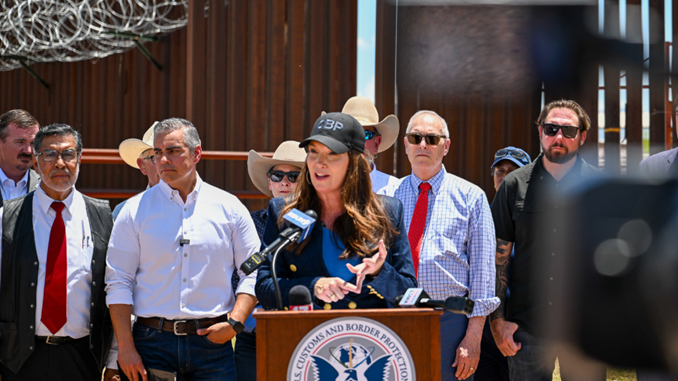
U.S. Agriculture Secretary Brooke Rollins announced a $25 million federal investment to build a sterile fly dispersal facility in Arizona. She made the announcement during a visit to the Douglas Port of Entry with Reps. Juan Ciscomani (R-AZ-06), Andy Biggs (R-AZ-05), and Eli Crane (R-AZ-02) ahead of the planned resumption of livestock imports from Mexico.
Rollins toured the port’s livestock inspection facilities Wednesday with Ciscomani, Biggs, Crane, and Arizona Department of Agriculture Director Paul Brierley. The Department of Agriculture plans to reopen the Douglas crossing to cattle imports on Aug. 24 as the first stage of a phased reopening of southern livestock ports.
During the visit, Rollins announced that the U.S. Department of Agriculture (USDA) would invest $25 million toward establishing a sterile fly dispersal facility in Arizona as part of the federal response to New World screwworm.
“Protecting American agriculture begins with protecting our borders and ensuring we have the strongest animal health safeguards anywhere in the world,” Rollins said. “The Douglas Port of Entry will reopen only because USDA has implemented one of the most rigorous livestock inspection protocols in history, giving us confidence we can safely resume this critical trade while ensuring cattle crossing the border are free from New World screwworm.”
Rollins said the facility would strengthen the infrastructure needed to push the pest back into Mexico and ultimately eradicate it from North America.
Ciscomani said Arizona livestock producers and agricultural leaders had pressed the department to establish a sterile fly facility in the state.
“Local agriculture leaders and I have been fighting to deliver this sterile fly dispersal facility because Arizona’s livestock industry cannot afford to wait on the New World screwworm threat,” Ciscomani said. “This $25 million investment is the direct result of that work, and I’m grateful to Secretary Rollins for listening to Arizona’s producers and delivering on it.”
The Douglas crossing was selected as the first port to reopen because the USDA considers Sonora among the Mexican states presenting the lowest screwworm risk, citing its animal-health inspection system and distance from the areas of southern Mexico where most cases are concentrated. The department said the closest active case to the Douglas port was approximately 325 miles away as of July 22.
The reopening remains contingent on Mexico’s compliance with a joint federal action plan and continuing USDA risk assessments. Following an evaluation of operations in Douglas, the department will consider reopening livestock crossings at Santa Teresa and Columbus, New Mexico.
Every animal imported through Douglas will receive multiple veterinary examinations, including an inspection by USDA veterinarians before entering the United States. Animals that fail to satisfy federal import requirements will be denied entry, and the discovery of New World screwworm would immediately halt imports through the port.
The USDA described the Arizona dispersal center as a proposed facility and said it would work with state officials to determine its specific location and operating plan in the Douglas area. The department said construction could be completed in as little as several months, depending on the selected site and available infrastructure.
Cochise County officials have proposed placing the center at Bisbee-Douglas International Airport, about eight miles from Douglas. The county has promoted the airport as a potential site because of its proximity to the border, transportation infrastructure, available land, and location in a less-populated area.
A previous USDA sterile fly facility operated near Douglas from 1963 until 1983. The former facility was located at Douglas Municipal Airport, approximately two miles from downtown.
Biggs led a June letter to Rollins urging the USDA to include Arizona in its long-term screwworm prevention and response strategy. The letter was signed by Crane, Ciscomani, and Reps. Paul Gosar (R-AZ-09) and Abraham Hamadeh (R-AZ-08) and identified the historic Douglas sterile fly facility site as a strategically valuable location for future production capacity.
New World screwworm is a parasitic fly whose larvae feed on the living tissue of warm-blooded animals, causing severe wounds that can become fatal. The pest can affect livestock, pets, wildlife, and, in rare cases, people. The USDA confirmed the first animal case in the current U.S. outbreak in a Zavala County, Texas, calf on June 3. Additional cases have since been confirmed in Texas and New Mexico, while Arizona has reported no confirmed cases.
The United States eradicated New World screwworm in 1966 through the sterile insect technique. The method releases sterilized male flies into affected areas. Female screwworm flies that mate with sterile males produce no offspring, reducing the wild population over successive generations.
The USDA said federal and state personnel have maintained trapping operations near Douglas during the past year. Nearly 1,000 captured flies were submitted for scientific testing, and none were identified as New World screwworm.
State Rep. Lupe Diaz (R-LD19), chairman of the Arizona House Land, Agriculture and Rural Affairs Committee, also attended the event and praised the federal investment and reopening plan.
“The port reopening demonstrates that we can protect American agriculture while responsibly restoring commerce through this vital trade corridor,” Diaz said. “USDA’s science-based approach includes multiple layers of inspection and strict federal oversight.”
Arizona’s fiscal year 2027 budget allows the state Department of Agriculture to use up to $250,000 from the Commercial Feed Trust Fund for two full-time-equivalent positions. One is designated for expenses associated with the screwworm response. The department may conduct border inspections as part of that response if the border opens for live cattle imports, and the state veterinarian may oversee the response. The second position is designated for expenses involving foreign animal diseases or pests, USDA program diseases, zoonotic diseases, and other emerging animal-disease responses.
“The new sterile fly distribution center at Bisbee-Douglas International Airport is another major step forward,” Diaz said. “It will serve Arizona, New Mexico, Nevada, and California, giving western states a critical regional resource to combat the New World screwworm and protect our livestock industry.”
Matthew Holloway is a senior reporter for AZ Free News. Follow him on X for his latest stories, or email tips to Matthew@azfreenews.com.