By Anna Van Hoek |
At the May 5 Higley Unified Governing Board meeting, the Board approved a lease agreement with AZ Aspire Academy to utilize a portion of Power Ranch Elementary.
I think it’s a good thing that the district is looking for ways to generate additional revenue from unused space. When enrollment is declining and budgets are getting tighter, we should absolutely be looking for creative ways to make better use of district assets.
But let’s be honest: leasing a portion of one building doesn’t solve the bigger problem.
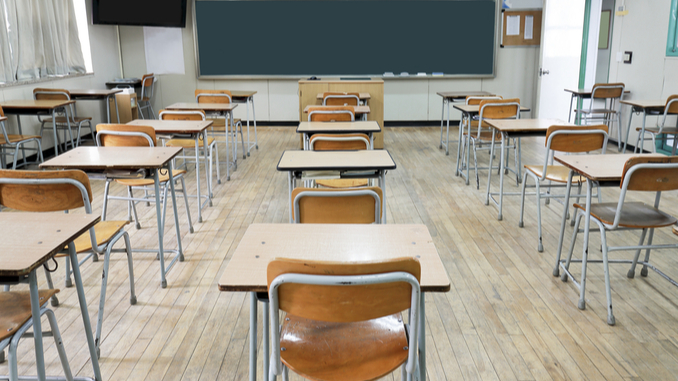
Higley currently has more than 10,200 vacant seats sitting empty across our schools. Several campuses are operating at less than half of their physical capacity. Power Ranch is only about 32% utilized. Centennial is around 31%. Cortina, Chaparral, and Cooley Middle are all below 50%.
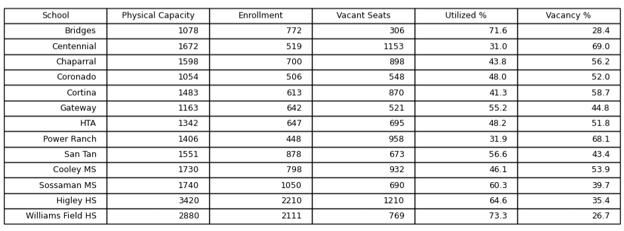
While we are making difficult budget and staffing adjustments because enrollment is declining, we have not had the same level of discussion about what it costs taxpayers to maintain thousands of unused seats.
Those numbers should prompt a serious conversation about how we plan for the future.
Every building costs money to operate whether it’s full or half empty. We still pay for utilities, maintenance, landscaping, repairs, insurance, security, and countless other expenses. The cost doesn’t disappear just because the students do.
At the same time, enrollment continues to decline.
For FY2027, Higley is projecting ADM of approximately 11,250 students, down from 11,695 in FY2026. As enrollment drops, so does funding. The district’s M&O budget limit is projected to decline from approximately $118.9 million to $111.5 million, a reduction of more than $7 million in a single year.
Because school funding is largely driven by student enrollment, staffing levels must eventually align with the number of students being served. The district has already reduced M&O-funded staffing from approximately 1,243 positions to about 1,203. While these reductions are difficult, they are a necessary response to declining enrollment and reduced revenue. The district’s maintained M&O reserve is projected to fall from approximately $17 million to about $13 million.
Yet despite making these necessary adjustments in staffing and operations, we continue carrying the costs associated with significant excess building capacity.
We also cannot forget that taxpayers are still paying approximately $3.5 million annually for the two middle schools. Those payments will continue for roughly the next 27 years. Whether a building is full or half empty, the debt payment remains. That makes it even more important that we have a long-term strategy for utilizing our facilities efficiently and aligning them with current enrollment realities.
This isn’t just happening in Higley. A recent report from the Common Sense Institute, Echoes in the Halls: Arizona School Districts’ Growing Problem with Empty Buildings and Empty Buses, highlighted a growing statewide challenge. School districts across Arizona built facilities during years of rapid growth and are now struggling with declining enrollment while taxpayers continue paying to maintain underutilized schools.
The report should serve as a wake-up call.
Too often, whenever school funding is discussed, the conversation immediately turns to needing more money. Before asking taxpayers for more, we should make sure we are using existing resources as efficiently as possible.
As board members, our responsibility is not simply to spend money. Our responsibility is to ensure taxpayer dollars are being used wisely and producing the best possible outcomes for students.
That means asking difficult questions:
- What is the district’s long-term plan for aligning facilities with enrollment trends?
- Are there additional opportunities to lease unused space?
- Are there community partnerships we should pursue?
- Are there alternative educational or community uses for underutilized facilities?
- How can we maximize the value of existing facilities while minimizing unnecessary costs to taxpayers?
- What is Higley going to do with the vacant land voters approved to sell or lease?
These are not easy discussions. But avoiding them doesn’t make the problem go away.
The district currently maintains approximately $13 million in M&O reserves and nearly $6.5 million in capital carryforward. Those reserves provide stability, but they are not a substitute for long-term planning. If enrollment continues to decline, reserves alone will not solve the challenge of maintaining significant excess capacity.
Taxpayers deserve a district that plans ahead instead of reacting after the fact. They deserve transparency about enrollment trends, building utilization, and long-term costs.
The lease approved on May 5 is a positive step. It brings in revenue and puts some unused space to productive use. But one lease agreement is not a long-term facilities strategy.
I believe the next step is for the district to begin a formal long-range facilities planning process. Whether through a board committee, community task force, or strategic planning effort, we need to start having honest discussions about enrollment trends, facility utilization, future land use, and the long-term costs associated with maintaining excess capacity.
The goal should not be to predetermine outcomes. The goal should be to develop a thoughtful 10-year plan that aligns our facilities with the students we serve and the resources available to support them.
Those conversations should happen before circumstances force decisions upon us.
Most importantly, taxpayers deserve confidence that every possible dollar is being directed toward students rather than maintaining excess capacity.
The goal isn’t to preserve buildings. The goal is to educate students and use taxpayer dollars wisely in support of that mission.
When we keep that priority in mind, the path forward becomes much clearer.
Anna Van Hoek is a member of the Higley Unified Governing Board and is seeking re-election in 2026.