Arizona legislative Republicans are again standing with state attorneys general over an issue of national importance.
This week, both the Arizona State House and Senate Republican Caucuses announced that Speaker Ben Toma and President Warren Petersen had joined a letter to President Joe Biden, “urging (the administration) to either enforce our immigration laws and protect our southern border or get out of the way so Texas can.”
🚨 FOR IMMEDIATE RELEASE: Arizona Senate Republicans Stand in Solidarity with Texas' Efforts to Defend Itself Against Biden's Border Invasion@votewarren@ShawnnaLMBolick@AZSenatorShamp ⬇️⬇️⬇️
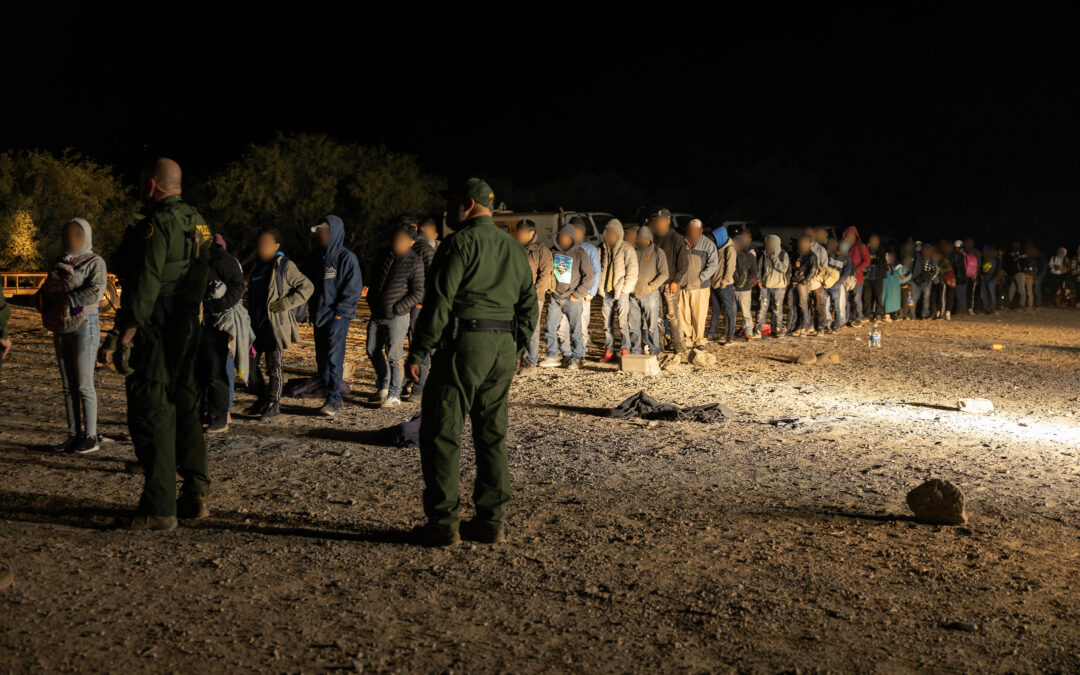
The letter to the White House follows an escalating disagreement between Texas state officials and the Biden Administration over enforcement of laws and allocation of resources pertaining to illegal immigration into that state. Both sides are looking to the Supreme Court of the United States to adjudicate this politically volatile dispute.
“Arizona is overwhelmed from the same dangers brought on by this invasion as Texas. Biden is literally dismantling our nation as we know it, allowing known terrorists and criminals to enter through our southern border with no consequences,” said President Petersen. “Since our Attorney General is not pushing back against the lawlessness Biden is promoting by working to destroy the border barriers Governor Abbott has built, the Legislature must speak out and stand in solidarity to support our neighbors.”
“Texas has every right to defend itself from the unprecedented flow of illegal immigration, drug trafficking, and countless threats at our southern border because of President Biden’s willful refusal to protect this nation,” said Speaker Ben Toma. “I stand with Governor Abbott and call on Governor Hobbs to follow his lead and invoke Arizona’s constitutional right to defend itself.”
“Texas has every right to defend itself from the unprecedented flow of illegal immigration, drug trafficking, and countless threats at our southern… pic.twitter.com/NP13xTfWzg
The letter that Petersen and Toma co-signed was led by the States of Iowa and Utah and joined by Alabama, Alaska, Arkansas, Florida, Georgia, Idaho, Indiana, Kansas, Kentucky, Louisiana, Mississippi, Missouri, Montana, Nebraska, New Hampshire, North Dakota, Ohio, Oklahoma, South Carolina, South Dakota, Tennessee, Virginia, West Virginia, and Wyoming.
In their letter, the attorneys general and legislators write, “The federal government should be working to stop this crisis, but it is not. And the Constitution’s Guarantee Clause requires that the federal government do so. It must ‘protect each [State] against invasion.’ But it has abandoned its duty. Nothing in the Constitution stops Texas from stepping up and doing its part to protect itself, and in so doing also protecting States across the country. To those that contend this power belongs only in Congress, they should take that up with Speaker of the House Mike Johnson, who stands with Texas. By following the Constitution, Texas is doing what the federal government has failed to do.”
Over the past few months, the two Republican legislative leaders have signaled a more aggressive shift in taking the reins from Arizona Attorney General Kris Mayes to defend the law and Constitution. Attorneys general are not usually joined by outside parties on their amicus briefs or letters, yet multiple coalitions of Republican state prosecutors have included Petersen and Toma on several major filings. In previews for the 2024 legislative session, both the House and Senate Majority Caucuses indicated more of these efforts are to be expected throughout this year.
Daniel Stefanski is a reporter for AZ Free News. You can send him news tips using this link.
China’s National Development and Reform Commission (NDRC) recently announced a new program in which the Xi Jinping government will subsidize the building of new coal-fired electricity generation plants. Part of an effort to ensure power grid reliability and stability into the future, NDRC’s notice says the program will commence January 1, 2024.
The program will enable new coal-fired power plants to recover about 30% of their capital costs in just the first two years of operation. The government subsidies will be funded from tariffs directed to operators of coal-fired plants by the country’s various electricity grids, using monies collected from commercial and industrial users.
The new program is just another proof point that China is continuing to increase the pace of expansion of its coal-fired power sector as time goes on. Indeed, a report released earlier this year by Global Energy Monitor and the Centre for Research on Energy and Clean Air (CREA) showed China permitted more coal-fired power plants in 2022 than it had since 2015, and has six times more coal-fired power plants under construction currently than the rest of the world combined.
Meanwhile, as the Xi government continues its massive expansion of coal-fired electricity to ensure grid reliability, the Biden government in the U.S. remains intent on destroying its own coal sector. The Institute for Energy Research (IER) notes that this effort is being underwritten by liberal billionaire philanthropists like former Democrat presidential candidate and New York City Mayor Michael Bloomberg, who has now pledged $1 billion from his personal fortune to, as he put it, “finish the job on coal.”
In September, Bloomberg Philanthropies stated, “With 372 of 530 coal plants announced to retire or closed to date—more than 70 percent of the country’s coal fleet—this next phase will shut down every last U.S. coal plant.” The effort also targets cutting natural gas-fired generation capacity by half, and would block any new plants from being built in the future. Noting that coal and natural gas power plants account for 98% of U.S. plant closures during 2023, IER points to the fact that the federal government’s forcing of those closures is now negatively impacting reserve margins on the nation’s power grids.
Until the recent hyper focus on cutting atmospheric carbon dioxide, it was customary for grid managers to work to maintain a reserve of up to 20% of total dispatchable generating capacity to be available to come online during severe weather conditions and other instances during which demand threatens to overwhelm supply. Grid managers are finding it increasingly difficult to avoid blackout conditions as grids become increasingly overwhelmed by intermittent, unpredictable wind and solar capacity at the expense of reliable dispatchable baseload.
The problem of lack of dispatchable reserves was highlighted in a deadly way in Texas during February 2021’s Winter Storm Uri, a series of three severe cold fronts that froze most of the state for almost a week, leading to blackouts in which an estimated 300 Texans died. In the storm’s wake, the legislature and regulators identified a series of issues on the grid and at grid manager ERCOT that needed correcting, many of which were dealt with in that year’s legislative session.
But the grid’s shortage of dispatchable thermal capacity – a long-known issue – was left unresolved that year. The 2023 legislature enacted a ballot proposal (Proposition 7) creating a fund to subsidize the rapid building of up to 10 GW of new natural gas generation capacity in the coming years. It is exactly the opposite approach being pushed by the Biden government and its political funders in the climate alarmist community, like Bloomberg.
Texas voters overwhelmingly approved Proposition 7 in the November 7 election. In doing so, Texans rejected the notion that their state, which produces more natural gas than all but two other countries, should ever be subjected to an unreliable, unstable power grid that causes hundreds of deaths during weather emergencies.
Sadly, Americans living in other parts of the country will remain saddled with the destructive Biden approach, with little hope for anything improving until at least 2025.
David Blackmon is a contributor to The Daily Caller News Foundation, an energy writer, and consultant based in Texas. He spent 40 years in the oil and gas business, where he specialized in public policy and communications.
The Arizona desert’s classic dry heat should now qualify as an “extreme heat,” according to Democratic lawmakers and leadership.
Rep. Ruben Gallego (D-AZ-03) is lobbying for more federal funding to counter the desert heat. Democrats at all levels have recharacterized summer temperatures as “extreme heat” in an attempt to pull more funding for a variety of progressive initiatives ranging from climate change to social justice. Trending usage of the word “extreme heat” has increased dramatically over the past 20 years, spiking with increased regularity every summer.
In a press release, Gallego commended President Joe Biden for increasing heat-related worker protections on Thursday. As part of the changes, Biden met with Phoenix Mayor Kate Gallego, the congressman’s ex-wife, and San Antonio, Texas Mayor Ron Nirenberg. Yet, those changes fell short of Rep. Gallego’s ultimate goal: he urged the Biden administration to go one step further by classifying heat as an emergency.
“Far too many people are dying or falling ill from these extreme temperatures,” said Rep. Gallego. “[M]ore must be done. We need a swift, immediate deployment of resources, and that requires FEMA declaring extreme heat as an emergency. I will continue pushing the administration and Congress to get that done.”
I'm thankful the admin is heeding our call with these meaningful steps to protect Arizonans from extreme heat. But more must be done. We need FEMA to declare extreme heat an emergency. I'll keep pushing the administration and Congress to get that done.https://t.co/kKlpEHn8Wy
Both Gallegos have worked together to lobby the federal government to declare summer heat as an emergency.
During her annual state of the city address in April, Mayor Gallego petitioned the Federal Emergency Management Agency (FEMA) to qualify extreme heat as a disaster by adding the regular seasonal occurrence to its national emergency declarations categorization.
A FEMA recognition would bring in more federal funding. The city has a number of heat mitigation projects that would likely benefit from such funding, like the manufactured shade and drinking water access areas known as “cool corridors,” which are determined on an equity basis, and the special sunlight reflective streets known as “cool pavement.” (Which, as AZ Free News reported, actually makes people hotter). Those initiatives were unique creations under Mayor Gallego’s administration.
Mayor Gallego was also responsible for the creation of one of the first heat mitigation offices within city government: the Office of Heat Response and Mitigation (OHRM). The city established the office with $2.8 million in 2021, with the explicit attempt to combat urban heat: the theory that urbanization causes higher temperatures.
Presently, the OHRM doles out COVID-19 relief federal funding provided by the American Rescue Plan Act (ARPA) for annual heat relief grants. These grants are earmarked for nonprofit, charitable, small business, and faith-based organizations existing within the city-recognized Maricopa Association of Governments Heat Relief Network that claim negative impacts from the COVID-19 pandemic. OHRM will give out a maximum of $450,000 total, with each recipient receiving anywhere from $10,000 to $25,000.
A major focus of the OHRM is providing heat respite for the homeless. The latest update from OHRM, issued last summer, announced initiatives costing millions to increase the comfort of the homeless residing within the infamous mass homeless encampment known as the Zone: the creation of seven new shade structures; distribution of insulated and reusable water bottles, hats, sunscreen, personal misters, towels, ice chests with water; and 475 shelter beds for 24/7 heat respite.
The first and current OHRM director is Arizona State University (ASU) professor David Hondula, who teaches within the Global Institute of Sustainability. ASU worked with the city of Phoenix on the trial run and report ahead of the full launch of the cool pavement program.
After the mayor, Rep. Gallego introduced the Extreme Heat Emergency Act last month. Rep. Gallego said that extreme cold weather warrants federal disaster relief and contended that the same should be the case for the opposite of extreme heat.
“If you’re in Chicago and you have two weeks of extreme cold weather and snow and 400 people die, and Chicago calls the federal government, they will get money from the federal government,” said Gallego.
When it gets dangerously hot in Arizona, our leaders should have the ability to call on FEMA to deploy the necessary resources to save lives.
As AZ Free News reported this week, a majority of heat deaths in Maricopa County last year were due to meth.
Rep. Gallego also introduced similar legislation last year alongside Rep. Bonnie Watson Coleman (D-NJ-12). Last year’s version, the Excess Urban Heat Mitigation Act of 2022, would establish a grant program through the Department of Housing and Urban Development. It never made it past introduction.
In this latest announcement from Biden on Thursday, the president directed the Department of Labor (DOL) to issue a Hazard Alert for heat and ramp up workplace heat-safety violation enforcement, allocated $7 million in Inflation Reduction Act (IRA) funding to the National Oceanic and Atmospheric Administration (NOAA) for weather prediction improvements, and allocated $152 million in Bipartisan Infrastructure Law (BIL) funding to expand water storage and equity-based climate resilience efforts in California, Colorado, and Washington.
The Biden administration has invested over $50 billion so far to address climate issues like heat waves. They have also established a website providing information on federal funding opportunities to mitigate health risks from heat, the #SummerReady awareness campaign, established the new Office of Climate Change and Health Equity, funded 10 community groups and localities for equitable heat relief, and launched heat mapping campaigns in 154 communities across 14 states.
Earlier this month, the Biden administration announced other heat mitigation initiatives: $5 million to NOAA for two virtual research centers providing technical assistance and information to historically marginalized and underserved communities, a National Heat Strategy focused on equity and environmental justice developed by the White House Interagency Working Group (IWG) on Extreme Heat, meetings with local and tribal leadership to offer federal support for summer heat, and affordable housing opportunities using IRA and BIL funding.
Corinne Murdock is a reporter for AZ Free News. Follow her latest on Twitter, or email tips to corinne@azfreenews.com.
Arizona ranked second in the nation for most officers shot in 2022, falling just behind Texas and ahead of Georgia. There were over triple the number of officer shootings and deaths compared to last year.
According to the National Fraternal Order of Police’s (FOP) annual report, 21 Arizona officers were shot in the line of duty. Three were killed by gunfire:
Officer Adrian Lopez, Sr., White Mountain Apache Tribal Police Department (EOW: June 2)
There is a growing memorial for fallen White Mountain Apache police officer Adrian Lopez. A vigil just started for the tribal officer who was shot and killed during a traffic stop last week. #azfamilypic.twitter.com/UBNtNF5sCx
Sergeant Richard Lopez, Yavapai County Sheriff’s Office (EOW: June 28)
On July 6th, 2022, Deputy Bacon attended & played the bagpipes for the funeral services held for Sergeant Richard Lopez of the Yavapai County Sheriff’s Department who lost his life last week while attempting to make an arrest. Our deepest condolences go out to all! pic.twitter.com/32lCxGbESi
— SBCSD Colorado River Station (@CORiverStation) July 7, 2022
Today our community said goodbye to Constable Deborah Martinez-Garibay. Her tragic death is a devastating loss for our community & a wakeup call: we have so much work to do. I love this photo of her that was shown at her service. She deserved many more moments of joy in her life. pic.twitter.com/17PrsJxhYx
A Customs and Border Protection (CBP) agent with a residence in Florida as well as Cochise County, Michel O. Maceda, was killed by gunfire last month during a drug bust off the coast of Puerto Rico. Maceda’s end of watch was on Nov. 17.
Marine Interdiction Agent Michel Maceda. EOW 11/17/2022 while confronting narcotic smugglers off the coast of Cabo Rojo, PR. Godspeed Brother. pic.twitter.com/obiTsdxqUL
Last year, Arizona had six officers shot in the line of duty, and one was killed. Drug Enforcement Administration (DEA) Special Agent Michael Garbo was killed by gunfire last October.
While Arizona’s shooting incidents and deaths more than tripled compared to last year, the national totals declined. Nationwide, 2022 marked a slight decline from 2021: this past year 323 officers were shot, and 60 died by gunfire. In 2021, 346 officers were shot, and 63 died by gunfire. In 2020, 312 were shot, 47 died by gunfire. In 2019, 319 officers were shot, and 50 died by gunfire.
🚨ONE OF THE MOST DANGEROUS YEARS FOR LAW ENFORCEMENT: The American Police Officer is Facing a Heightened Level of Danger
⚠️ 323 Officers Shot This Year
⚠️ 60 Officers Killed by Gunfire
⚠️ 124 Officers We’re Shot in 87 Ambush-Style Attacks
— National Fraternal Order of Police (FOP) (@GLFOP) December 21, 2022
There have been a total of 87 ambush-style attacks on officers this year, resulting in 124 officers shot and 31 killed.
This increase in officer shootings and deaths conflicts with the decline in the state’s crime levels. According to Arizona Department of Public Safety (AZDPS) data, violent crimes have so far declined by 35.3 percent since last year: homicides are down 36 percent (72.8 percent with firearms), aggravated assaults are down 32.2 percent (30.3 percent with firearms), robberies are down by 44.7 percent (35.3 percent with firearms), and sexual assaults are down by 37.4 percent (less than 1 percent with a firearm).
This data may change by next month after participating agencies submit their crime reports for December.
The decline follows a three-year steady increase in crime rates. Last year, violent crimes increased by 3.6 percent from 2020. Homicides were up by 16.5 percent, (69 percent committed with a firearm); aggravated assaults were up by 2.7 percent (29 percent with firearms), robberies were up by 2 percent (28.8 percent with firearms), and sexual assaults were up by 11 percent (less than 1 percent with a firearm).
AZDPS’ past annual crime reports from 2006-2020 are available here.
Corinne Murdock is a reporter for AZ Free News. Follow her latest on Twitter, or email tips to corinne@azfreenews.com.
A partisan effort to make it harder for fossil fuel-based energy companies to obtain bank financing and banking services prompted a warning letter to the U.S. banking industry on Nov. 22 from the top financial officers of several states, including Arizona.
“Denying banking services to traditional, reliable energy production industries simply to advance radical, socialist policies from the White House, is both immoral and goes against the very free market principles that our country was founded upon,” said Arizona Treasurer Kimberly Yee in announcing the letter. “In this case, they are picking the energy industry as the losers and that goes against the free marketplace in America.”
Yee joined the financial officers of Alabama, Arkansas, Idaho, Kentucky, Louisiana, Missouri, Nebraska, North Dakota, South Carolina, South Dakota, Texas, Utah, West Virginia, and Wyoming in signing the letter, cautioning the banking industry of potential consequences for allowing itself to be used as a political pawn against law-abiding companies in the coal, oil, and natural gas industries.
According to the letter, the Biden Administration is “pressuring U.S. banks and financial institutions to limit, encumber, or outright refuse financing for traditional energy production companies.” The White House is also supporting an end to American financial support for traditional energy production projects in developing countries around the world, “likely ceding future development and exploration to Chinese interests,” the letter states.
“We believe, as almost all Americans do, that the free market should remain free and not be manipulated to advance social agendas,” the letter states. “We are not asking for special treatment of the fossil fuel industries. To the contrary, we simply want financial institutions to assess fossil fuel businesses as other legal businesses – without prejudice or preference.”
The letter also says the states have a compelling government interest “to select financial institutions that are not engaged in tactics to harm the very people whose money they are handling.”
Each state will undertake its own actions to counter the “undue pressure” being placed on the banking industry, according to the letter. Yee has not outlined what steps her office might take if financial institutions which do business with the state engage in efforts to deny services to the energy industry.