by Ethan Faverino | Mar 14, 2026 | News
By Ethan Faverino |
The Arizona House of Representatives has passed House Bill 2601, a measure sponsored by Representative Matt Gress (R-LD4), to advance the long-planned Interstate 11 corridor and prevent further delays in critical transportation infrastructure.
The bill, approved on March 10, now moves to the Arizona Senate for consideration. HB 2601 directs the Arizona Department of Transportation (ADOT) to take specific steps to segment and progress the project, focusing on the portion between Interstate 10 at Casa Grande and Wickenburg as a “segment of independent utility.”
Under the legislation, ADOT must formally request federal segmentation approval from the Federal Highway Administration (FHWA) within 14 days of the bill’s effective date. Following federal approval, ADOT is required to complete necessary environmental reviews and secure any required federal or state authorizations consistent with applicable laws and FHWA guidance.
Within three months of that approval, ADOT must initiate any required Tier 2 environmental and engineering studies to prepare for potential construction.
The measure addresses ongoing challenges to the Interstate 11 project, including a 2022 lawsuit that has stalled progress statewide, even in unaffected areas. Legislative findings in the bill emphasize that segmenting the corridor is consistent with federal precedent and National Environmental Protection Act practices, allowing discrete portions to advance independently.
The northern and central segments are described as environmentally distinct from contested southern areas, serving existing and projected transportation needs without relying on unresolved southern alignments. “Arizona is growing, freight is increasing, and traffic is not getting any lighter,” stated Rep. Gress. “This bill keeps a major corridor from stalling out in process and delay. House Republicans are working to expand capacity, improve mobility, and make sure Arizona has the highway system needed to support growth across the state.”
HB 2601 aligns with the House Republican Majority’s broader transportation agenda, which prioritizes reducing congestion, enhancing safety, strengthening freight movement, and aligning infrastructure with Arizona’s rapid population and economic expansion.
Republicans have supported other key investments around the Valley, including widening I-10 between Casa Grande and Chandler, widening SR 347 in Pinal County, West Valley upgrades, and upgrades at the I-17 and Loop 303 interchange.
Interstate 11 is envisioned as a vital north-south corridor connecting Phoenix, Tucson, and Las Vegas, delivering long-term benefits for regional connectivity, efficient freight transportation, interstate commerce, and economic development in growing communities.
Ethan Faverino is a reporter for AZ Free News. You can send him news tips using this link.
by Ethan Faverino | Feb 20, 2026 | Education, News
By Ethan Faverino |
Arizona lawmakers have introduced legislation aimed at preventing disruptions to public school operations by prohibiting teacher strikes and coordinated work stoppages, while tying state funding more closely to in-person classroom instruction.
House Education Committee Chairman Matt Gress (R-LD4) and Senate Education Committee Chairman Hildy Angius (R-LD30) are advancing the proposal as a striker amendment to House Bill 2313.
The measure would make it unlawful for teachers in Arizona public school districts and charter schools to engage in strikes or any organized efforts to halt work against their employers.
Teachers who participate in such collective actions would forfeit key employment protections, including civil service status, reemployment rights, and benefits or privileges associated with their public school positions. These penalties would apply only to group participation in strikes or work stoppages—individual employment decisions or absences would not be affected.
“Taxpayers fund instruction delivered in classrooms,” stated Rep. Gress in a press release announcing the striker. “When adults coordinate mass callouts to shut down campuses, that is a strike in practice. It robs students of instructional time and throws working parents into chaos. Public schools exist to educate children. If someone organizes a work stoppage, they should not retain the privileges and protections of public employment. If regular school days are moved online because of coordinated political action, funding must reflect that.”
In addition, the bill directs the Arizona Department of Education to cut down a school’s base support funding when remote instruction increases as a direct result of an organized work stoppage. The legislation includes safeguards for schools operating under approved alternative instructional models, full-time online programs, or during declared emergencies.
Lawmakers say the proposal is a response to events in late January, when thousands of teachers and staff members in Tucson called out sick in connection with a nationwide protest. This action led to the temporary closure of around 20 campuses in the Tucson Unified School District, disrupting student learning and creating challenges for families.
“Parents should not wake up to closed campuses because of organized protests,” added Senator Angius. “The Tucson closures showed how a coordinated call-in can shut down learning overnight. This legislation restores accountability and stability for families and keeps the focus where it belongs, on students in seats and classrooms open.”
Consideration of the striker amendment to HB 2313 is expected soon.
Ethan Faverino is a reporter for AZ Free News. You can send him news tips using this link.
by Matthew Holloway | Feb 9, 2026 | News
By Matthew Holloway |
The Arizona House of Representatives nearly unanimously approved legislation on Tuesday to increase funding for the state’s legal defense fund related to Colorado River water rights, advancing the measure to the Arizona Senate. The bill passed the House with 56 votes in favor and 4 members not voting.
The measure, known as House Bill 2116, sponsored by Rep. Gail Griffin (R-LD14), and supported by fellow Republican Reps. Pamela Carter and Matt Gress of Legislative District 4, would appropriate $1 million from the state’s general fund to the Colorado River Litigation Fund for fiscal year 2026-27.
“Waiting until a lawsuit is filed to start planning would be reckless,” Griffin told AZ Family. “HB 2116 puts Arizona on offense, not defense.”
The Colorado River Litigation Fund was created during the 2025 legislative session to ensure that Arizona could pursue or defend legal action if disputes arise over its legally entitled share of Colorado River water.
In a joint news release, Carter said the additional funding would help protect Arizonans’ water supply by preparing the state for litigation if interstate negotiations fail. She noted that cities, including Phoenix and Scottsdale, remain dependent on water delivered through the Central Arizona Project (CAP).
“We must ensure a safe and reliable water supply for our residents,” Carter said in a statement. “If other states refuse to honor the Compact, we have to be ready to defend our rights in court. HB 2116 ensures Arizona is not caught flat-footed if negotiations fail and litigation becomes unavoidable. I voted yes to protect our water supply, families, jobs, and future.”
Gress emphasized that proactive funding was necessary in case the governor could not secure a satisfactory agreement in ongoing multistate negotiations over river water allocation, saying, “No one wants to go to court over water, but ignoring the risk of litigation would be irresponsible. This funding gives Arizona the ability to defend itself and its rights if the Governor fails to reach a fair agreement. When the water supply of millions of Arizonans and our state’s economy are on the line, every step we take in preparation matters.”
Griffin, chair of the House Natural Resources, Energy and Water Committee, also issued a statement highlighting the importance of readiness. “Other states have been positioning themselves for court long before this fund was created. Hopefully the fund will not be needed, but if it is — this bill makes sure that Arizona is ready to defend the water that millions of people and billions of dollars of economic activity depend on,” she said.
The House approved HB 2116, following bipartisan support in the House Natural Resources, Energy and Water Committee and the Appropriations Committee, and with unanimous approval from the House Rules Committee.
About 36 percent of Arizona’s water supply is drawn from the Colorado River, a resource shared by seven Western states that are currently negotiating a post-2026 operating agreement. If states fail to reach a new deal by the federal government’s deadline of Feb. 14, 2026, federal authorities could impose their own rules on water cuts.
Arizona’s top elected officials, both Republican and Democrat, penned a joint letter in November 2025, urging federal action in the absence of an agreement between the seven Colorado River Basin states. The letter cited the upper basin states’ refusal to commit to verifiable conservation.
In the news release from House GOP Leaders, they note, “Officials from Upper Basin states have openly stated they want to see [Central Arizona Project] CAP deliveries cut before accepting reductions themselves, despite their legal obligation under the 1922 Colorado River Compact to deliver minimum flows to Lower Basin states like Arizona.”
State leaders and stakeholders have increasingly framed the funding boost as a precautionary legal strategy amid complex negotiations and possible delivery shortfalls, as reported by KJZZ. Some water policy analysts say litigation may be difficult to avoid given entrenched positions among basin states; others urge continued negotiation to reach a sustainable agreement without court involvement.
The bill now moves to the Arizona Senate for further consideration.
Matthew Holloway is a senior reporter for AZ Free News. Follow him on X for his latest stories, or email tips to Matthew@azfreenews.com.
by Staff Reporter | Feb 6, 2026 | News
By Staff Reporter |
Republican lawmakers in the Arizona House are continuing their investigation into Gov. Katie Hobbs over an alleged pay-to-play scheme.
On Monday, House Speaker Steve Montenegro (R-LD29) announced the House advisory team obtained outside counsel from out of state to investigate the connection between Hobbs and a Glendale group home, Sunshine Residential Homes, independently.
Montenegro said in a statement that the connection between the governor and the group home constituted special treatment derived directly from political donations. The lawmaker said that the addition of outside counsel was necessary to achieve the full independence an investigation of this significance needed.
“The advisory team has done serious, disciplined work, and their recommendation to bring in independent counsel is the right next step,” said Montenegro. “The House will not look the other way when taxpayer dollars and vulnerable children may have been used as leverage in a political scheme. We will follow the facts, consider the findings, and ensure transparency and accountability in state government. Arizonans deserve nothing less.”
The outside counsel is Justin Smith with the Missouri-based James Otis Law Group. The law group was founded by Trump’s solicitor general, D. John Sauer.
Smith is the listed counsel in President Donald Trump’s lawsuit against a woman, E. Jean Carroll, alleging battery and defamation. Carroll sued Trump for defamation after he publicly denied her 2019 claims of him sexually assaulting her in the 1990s.
That petition is before the Supreme Court.
According to Montenegro, Smith will conduct records review and interviews. All findings will go directly to the advisory team and House leadership.
Advisory team members are State Reps. Selina Bliss (R-LD1), David Livingston (R-LD28), Matt Gress (R-LD4), Quang Nguyen (R-LD1), and Neal Carter (R-LD15).
Last November, that advisory team was created to follow up on 2024 media reporting alleging the pay-to-play scheme within the Arizona Department of Child Safety under Hobbs’ direction.
In the summer of 2024, the Arizona Republic reported that Sunshine Residential Homes received a unique 30% rate increase following a donation exceeding $400,000 to Hobbs and the Arizona Democratic Party.
Much of 2024 was spent attempting to determine who, if anyone, was fit to conduct an investigation into the allegations against the governor.
One of the earliest requests came from Republican State Sen. T.J. Shope, who asked Attorney General Kris Mayes to investigate. Mayes complied initially, but was immediately hit with other Republican lawmakers and state leaders asking her to recuse herself due to an alleged conflict of interest.
State Rep. Matt Gress asked Maricopa County Attorney Rachel Mitchell and Auditor General Lindsey Perry to investigate.
All three leaders are investigating. Mitchell and Perry are coordinating on one investigation, while Mayes will conduct her own investigation.
As reported last November, the work of the House’s advisory team will coordinate with these parallel investigations by the auditor general and county attorney, and the attorney general.
In February 2024, Sunshine Residential Homes owners Elizabeth and Simon Kottoor maxed out their donations to Hobbs’ reelection campaign. Each gave the maximum $5,400 contribution amount.
In October 2022, the Kottoors gave Hobbs’ initial gubernatorial campaign $10,000.
AZ Free News is your #1 source for Arizona news and politics. You can send us news tips using this link.
by Ethan Faverino | Feb 4, 2026 | News
By Ethan Faverino |
The Arizona House of Representatives paid tribute to the life and legacy of Charlie Kirk, founder of Turning Point USA, during a special session at the State Capitol in Phoenix on Thursday, January 29, 2026.
Erika Kirk, widow of Charlie Kirk and current leader of Turning Point USA, was warmly welcomed to the House floor, where she delivered a heartfelt opening prayer. She drew from a Bible verse on Charlie’s desk as she prayed for courage in defending freedom, healing for the nation, integrity in governance, and blessings upon those present.
Following the prayer, a Legislative Proclamation sponsored by State Representatives Teresa Martinez (R-LD16) and Matt Gress (R-LD4) was read aloud in the chamber. Titled “In Recognition of Charlie Kirk on National Freedom Day,” the proclamation honors Kirk’s profound contributions to civic education, constitutional literacy, and public engagement among young Americans.
The proclamation stated, “Charlie believed deeply in this country and in what it stands for. His work expanded opportunities for young people to engage thoughtfully in public life and reinforced the principle that freedom must be renewed by each generation.”
It highlighted Kirk’s role in founding Turning Point USA, which has grown into a national force through campus initiatives, events, debates, and training programs that promote individual liberty and free expression.
Kirk’s efforts, the proclamation notes, align with the ideals of National Freedom Day, observed annually on February 1 to commemorate President Abraham Lincoln’s signing of the resolution leading to the Thirteenth Amendment and the nation’s commitment to liberty and equal justice.
“I’m going to speak from the heart,” expressed Rep. Martinez to Erika Kirk. “For those who knew Charlie, you know the vast void that is left. I ask that all the love we want to give to Charlie be shown to his beautiful wife and family, and that we continue to bless them.”
Rep. Gress added, “Citizenship is not a skill to be learned, but a muscle to be exercised, and Charlie Kirk was one of our best personal trainers in civic responsibility in our generation.”
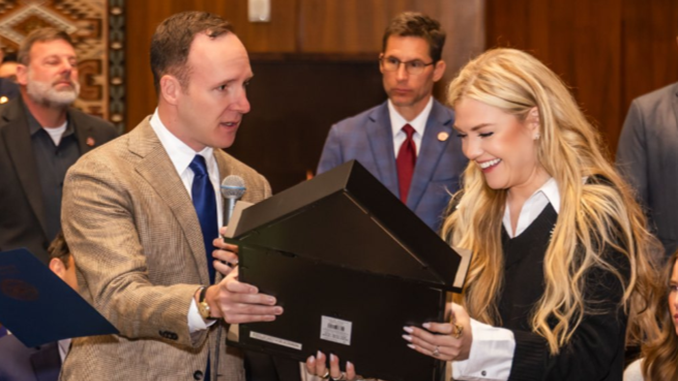
The lawmakers also presented Erika Kirk with a framed Arizona state flag that had been flown over the State Capitol on behalf of the House in Charlie Kirk’s honor, along with a signed copy of the proclamation.
Ethan Faverino is a reporter for AZ Free News. You can send him news tips using this link.