by Matthew Holloway | Jul 26, 2025 | Education, News
By Matthew Holloway |
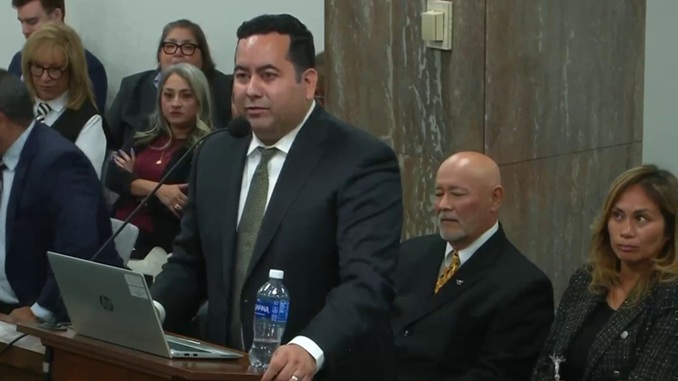
Tolleson Union High School District Superintendent Jeremy Calles found himself the subject of intense grilling at the hands of Joint Legislative Audit Committee (JLAC) Co-Chairmen Matt Gress and Mark Finchem during a three-hour hearing this week. Following the exchange, Gress told reporters that he and Finchem “will be reviewing our options with the Auditor General.”
The fiery hearing came about in response to concerns over a Tolleson Union High School District (TUHSD) leaseback deal with the Isaac Elementary School District that would see TUHSD purchase Isaac Middle School for $25 million with the elementary district then leasing the building at an interest rate of 6%.
Calles revealed in the hearing that he holds two professional roles, one as a consultant and the second as Superintendent, and he confirmed to the committee that initial conversations on the deal began in his role as a consultant.
He told the JLAC, “The first conversation I had came from a text message from, yes, the prior superintendent, Mr. Mario Ventura, who texted me and asked if I could take a look at his finances.”
Calles explained that when his district became involved, his role in the deal changed, although he claimed to have never billed for the conversation and never contracted with Isaac Elementary School District as a consultation client.
“This is not a new concept; the only thing novel on this idea is that both sides of the transaction, you have a school district. Everything else about this transaction, both sides of the transaction are not unseen,” he told lawmakers.
The Superintendent said that the agreement between the districts lacked a prepayment penalty, had no lock-in requirement, and aided the district in a financial crisis. He suggested that the benefit for TUHSD students was in generating up to $7 million in funding for the district. However, committee members balked at this suggestion, noting that although the district holds a “B” letter grade from the Arizona State Board of Education, only 30% of its students are proficient in Mathematics, English, and Language Arts.
Gress challenged him, “Here, you have not been able to demonstrate the $25 million financial transaction benefiting Tolleson Union students directly, given that you have no square footage, you’re not providing any learning services. It’s not even in your district so this is far beyond novel. I think you’ve made a mockery of our state law.”
He added, “I think you should be ashamed of yourself for the way you’ve mistreated taxpayers of Tolleson Union.”
The Superintendent was later asked by Rep. Carbone, “Why doesn’t every school district now just follow your lead and start making money and become a bank?”
In a reponse that appeared to show defiance, he said, “I don’t think every school district has a superintendent willing to stand in front of you like this.”
As reported by State 48 News, Calles confirmed that he utilizes his district office to conduct personal business during working hours. The outlet noted that under questioning it was further revealed that two members of the school district are also employed by the Superintendent through his consultancy.
When pressed to answer questions from Tolleson City Manager Reyes Medrano Jr., along with Police Chief Rudy Mendoza and former Superintendent Kino Flores regarding his conduct, including an alleged request for Tolleson to pay Calles’ real estate broker an $85,000 fee related to the district’s purchase of city land, Medrano suggested this violated state procurement laws.
“The 85 was going to be on top of the purchase price, and then we were supposed to pay the broker with it,” he told the committee. According to Medrano, Calles told him “it would be cleaner” to do so.
Calles lashed out in response, claiming the allegation “borderlines defamation.” He said in full: “I believe that borderlines defamation, the way he made that implication as if something nefarious was happening.”
Speaking with a reporter, Calles rejected the allegations saying that “they’re all lies. Do you see our improvement on the letter grade system? You see that our schools are moving up on their performance?”
The Superintendent told 12News that he expected the committee to request review of his conduct by the Arizona Auditor General and said, “When the Auditor General’s Office finally sends me someone, I’ll give them the full story.”
In a statement following the hearing, Gress said, “The hearing today revealed deeply troubling information that shows a pattern of disregard for public transparency. Combining public service with private consulting work, including using Tolleson District facilities and employees to support superintendent Calles’s consulting company reeks of corruption. Chairman Finchem and I will be reviewing our options with the auditor general.”
Matthew Holloway is a senior reporter for AZ Free News. Follow him on X for his latest stories, or email tips to Matthew@azfreenews.com.
by Jonathan Eberle | May 15, 2025 | News
By Jonathan Eberle |
Arizona Governor Katie Hobbs has signed HB 2611, also known as “Preston’s Law,” into law, marking a significant change in how the state prosecutes violent assaults involving multiple offenders. The legislation, championed by State Representative Matt Gress (R-LD4), was named in honor of 16-year-old Preston Lord, who was killed in a brutal group assault in October 2023.
The new law classifies coordinated violent group assaults that result in physical injury as aggravated assault—a class 4 felony under Arizona law. Prior to this legislation, Arizona statutes lacked specific language addressing violent attacks carried out by multiple individuals acting together, limiting the ability of prosecutors to pursue enhanced charges in such cases.
“Preston’s Law ensures that those who commit violent acts as a group will face real consequences,” said Rep. Gress in a statement. “We’ve seen what happens when mobs believe they can act with impunity. This law sends a clear message: if you gang up to hurt someone, you will be held accountable.”
The law’s passage follows public outcry and widespread grief over the circumstances of Lord’s death, which drew attention to what many saw as a gap in the legal system when it comes to addressing group violence, particularly among teenagers. The case prompted renewed discussion about youth violence and accountability, especially in suburban communities where such incidents have historically been rare but have become more visible through social media and viral videos.
Gress worked closely with Preston Lord’s family and the Maricopa County Attorney’s Office to draft the bill. The bill moved through the Arizona Legislature with broad bipartisan support, reflecting a shared desire to address organized violence and enhance protections for victims.
Lord’s death became a rallying point for change, with his family actively advocating for new laws to ensure other families don’t suffer the same fate. “We honor Preston Lord by making his name a legacy of reform—not just a reminder of tragedy,” Gress said.
Under current Arizona law, aggravated assault encompasses a range of scenarios, such as assaults with deadly weapons or against certain protected classes. With Preston’s Law now enacted, group coordination becomes a specific aggravating factor, giving prosecutors stronger grounds to pursue felony charges when more than one person participates in an assault.
Jonathan Eberle is a reporter for AZ Free News. You can send him news tips using this link.
by Matthew Holloway | May 10, 2025 | Education, News
By Matthew Holloway |
Arizona schools will be protected by more armed school campus officers, newly developed safety technology, and advanced training through a new bipartisan bill, just signed into law. The bill, HB 2074, was signed into law by Governor Katie Hobbs on Tuesday.
Sponsored by State Representative Matt Gress (R-LD4), the new law makes a massive expansion to the existing, already successful, School Safety Program and allows retired law enforcement officers to serve their communities again as school officers.
Speaking in support of the new law, Superintendent of Public Instruction Tom Horne said, “I am very pleased that this bill has become law. There is a need for more armed officers in schools and expanding the pool of available law enforcement professionals to include those who have retired in good standing is a commonsense idea that will put more officers in schools, making campuses safer. The added training and technology will increase the value of this successful program that makes our students, educators and staff safer on campus.”
“Schools must be places where all students, teachers, and staff feel safe,” said Gress in a press release. “I’m proud that this bill has been signed—crafted through collaboration with educators, certified mental health professionals, law enforcement, legislators, and Superintendent Tom Horne—into law. This marks a major step forward in implementing meaningful, commonsense school safety enhancements.”
According to a statement from the Arizona Department of Education, the new law contains provisions for Arizona schools to install new safety equipment and infrastructure. School districts and charter schools will also have access to training for safety officers on interacting with special needs students in addition to civil rights, student privacy laws, and adolescent mental issues. Each of the districts and charters must also prepare and submit a campus emergency response plan.
Matthew Holloway is a senior reporter for AZ Free News. Follow him on X for his latest stories, or email tips to Matthew@azfreenews.com.
by Matthew Holloway | Apr 5, 2025 | News
By Matthew Holloway |
This week, Governor Katie Hobbs issued a directive to all of her agency directors not to appear or testify at the inaugural hearing of the Arizona House Ad Hoc Committee on Executive Budget Mismanagement. Hobbs issued the directive 15 minutes prior to the start of the meeting. Democrats on the committee also refused to attend.
According to Committee Chairman Matt Gress (R-LD4), agency leaders from AHCCCS and the Department of Economic Security (DES), who share responsibility for the $122 million shortfall in Arizona’s Developmental Disabilities (DD) program, were scheduled to appear before the committee and answer for the program’s massive cost overruns that have threatened to disrupt critical services for Arizona families.
Gress said in a statement, “The Governor pulled her directors because she can’t defend the damage she’s done. If she had a plan, she would have sent her team to explain it. Instead, she’s hiding behind a press release while Arizona families face the consequences of her financial mismanagement. This Legislature asked for answers. The Governor responded with a tantrum. What she calls a ‘political stunt’ is actually legislative oversight—a constitutional duty that we will carry out whether she likes it or not.”
In the press release referred to by Gress, Hobbs and Democratic House Assistant Leader Nancy Gutierrez claimed the “Ad Hoc committee is a waste of time and a shameless political stunt,” and derided it as a “sham,” demanding instead that the legislature issue a supplemental budget bill to cover the shortfall.
Despite the conspicuous absence of Democrat members of the committee, the hearing went forward with the Republican members reviewing budgetary data, testimony from the Joint Legislative Budget committee, and expert testimony from former Idaho House Majority Leader Megan Blanksma, whose state suffered what Gress’ office called “a near-identical funding crisis.”
The committee issued its formally adopted findings, naming the Hobbs administration accountable for:
-
-
“Without approval from the Legislature or specific appropriation authority, dramatically expanded its Developmental Disability program by making permanent a temporary, COVID-era program to pay parents to provide attendant and habilitative care to their minor children.”
-
“The programmatic and scope changes of the DD program adopted by AHCCCS and implemented by DES led to dramatic unfunded liabilities, threatening the entire DD program and leaving the state with at least a $122 million budget deficit in FY2025.”
-
“Through its Medicaid agency at AHCCCS, put the Department of Economic Security under legal threat with a November 2023 Corrective Action Plan, which aimed to grant parents 2 additional hours for care under the PPCG program, which was at odds with the ’extraordinary care’ standards and dramatically expanded costs to the state.”
-
“AHCCCS delayed implementation of guardrails on the PPCG program by over 18 months, despite its original plan submitted to the Federal CMS in August 2023, causing considerable cost overruns and unrealistic expectations for families.”
The committee further found that “The critical nature of the Developmental Disabilities program and its pending exhaustion of funds requires that the Executive identify available federal funds, and the Legislature will work to identify transfers of other available funds, in the month of April, to continue the program.”
It also added that “the State Legislature must receive annual reports from the executive administration identifying all federal funds received and an exit plan should those federal funds be eliminated.”
In a statement following the hearing, Gress addressed the Democrats’ absence and Hobbs’ order for her agency directors not to attend.
“Fifteen minutes before the committee hearing began, I received a letter from Governor Hobbs criticizing legislative intent on providing oversight and learning exactly what happened. Now this is a pattern and a practice of Governor Hobbs. She fails to even acknowledge who’s responsible for this problem. Instead, it’s deflection and trying to scare families who rely on the DD services for their loved ones.
“We will not be deterred. Her unhinged, chaotic letter falls far below the standard that Arizonans expect of their leaders. We will continue to find the facts. We will be the adults in the room to provide a supplemental appropriation, and we will ensure that there are guardrails put in place so that this never happens again.
“Let me be very clear, we will not pass a financially irresponsible supplemental. It will include the reforms necessary to protect families who rely on DD for their loved ones. We demand accountability and transparency, and it’s going to happen soon.”
Matthew Holloway is a senior reporter for AZ Free News. Follow him on X for his latest stories, or email tips to Matthew@azfreenews.com.
by Jonathan Eberle | Mar 14, 2025 | News
By Jonathan Eberle |
Arizona lawmakers are advancing a series of bills aimed at increasing transparency, accountability, and taxpayer protection. These measures tackle issues ranging from government spending on elections to school board meetings and travel, with a focus on ensuring that public funds are used responsibly and efficiently. With strong support from various groups, these bills reflect ongoing concerns about how taxpayer money is spent and how local government actions are conducted.
One of the most significant pieces of proposed legislation, HB2722, is backed by the Arizona Free Enterprise Club and sponored by Rep. Neal Carter (R-LD15). The bill seeks to prevent taxpayers from indirectly subsidizing private businesses through government gifts. Specifically, it targets “gift clauses” in state and local government contracts, which some argue allow for inappropriate use of taxpayer funds to benefit private entities.
The Arizona Free Enterprise Club has been vocal about the need for stronger protections against such expenditures. The organization has stated that this bill is necessary to curb the growing trend of government spending on private corporations without clear public benefit.
“Taxpayers should not be used as a backdoor financing mechanism for private companies,” said Arizona Free Enterprise Club officials. “This bill is about ensuring that public dollars are spent in a way that directly benefits the public, not private interests.” If passed, this bill would create stricter guidelines on how public funds can be spent and would allow taxpayers to hold officials accountable when misused funds are discovered.
Another bill making its way through the Arizona legislature is SB1036, supported by the Goldwater Institute and sponosred by Sen. John Kavanagh (R-LD3). This bill targets government spending on influencing elections, a topic that has sparked considerable debate in recent years. SB1036 would create a private right of action for taxpayers, allowing individuals to sue if they believe government funds are being spent on efforts that influence an election. This would make it easier for citizens to challenge the use of taxpayer money in elections, particularly when the spending appears to be partisan or otherwise improper.
The Goldwater Institute has argued that taxpayers have a right to ensure their money isn’t used to sway political outcomes. According to a recent report by the organization, there have been multiple instances of local governments spending taxpayer funds to advocate for policies that align with political interests, which has raised concerns about government overreach.
“Governments should not be using taxpayer money to influence the political process,” said Goldwater Institute officials. “This bill provides taxpayers with the ability to stand up for their rights and ensure public resources are not misused.”
Another bill, HB2169, which was introduced by Representative Matthew Gress (R-LD4), seeks to address transparency within Arizona’s public school districts. The bill would require school board meetings to be held in public facilities within the district, ensuring that they are easily accessible to the communities they serve. Additionally, the bill mandates that school boards must receive public approval before engaging in out-of-state travel, making it more difficult for administrators to make costly decisions without community oversight.
This legislation gained near-unanimous support, with proponents arguing that it ensures greater accountability for how public schools operate and how funds are spent. Critics of the current system have pointed to examples of school board members using taxpayer money for luxury travel without clear, public approval or benefit. A notable incident involved a local school district that faced backlash after spending taxpayer funds on extravagant trips while simultaneously requesting additional funding from voters for educational needs.
“Public education is about serving the community,” said Representative Gress in a statement. “We need to make sure that the actions of school boards are always in the public interest. This bill strengthens public trust in our school systems.”
Jonathan Eberle is a reporter for AZ Free News. You can send him news tips using this link.
Page 4 of 10«12345678910»