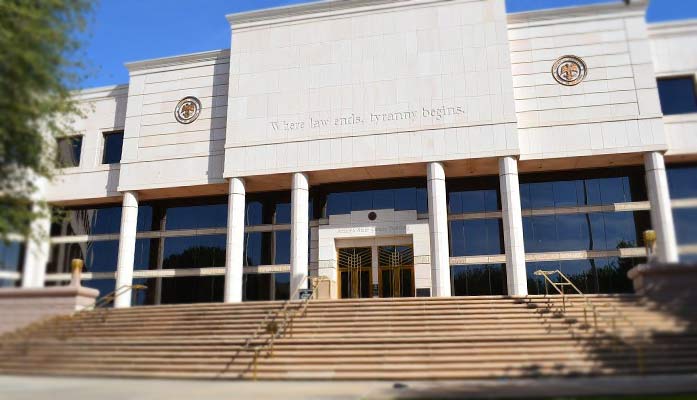
Teachers’ union activists were once again dealt a serious blow after the Arizona Supreme Court issued an order effectively removing an initiative from the ballot that aimed to undo the state’s universal school choice program.
Nearly four years ago to date, a similar initiative was removed from the ballot for failing to have the required number of signatures. Katie Hobbs, secretary of the state at the time and now the governor, held out on invalidating the ballot initiative.
The court’s order to recalculate the signature totals using the trial court’s formula, issued on Tuesday, is projected to have brought Proposition 212, the Protect Education Act, below the required signature total following a legal challenge filed by the Goldwater Institute in Clark v. Fontes.
Protect Education Accountability Now, the political action committee (PAC) behind the Protect Education Act, confirmed that the Arizona Supreme Court order meant their initiative would not qualify for the ballot.
The PAC blamed “big money in partnership with Republican lawmakers and the anti-public education lobby” for the initiative’s demise.
A spokesperson for the PAC stated that the initiative should have been included on the ballot regardless of the invalid signatures.
“This does not reflect what Arizona voters want. It does not reflect the overwhelming support of educators, parents and public school advocates across the state who volunteered their time and demanded a voice in reforming a program that abused taxpayer money and pulled funding from their neighborhood public schools,” said the spokesperson. “Instead, the hard-earned resources educators raised to fund this were buried under a mountain of big money, political power, and a system that consistently sides with special interests.”
— Protect Education Ballot Initiative (@ProtectEdAct) August 18, 2026
Activists submitted around 420,000 signatures to qualify for the ballot. Pending a review incited by the Goldwater Institute’s court challenge, the number of valid signatures will fall to a projected total of approximately 245,000. The initiative needed approximately 256,000 to qualify for the ballot.
Nearly 70,000 signatures were invalidated due to their discovery as duplicates or having been collected by legally ineligible circulators, like felons. The court also upheld the trial court ruling which invalidated entire sheets of signatures due to the petition circulator providing an address at which they weren’t living.
The ballot measure would have rolled back the universality of the Empowerment Scholarship Account (ESA) program by imposing an income cap.
The union-backed Protect Education Act appears to have fallen short of the valid signatures needed to make the November ballot.
In this special Keep Arizona Free Update with @Darla4freedom:
➡️ The campaign submitted roughly between 416,000-421,000 signatures, but after trial… pic.twitter.com/l7886cgtT9
The court also agreed with a lower court ruling that the ballot language drafted by Secretary of State Adrian Fontes was false and misleading because it used the term “voucher” to describe the ESA program. Vouchers must be spent immediately and only at certain approved schools, whereas ESA program funds may be rolled over and applied to various schooling types and educational resources.
The PAC behind this second failed initiative to end universal school choice raised more than $7.5 million and spent more than $7.2 million.
More than $6.5 million, or 87%, came from the National Education Association. $810,000, or nearly 11%, came from the Arizona Education Association.
Other major donors included $50,000 from the United Food and Commercial Workers Active Ballot Club, the PAC of a D.C.-based union; and $50,000 from Arizonans for Quality Education, a corporation or LLC based in Phoenix.
The latter entity was formerly known as Friends of ASBA, with ASBA standing for the Arizona School Boards Association, and was registered as a domestic nonprofit corporation, according to Arizona Corporation Commission (ACC) records.
AZ Free News is your #1 source for Arizona news and politics. You can send us news tips using this link.
The proposed ballot initiative would have required the Arizona Department of Education (ADE) to establish an online marketplace payment system next year for all ESA purchases with approved vendors, and would have eliminated the current reimbursement and debit card system.
The initiative would also have further restricted allowable expenditures, and required valid fingerprint clearance cards for qualified tutors and school personnel. Any parents who intentionally misuse funds would have been disqualified permanently from the ESA program.
Under the canceled initiative, the ESA program would have had to submit quarterly reports addressing vendor payments, disqualifications, and recovered funds to the attorney general as well.
Fortify AZ was supported in its signature-gathering efforts with millions from the American Federation for Children (AFC). Arizona campaign finance records reflected $1.2 million to their political action committee, but AFC said they invested over $5.3 million into the ballot initiative.
AFC said the proposed reforms were aligned with best policy practices implemented in other states: Texas, Arkansas, Florida, Iowa, Indiana, Ohio, Utah, Tennessee, New Hampshire, and West Virginia.
In a press release issued on Tuesday, AFC CEO Tommy Schultz said their organization backed the ballot initiative as the “best opportunity to save school choice in Arizona,” which they say is under threat by school choice opponents behind the other proposed ballot initiative which would end universal school choice, the Protect Education Act.
“After a small number of individuals acted to sabotage this chance for the school choice-gutting petition to be pulled and commonsense reforms enacted, we are evaluating our best next steps to ensure the union-backed petition does not rip school choice away from thousands of Arizona students overnight and fundamentally break the program for the rest,” said Schultz.
As the Arizona Agendareported, Republican lawmakers and the Arizona Education Association, the state’s largest teachers union, nearly reached a secretive school choice reform deal to end both the Arizona Empowerment Scholarship Accounts Reform and Accountability Act as well as the Protect Education Act.
However, the Arizona Free Enterprise Club raised concerns over the impact of the secretive deal on the ESA program.
Don't Cut a Deal that Kills ESAs — Lawmakers are negotiating a secret bargain with teacher unions tonight. Over 100,000 Arizona students hang in the balance. https://t.co/dToo9ac4uQ
— AZ Women of Action (@AZWomenofAction) June 12, 2026
Ultimately, lawmakers voted against the proposed deal.
Matthew Nielsen, founder of the Educational Freedom Institute, called the Arizona Empowerment Scholarship Accounts Reform and Accountability Act an “ill-conceived, and now ill-fated […] waste.”
The other ballot initiative to end the universality of the ESA program will continue. The Protect Education Act would place a $150,000 income cap for ESA program enrollees.
Additionally, this initiative would not only require qualified tutors and schools to have valid fingerprint clearance, it would subject them to Arizona State Board of Education discipline and require them to pay a fee and register annually with ADE.
Protect Education, Accountability Now, the political action committee behind the still-active ballot initiative, has spent about $2.7 million of the nearly $4.6 million it has raised.
98% of those funds (more than $4.4 million) came from the National Education Association, a national teachers’ union and the largest labor union in the nation.
As of this report, the ESA program has over 100,700 students enrolled.
AZ Free News is your #1 source for Arizona news and politics. You can send us news tips using this link.
For months, we have documented the pattern of errors, distortions, and outright fabrications that characterize the coverage of Arizona’s Empowerment Scholarship Account program by Channel 12’s political reporter Craig Harris. Each new episode—the fabricated 20% fraud claim, the defiance in the face of correction by the Arizona Department of Education itself, the constant shifting of goalposts as each of his claims is debunked—seemed like it might result in Channel 12 taking appropriate corrective action.
But they never did.
Last week, at the Arizona Legislature’s final stretch of its 2026 session, the mask came off entirely.
While lawmakers debated a series of consequential ESA-related bills and resolutions on Thursday and Friday—including a constitutional amendment to protect military family scholarships—Harris was captured on camera doing something that no journalist who takes the job title seriously can explain away: coordinating, via text message, with members of Save Our Schools Arizona, the anti-school-choice advocacy group that is a principal sponsor of the Protect Education Now ballot initiative, about where they should position themselves inside the Capitol building for maximum political impact.
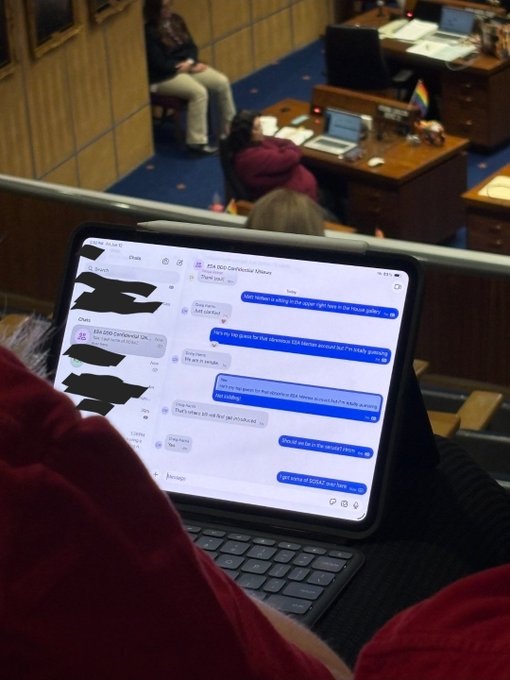
Text message conversation between Channel 12’s Craig Harris and anti-school choice activists.
Let that sink in. A reporter on the education beat, covering legislation in real time, was not observing the advocacy groups in the building. He was directing them.
The text exchange was visible on the screen of a Save Our Schools activist—readable thanks to a conspicuously large font and no privacy screen—and was flagged by our Heritage Foundation colleague Corey DeAngelis, who shared images of the messages on social media after receiving them from a local activist. Harris subsequently confirmed on X that the images of the group chat, named “ESA DDD Confidential 12News,” were real.
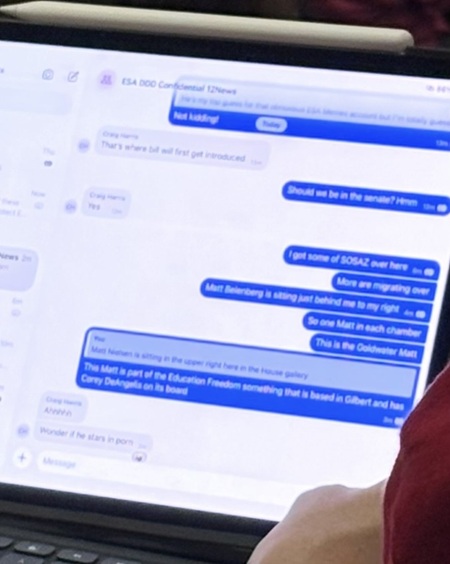
After Harris told the activist that he was in the state senate chamber as that is “where [the] bill will first get introduced,” Save Our Schools board member Kathy Boltz asked Harris for advice regarding where their team of activists should place themselves in the capitol building. “Should we be in the senate? Hmm,” she asked. Within a minute, Harris answered in the affirmative.
This is not ambiguous. This is not a misunderstanding. This is a journalist using his knowledge of the Arizona Legislature’s political process to provide tactical advice to an advocacy group that has a direct political stake in the legislation he is supposed to be covering neutrally.
Harris was no longer covering the news. He was helping to manufacture it.
But that wasn’t the worst of it.
The same captured text conversation revealed Harris mocking a local school choice supporter, asking whether the individual “stars in porn.”
This derision was not just a lapse in professionalism. This was contempt—contempt for the families, advocates, and ordinary citizens who show up at the Capitol to make the case for educational freedom, expressed in a private conversation with advocates on the other side of the issue.
Text message conversation between Channel 12’s Craig Harris and anti-school choice activists.
Multiple Arizona politicos were quick to call out the behavior publicly. State Senator Jake Hoffman called for Channel 12 to fire Harris and called on the station to “open an investigation into every story he was involved in and retract any instance of undisclosed coordination.” Hoffman observed that this coordination with activists is “precisely the kind of unethical behavior that has caused the majority of Americans to deeply distrust the media.”
Arizona Republic columnist and former State Senator Paul Boyer called it “a really bad look” for Channel 12 to have their reporter, “who is also reporting on these same groups” to be discovered “coordinating with them at the legislature to defeat the same type of legislation he’s myopically focused on.” Similarly, J.P. Twist, executive director of Citizens for Free Enterprise, called out Harris for “literally strategizing with a partisan union to undermine parents’ rights.”
The parent company of Channel 12 publishes a “Principles of Ethical Journalism” statement committing its journalists to the values of truth, independence, public interest, fair play, and integrity. It’s hard to see how coordinating with one group of political activists and crudely mocking the other side comports with those standards.
Sadly, Harris’s breach of journalistic ethics does not end there.
Later that night, in a hearing on legislation to protect military family scholarships, Harris took to social media to characterize two of the three supporting witnesses who testified as people “making money off ESAs,” implying their support was financially motivated rather than principled.
One of those witnesses was Kevin Biesty, spokesperson for the Arizona Christian Education Coalition. As Biesty detailed on X, he reached out to Harris privately and asked him to correct or remove the post. Harris declined. As Biesty observed, the logic Harris applied to him — that representing clients who are affected by ESA policy makes one a financially conflicted advocate — is never applied to the other side. The staff and lobbyists of Save Our Schools Arizona and the teachers unions, who are paid to oppose the ESA program, are never characterized by Harris as people “making money off” the issue.
Harris also claimed that no military family spoke at the hearing. That too was false. Biesty had personally presented a written statement from a military mother who could not remain for the late-night session, and referenced letters from other military families — all of this while Harris was in the room. At no point did Harris ask Biesty for that mother’s contact information or seek to include her perspective in his coverage. He was, however, apparently attentive enough to the gallery to communicate with his Save Our Schools contact — the same ESA mother and SOS board member who, Biesty observed, is never identified as such in Harris’s stories — while sitting at the press desk on the floor.
Indeed, when ESA students and their families share their stories, Harris is quick to dismiss them. Recently, a young ESA student with disabilities named Jordan Visser shared on video about the ways the Protect Education Now initiative would harm students like himself. Harris went on social media to dispute his account, claiming that the initiative would not affect students with special needs—effectively accusing a student with disabilities of lying about the impact of a ballot measure on his own situation.
He was wrong. As the student’s mother, Kathy Visser, and others documented, the text of the initiative itself bore out what the student had said—the ESA funds that the family had saved to continue providing him with services would be seized by the state if the Save Our Schools ballot initiative were adopted.
The irony of Harris’s posture—aggressively checking the credibility of a disabled student while coordinating inside the Capitol with the very advocacy group sponsoring the initiative in question—encapsulates the problem. It is not that Harris is a journalist who occasionally makes mistakes. It is that the mistakes run in one direction, consistently, and that when corrected, he doubles down rather than acknowledging any error. And it is now documented, on camera, that he was coordinating tactics with one side of the debate he was purportedly covering.
Arizona families with children in the ESA program deserve better than a reporter who coordinates with the opposition at the very hearings he is assigned to cover. Arizona viewers deserve better than a news organization that has allowed this pattern to continue unchecked. And the thousands of children—including those with disabilities—who rely on these scholarships deserve a press corps willing to represent their stories honestly.
Channel 12 has not issued a correction or a retraction of the false fraud statistics. It has not yet acknowledged Harris’s coordination with activists or the mockery of a school choice supporter.
Channel 12’s parent company should answer a simple question: Is the behavior documented at the Capitol last week consistent with its Principles of Ethical Journalism? If not, what will it do about it?
Jason Bedrick is a Senior Research Fellow and Matthew Ladner is aSenior Advisor for education policy implementation at The Heritage Foundation’s Center for Education Policy.
For more than a decade, the teachers’ unions and their allies at Save Our Schools (SOS) have made their mission clear: stop school choice in Arizona. They fought the expansion of our state’s Empowerment Scholarship Account (ESA) Program at every turn. And after the program was made universal in 2022, they have endlessly pushed to repeal the expansion—including a failed ballot initiative where their signature count was off by more than 50,000. (Yes. These are the people pushing public education.)
With another election around the corner, SOS and the teachers’ unions have once again launched a ballot initiative designed to cripple ESAs. But a funny thing has happened in their efforts to get on the ballot. SOS and the teachers’ unions are suddenly claiming that the initiative isn’t about “eliminating the program.” And they’re pushing a talking point that their only concern is that the program isn’t “functioning properly.”
It’s a remarkable rewrite of history—and Arizona voters shouldn’t buy it…
Nearly half of high school seniors are not proficient in reading or math, and one-third of eighth graders cannot read at a basic level. The aftershocks of pandemic-era school closures are still playing out, with students regressing to levels not seen in more than 25 years, and one in four now chronically absent from the classroom. An overreliance on technology, lax policies around personal devices like cell phones, and weakened discipline standards have only deepened the problem, eroding focus, accountability, and real learning.
The current challenges also extend beyond students. Nearly eight in 10 teachers say they have considered leaving the profession, citing burnout as their pay continues to fall behind that of other college-educated workers. The system is strained at every level, and every person with skin in the game knows it.
Who is at the center of it all? America’s teachers’ unions. While students slip to historic lows in reading and math and classrooms struggle to recover from union-driven school shutdowns, the American Federation of Teachers (AFT) and its president Randi Weingarten appear focused elsewhere, pouring time, money, and political muscle into ideological conflicts and partisan campaigns instead of fixing the schools they supposedly represent.
As president of the nation’s largest teacher’s union, Weingarten represents 1.8 million educators and plays a central role in shaping K-12 policy and the direction of American education. At a moment of historic academic decline, one might expect her influence to be directed toward fixing it.
It’s not. She is focused on her own political ambitions.
Weingarten has directed the AFT’s resources toward organizing and amplifying explicitly political activism, including the anti-Trump “No Kings” rallies. There, she took the spotlight to declare that “we are not going to let Donald Trump continue to do what he has been doing” and ignoring the fact that Americans voted to elect Donald Trump as President, boldly claimed that “we, the people, have to have the ultimate say.”
Unfortunately, this latest spectacle is nothing new. The AFT has a long record of channeling resources into left-wing political campaigns, protests, and advocacy efforts that have little to do with whether students can read, write, do basic math, or are proficient in these core competencies.
The AFT has funneled tens of millions of dollars to left-wing aligned groups and candidates since 2022, and spent most of last year engaged in aggressive legal and activist campaigns against Trump administration-directed education reforms aimed at restoring parental oversight in curricula and de-politicizing the classroom.
This ideological activism was on full display during the pandemic, when Weingarten advocated and defended keeping schools closed far longer than necessary, even as evidence showed it was safe to reopen. After these devastating setbacks from school closures and virtual learning, the average student is less than halfway to a full academic recovery. In some grades, there has been little to no improvement in reading since classrooms reopened. Chronic absenteeism has surged, especially among lower-income students; in 2024, rates were 57 percent higher than before the pandemic, and Weingarten is directly responsible for this generational learning loss.
Even after nearly $200 billion in emergency federal spending on K-12 education, student performance continues to decline. Students are doing worse than they were a decade ago, and lower-performing students are now further behind than their counterparts were more than 30 years ago. National test scores have fallen to their lowest levels in decades, while The Nation’s Report Card data shows the gap between high- and low-performing students continuing to widen.
At a moment when student outcomes are deteriorating at record levels, the priorities for educational leadership like Weingarten should not be difficult to identify. It begins in the classroom: ensuring children are given foundational tools for critical thinking and can learn how to think (not what to think) and supporting teachers and parents as they help students achieve their full potential.
At the American Parents Coalition, we will continue to educate parents on the blatant partisan actions academic leaders like Weingarten are doing, at the expense of our children. It’s time to reclaim parental authority, and to demand teachers’ unions focus on academic success and not divisive ideologies.
Our children do not get another chance at learning. Their childhood is finite. The major setbacks taking hold now will shape not only academic prospects in their immediate future, but also their confidence, opportunity, and quality of life.
Randi Weingarten prioritizes a political agenda over our kids. She promotes policies that cut parents out of their children’s lives. She uses her platform to advocate for herself, not teachers or students. It’s time for Randi Weingarten to be replaced with a true advocate for education.