By Ethan Faverino |
Congressman Eli Crane (R-AZ-02), spent the final days of the congressional district work period visiting communities and key infrastructure sites across Arizona, focusing on rural health care, the recovery of the Grand Canyon’s North Rim, water security, and domestic mineral production.
Crane was joined during portions of the visits by Interior Secretary Doug Burgum and Rep. Andy Biggs (R-AZ-05).
The engagements included stops with the Gila River Indian Community, Grand Canyon National Park, Salt River Project, and Freeport-McMoRan as Crane highlighted what he described as efforts to strengthen Arizona’s long-term economic and infrastructure needs.
Crane visited the Gila River Indian Community following the University of Arizona and Gila River Health Care’s announcement of a new partnership to expand medical education and physical recruitment in the community.
The partnership will establish a Doctor of Medicine-granting program that the university describes as the first rural regional branch of its kind established in partnership with a federally recognized Tribe on Tribal land.
Students will begin their foundational science coursework in Phoenix before moving to Gila River Health Care and other regional sites for clinical training.
The program is intended to encourage medical students to establish careers in rural and Tribal communities, where access to physicians and other health services can be limited.
Crane said the program could help create a long-term physician workforce within the community.
The visit followed Crane’s support for the Ak-Chin Indian Community’s selection for the Indian Health Service Joint Venture Construction Program.
The partnership is expected to support construction of a new health center providing primary care, dental services, behavioral health, and specialty care.
Crane also pointed to more than $160 million recently directed to Arizona through the Rural Health Transformation Program for health care clinics, workforce development, and infrastructure.
On August 25, Crane accompanied Burgum to both the North and South Rims of the Grand Canyon National Park.
At the North Rim, park personnel and other stakeholders briefed the officials on recovery efforts following the 2025 Dragon Bravo Fire, which severely damaged critical facilities.
The fire has left the North Rim facing additional challenges, including erosion, flash flooding, and disruptions to its water system, along with longer-term infrastructure and rebuilding needs.
Crane discussed his North Rim Restoration Act of 2025, which would streamline federal contracting procedures to allow the National Park Service to move more quickly on rebuilding efforts.
He also highlighted an amendment he introduced to the 2026 Farm Bill aimed at expediting recovery efforts related to the White Sage Fire.
Both measures passed the U.S. House unanimously and are awaiting further consideration in the Senate.
The following morning, Crane and Burgum traveled to Theodore Roosevelt Dam, located northeast of Phoenix.
The dam and Roosevelt Lake are operated by the Salt River Project (SRP) and provide water storage, flood control, hydropower, and recreation.
SRP officials briefed Crane and Burgum on the effects of recent dry winters, changing runoff patterns, and the importance of maintaining reliable water storage within the state.
Officials also discussed a 2024 decision by the U.S Army Corps of Engineers that allows SRP to retain water in a portion of Roosevelt Dam’s Flood Control Space for up to 120 days, compared with the previous 20-day limit.
The additional flexibility allows more water to remain stored following qualifying runoff events rather than being released downstream before it can be put to beneficial use.
SRP estimates the change could help support the water needs of hundreds of thousands of households during eligible periods.
Although Roosevelt Dam is not part of the Colorado River system, Crane said the reservoir remains important as Arizona prepares for potential reductions to Lower Basin water allocations beginning in 2027.
During the visit, Crane and Burgum discussed several issues surrounding the negotiations, including avoiding costly litigation, maintaining adequate water storage capacity, and supporting potential desalination projects.
While Governor Hobbs’ administration is leading the state’s interstate negotiations, Crane said he believes the federal government may need to intervene if the state cannot reach an agreement.
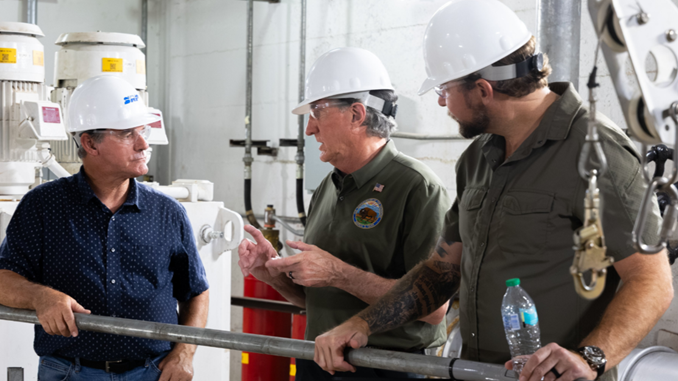
That afternoon, Crane, Burgum, and Biggs visited the Miami Smelter in Claypool, a copper processing facility operated by Freeport-McMoRan.
The century-old facility processes copper concentrate from Freeport’s Arizona mines and is the company’s largest U.S. source of sulfuric acid for its copper leaching process.
Freeport officials briefed lawmakers on the facility’s operations and recent maintenance work.
According to the company, the smelter processed approximately 821,000 metric tons of copper concentrate in 2025 and produced roughly 209,300 metric tons of copper anodes.
The 2025 maintenance turnaround was associated with approximately $73 million in maintenance and idle-facility costs.
Company officials also discussed the possibility of expanding the facility, arguing that using the existing infrastructure could be more practical than securing permits and constructing an entirely new domestic smelter.
Crane focused on federal regulations affecting the facility’s competitiveness, including Environmental Protection Agency standards finalized in 2024 for primary copper smelters.
Freeport had previously warned that complying with the standards could require significant equipment changes and additional costs.
Crane praised a two-year regulatory exemption granted to the facility by the Trump administration in October 2025, but said he believes a permanent solution is needed.
Crane said the series of visits provided an opportunity to examine challenges facing several of Arizona’s major industries and communities while working with state, federal, Tribal, and private-sector leaders.
“To our friends at Grand Canyon National Park, Salt River Project, Freeport-McMoRan, as well as the Gila River Indian Community and the University of Arizona, thank you for your generous hospitality,” stated Crane. “This past week and a half has been invaluable in terms of briefings, new partnerships, and progress toward recovery and growth.”
Crane also thanked Burgum for traveling to Arizona and meeting with leaders across the state.
“I’m also grateful to Secretary Burgum for taking the time to visit our state and meet with leaders across our vital industries. It was a tremendous honor to host the Secretary and his team as we worked to strengthen our blueprint for long-term stability,” Crane added.
Ethan Faverino is a reporter for AZ Free News. You can send him news tips using this link.