by Matthew Holloway | Oct 11, 2024 | Education, News
By Matthew Holloway |
A former superintendent secretary with Yuma County’s Hyder Elementary School District, Nubia Gonzalez, has been indicted for Theft, Misuse of Public Monies, and Forgery. The indictment comes eight weeks after her arrest in Scottsdale in connection with an elaborate fraud scheme against the Cocopah Middle School Association of Parents and Teachers (APT).
A press release from the Arizona Auditor General revealed that Gonzalez has been indicted on allegations that in December 2020 she “embezzled $2,486 when, 3 months after she was terminated, an illicit District check in that amount was deposited in her business checking account.”
As reported by Fox10, court documents revealed that the Yuma County case “is currently with the AZ Attorney General’s Office,” however, Attorney General Kris Mayes’ Office replied to reports that the AG “cannot comment on this matter at this time.”
On July 3rd, Scottsdale Police received a report of suspected fraud from the president of the Cocopah Middle School APT. After returning from travel outside the U.S., the president had found the organization’s savings account emptied.
Per Fox10, court documents showed, “After she saw this, [the APT president] reached out to the former treasurer to ask her about the zeroed out accounts.” The documents noted also, “[the former treasurer] stated that she had no idea what had happened.”
The two APT officials reached out to the organization’s bank investigators. They discovered that the entire balance of the organization’s accounts had been wiped out in a series of withdrawals from their savings and checking accounts, linked to Gonzalez.
Police reported in the court documents that, “The total combined loss between both accounts was $36,512.09. Banking documents were obtained directly from Wells Fargo personnel, which showed Nubia Gonzalez signing each withdrawal slip.”
According to AZFamily, the group’s president said that Gonzalez was elected as treasurer in April and was given control and signing authority over the group’s accounts at Wells Fargo bank. Only the two of them had access. The authorities said, “It became readily apparent” that the suspect “immediately withdrew the money,” once the president had left. On the same day, Gonzalez reportedly deposited $22,300 into her personal checking account which she subsequently used to pay her own bills including “credit cards and other various accounts.”
The court documents described that Gonzalez allegedly told the president she was moving the group’s funds to a higher-yield interest bearing account, however, none was created per the bank. She reportedly sent doctored screenshots and forged documents supporting this claim.
The authorities wrote, “This was a well-thought out fraud scene, which involved counterfeit and forged banking documents.”
The board members promptly voted to remove Gonzalez from her position as treasurer. She later turned herself in following media reports of the allegations and has been charged with theft, fraudulent schemes, and forgery. Funds totaling $14,212.09 are still unaccounted for according to Scottsdale Police.
Per 12News, Gonzalez is being held on a $40,000 bond in Scottsdale and a $30,000 bond in Yuma County.
In a statement to Fox10 the Cocopah Middle School APT wrote:
“The Cocopah APT would like to express our appreciation to the community at large for all the support shown to us. We are moving forward stronger and more united than ever.
We have added additional security measures and will continue to educate and inform other school parent organizations to learn from this incident and adapt their processes as well. Unfortunately at this time, it does not appear the money will be recovered. We are working hard to raise needed funds for our school and students during our current fundraising campaign for this school year.
This investigation is in the very capable hands of Maricopa County and we thank them as well as the Scottsdale PD for their diligent work in this matter.”
Matthew Holloway is a senior reporter for AZ Free News. Follow him on X for his latest stories, or email tips to Matthew@azfreenews.com.
by AZ Free Enterprise Club | Aug 13, 2023 | Opinion
By the Arizona Free Enterprise Club |
Clean and accurate voter rolls are a cornerstone to safe and secure elections. And they are required by both state and federal law. Section 8 of the National Voter Registration Act (NVRA) specifically obligates states to conduct a general program that makes a reasonable effort to remove the names of ineligible voters from the official lists of eligible voters due to death or change of residence. The U.S. Supreme Court even backed this up in its 2018 decision in the case Husted v. A. Philip Randolph Institute.
But Arizona’s current Secretary of State Adrian Fontes and its former Secretary of State (now Governor) Katie Hobbs have failed to perform the necessary voter list maintenance. And right now, 14 Arizona counties are in violation of Section 8 of the NVRA…
>>> CONTINUE READING >>>
by Terri Jo Neff | Apr 1, 2023 | Economy, News
By Terri Jo Neff |
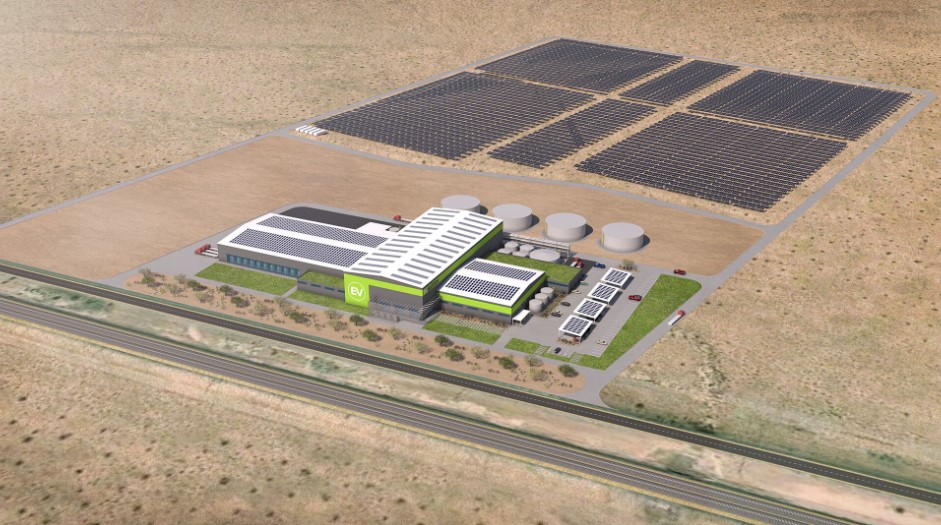
An Arizona company has announced plans to ship African-mined cobalt to Mexico, then truck it north to be processed at a new, state-of-the-art facility in Yuma County so it can be sold to companies that make batteries for Electric Vehicles (EVs).
EVelution Energy is expected to start construction of its Yuma cobalt processing facility next year, with a goal of being operational no later than early 2026. It forecasts more than 1,000 construction phase jobs, along with 60 direct and 300 indirect jobs once the facility is fully functional.
Cobalt is a rare, ferromagnetic metal primarily used in lithium-ion batteries and in the manufacture of magnetic, high-strength alloys. Dating back to 3000 BC, cobalt was mostly used for its blue coloring in the making of ceramics and glass.
Other uses were limited due to the fact arsenic fumes are a by-product of smelting. But new processing methods in the last few decades changed all of that.
In March, the Yuma County Board of Supervisors unanimously approved a special-use permit allowing EVelution to move forward with construction on 139 acres just east of the City of Yuma and south of the Kofa National Wildlife Refuge.
The property, which spans Union Pacific Railroad tracks and U.S. Interstate 8, is located within one of Arizona’s Qualified Opportunity Zones which provide a wide range of tax incentives for private, long-term investments in economically distressed communities.
There are also various federal economic development incentives currently available for EVelution Energy’s project, such as the Inflation Reduction Act and the Infrastructure Investment and Jobs Act.
According to the U.S. Geological Survey, nearly two-thirds of all mined cobalt (150,000 tonnes in 2019) comes from the Democratic Republic of the Congo (100,000 tonnes in 2019). The USGS also estimates there is about 4 million tonnes of cobalt reserves on the African continent, and another 3 million tonnes globally.
EVelution plans to transport cobalt hydroxide feedstock sourced from the Democratic Republic of the Congo to a port in Ensenada, Mexico, a roughly four hour trip by truck to the Yuma processing facility. And the company knows there is domestic market for its product.
Currently, more than 70 percent of the world’s battery grade cobalt is processed in China. That puts U.S.-based Electric Vehicle manufacturers overly reliant on imports.
The Yuma cobalt facility’s expected annual 7,000 tonnes capacity could meet 40 percent of the expected demand for U.S.-produced EVs in 2027.
The forecasted $55 million economic benefit from EVelution Energy’s project is very much needed, particularly in southwestern Arizona. However, two environmental concerns will be closely monitored even though Yuma County approved the company’s special use permit.
First is the sourcing and disposal of water. EVelution expects to use 74 million gallons of water per month. The water will be sourced from aquifers running under the property, likely via wells which will run more than 1,000 feet deep.
“Our water usage is therefore not expected to impact the surrounding area’s water table/groundwater,” the company says, adding that a water treatment plant will allow for about 70 percent of its used water to be recycled.
The second concern is the disposal of “tailings,” which are the unused materials which remain after processing. EVelution intends to minimize risks of potential contamination to its or surrounding land by foregoing on-site tailing ponds.
“Tailings will be collected, transported and safely disposed of at a licensed local landfill located less than 20 miles away,” the company says.
EVelution Energy is also focused on transitioning to a net zero carbon future. Getting there will mean building a 38.4 MW (peak) solar power array to power the processing plant. The company expects to use excess power from the day to recharge its battery storage.
There is also the possibility some of the excess electricity can be sold to a local power utility to service nearby agricultural companies.
“Solar power will heat the water and process solutions for hydrometallurgical cobalt processing,” according to the company’s website. ‘This heated solution will be stored at temperature in large storage tanks overnight. Using solar power rather than propane or natural gas will further reduce our carbon-footprint.”
As with most mining operations in Africa, there are concerns with the health impacts to workers and with the use of child labor. EVelution’s website shows the company is aware of those issues.
“We are committed to sourcing cobalt in a socially responsible manner, preventing child labor and to promoting respect for human rights of people employed in or affected by our cobalt supply chain,” the website states. “We plan to source our cobalt only from companies that comply with the guidelines of the Responsible Cobalt Initiative.”
EVelution’s proximity to California could lead to further revenue streams, given that state’s early acceptance of EVs.
With EV batteries being quite heavy, and thus expensive to transport, the company is “well positioned to potentially recycle EV batteries from electric vehicles that reach the end of their product lifespan,” its website notes. “The oldest electric vehicles are predominantly located in California and therefore their batteries will be in need of recycling the soonest.”
Terri Jo Neff is a reporter for AZ Free News. Follow her latest on Twitter, or send her news tips here.
by Terri Jo Neff | Sep 11, 2022 | News
By Terri Jo Neff |
The shipping container “Border Barrier” approved by Gov. Doug Ducey earlier this summer along some previously unsecured sections of the border in Yuma County is fulfilling its promise, several officials reported Thursday.
The governor was in Yuma for an update on the effectiveness of the 130 double-stacked, state-owned containers he ordered put in place this summer to fill gaps in the U.S. border wall. His trip included an inspection of the project completed last month. The project was funded by border security legislation passed by state lawmakers earlier in the year.
The Arizona Department of Emergency and Military Affairs oversaw the project which closed off more than seven-tenths of a mile of border in Yuma County. That area of the border experienced 259,895 migrant encounters from October 2021 to July 2022 — a nearly 250 percent increase over the prior fiscal year.
Migrant traffic in those areas is now funneled to a few crossing points manned by U.S. Customs and Border Protection (CBP) and U.S. Border Patrol (USBP) personnel.
President Joe Biden promised in July “to review” border security concerns and enhance barriers along the southwest border, but no timeline was provided. This lack of action, Ducey previously explained, was the impetus for his executive order to utilize the containers as a temporary border barrier.
“Five wide open gaps in the border wall near Yuma neighborhoods and businesses are now closed off,” Ducey said Thursday. “In just 11 days, Arizona did the job the federal government has failed to do — and we showed them just how quickly and efficiently the border can be made more secure – if you want to.”
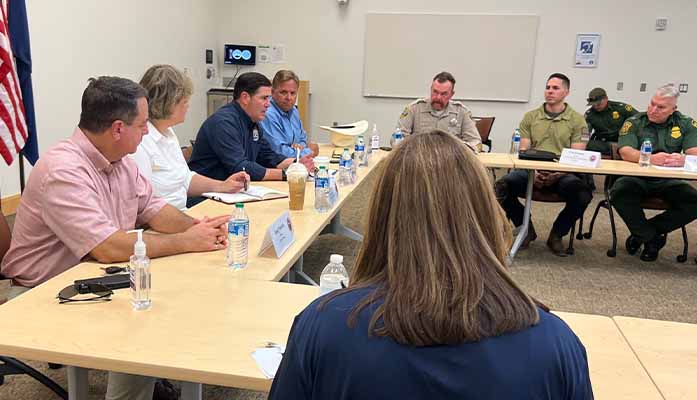
The governor also took part in a roundtable discussion in Yuma with several local, county, state, and federal officials as well as business leaders and community members. Among those providing Ducey an “update on the ground” were USBP Yuma Sector Chief Chris Clem and CBP’s San Luis Port of Entry Director John Schwamm.
Ducey noted that multiple migrants illegally crossed the border “right in front of us” the last time he stood along the border in Yuma.
“Securing the nation’s southern border is a federal responsibility,” the governor noted. “A responsibility President Biden refuses to address. So Arizona filled the gap.”
Jonathan Lines of the Yuma County Board of Supervisors visited the Yuma “Border Barrier” with the governor on Thursday. He says the containers are working, as there have been less people attempting to cross in those areas.
“The containers have helped regain operational control of our nation’s southern border,” said Lines. “Governor Ducey’s strategy has allowed law enforcement to concentrate resources and protect our communities.”
Tim Roemer, Arizona Department of Homeland Security Director and the state’s Chief Information Security Officer, emphasized that crossing into the U.S. between official CBP ports of entry is illegal.
“The cartels have been taking advantage of the gaps in the border wall to surge migrants and overwhelm law enforcement,” Roemer noted.
Also Thursday, Ducey reacted to data released by the U.S. Department of Homeland Security that 748 deaths have been reported of migrants crossing the U.S. / Mexico border since Oct. 1, 2021. That number of deaths already far exceeds the 557 deaths reported from Oct. 1, 2020 to Sept. 30, 2021.
“This is a humanitarian crisis,” Ducey said. “Migrants making the dangerous journey across the border are faced with immense heat, crime and unfortunately, sometimes death. Enough is enough. That’s why Arizona is closing the border wall gaps.”
U.S. officials have not directly acknowledged the huge increase of deaths over the current fiscal year, which many border observers attribute to a lack of immigration law enforcement by the Biden administration. However, a CBP spokesperson appeared to put all blame for the rise in deaths on the cartels.
“Transnational criminal organizations continue to recklessly endanger the lives of individuals they smuggle for their own financial gain with no regard for human life,” according to the CBP statement. “The terrain along the border is extreme, the summer heat is severe, and the miles of desert migrants must hike after crossing the border in many areas are unforgiving.”
by AZ Free Enterprise Club | Jun 10, 2022 | Opinion
By the Arizona Free Enterprise Club |
The Left says it isn’t happening. And they’re quick to run to their allies in traditional corporate media to further the lie that voter fraud is a made-up problem. But then maybe they would like to explain the guilty plea from last week.
On Thursday, Guillermina Fuentes of San Luis pleaded guilty to one count of Ballot Abuse for her role in a ballot harvesting scheme from the August 2020 Primary Election. And she wasn’t the first one to do so. Back in March, Alma Juarez, also of San Luis, entered the same plea. Both women admitted that they knowingly collected ballots from another person, and those early ballots belonged to individuals for whom they were not a family member, household member, or caregiver.
>>> CONTINUE READING >>>