by Matthew Holloway | Jan 12, 2025 | Economy, News
By Matthew Holloway |
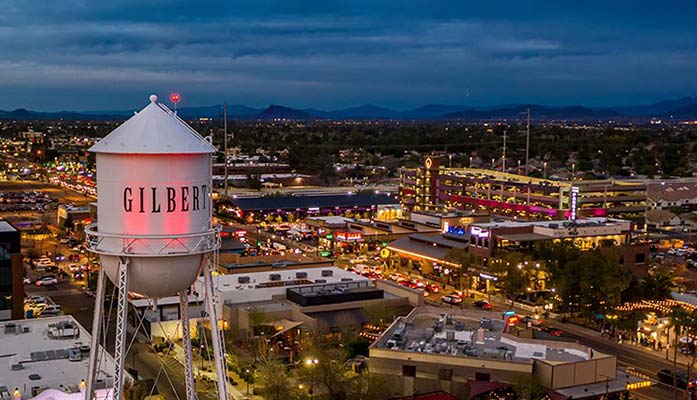
The Town of Gilbert is the target of a lawsuit by the Goldwater Institute on behalf of the Home Builders Association of Central Arizona and a local property owner, Jonathan Barth, for allegedly violating the Arizona Constitution which bans tax increases on “services.”
According to Goldwater, the tax increase imposed by the Town of Gilbert includes “many types of business that do not produce tangible goods, such as advertising, photography, utilities, hotel/lodging, and construction.”
Goldwater is challenging two of the tax increases in particular: on homebuilding and short-term rental properties.
As noted in the text of the lawsuit, the Arizona Constitution prohibits “any county, city, town, municipal corporation, or other political subdivision of the state, or any district created by law” from creating any new or increasing any existing transaction-based taxes on the “privilege to engage in, or the gross receipts of sales or gross income derived from, any service performed in this state.”
The new tax ordinance in question, per the Town of Gilbert’s website, imposes a 0.5% increase in the existing sales tax and creates a “use tax” to be “paid for by residents and businesses when purchases are made online with out-of-state vendors who do less than $100K of sales in Arizona per year.”
The lawsuit explains that, “As a result of the Ordinance, individuals, businesses, and taxpayers, including Plaintiff Jonathan Barth, who engage in the rental or lease of real property, including for transient lodging, will pay a higher tax rate for the services they perform. Additionally, individuals, businesses, and taxpayers that engage in general contracting services, including the members of Plaintiff Home Builders Association of Central Arizona (“HBACA”), will pay a higher tax rate on the services they perform.”
Barth, an educator and father of five, will be impacted because he earns supplemental income by managing his detached bungalow as a rental for short-term tenants. He told Goldwater, “This tax hike makes it all the more difficult to make ends meet in Gilbert.”
Former Mayor Brigette Peterson and all of the members of the Town Council are named as defendants in addition to the town itself.
The town allegedly intends to use the projected $55 million yield of this new tax for “Critical Infrastructure Projects,” adding that “Time is of the essence as many of Gilbert’s services are over capacity and new infrastructure is needed.”
The Goldwater Institute has found however, that these “Critical Infrastructure Projects,” include pickleball courts, splash pads, a ropes course, and a “statement” bridge.
The Home Builders Association of Central Arizona (HBACA) told Goldwater that the new taxes will result in increased construction costs in the town as well. HBACA CEO Jackson Moll warned, “Gilbert officials are trampling on their own constituents’ rights with no regard for the consequences their illegal actions will have on taxpayers and homebuyers. The Arizona Constitution is clear: increasing taxes on services, including on construction contracting, is unlawful.”
As previously reported by AZ Free News, the Goldwater Institute pursued a similar action against the Town of Payson in September when the Town Council decided to incur a $70 million debt via a bond measure without a public referendum.
Matthew Holloway is a senior reporter for AZ Free News. Follow him on X for his latest stories, or email tips to Matthew@azfreenews.com.
by Daniel Stefanski | Dec 4, 2024 | News
By Daniel Stefanski |
Republicans in the Arizona Legislature scored another legal victory with the nation’s high court granting cert on a case they had intervened in earlier this year.
On November 22, the Supreme Court of the United States agreed to hear FCC v. Consumers’ Research in its current term. The case will be consolidated with SHLB Coalition v. Consumers’ Research. This case involves a question of the nondelegation doctrine, which, according to the Legal Information Institute at Cornell, is “the principle that Congress cannot delegate its legislative powers or lawmaking ability to other entities.”
The decision from the U.S. Supreme Court represents a significant victory for Republicans in the Arizona Legislature, who had joined an amicus brief from state attorneys general from around the country to urge the justices to hear arguments in this case.
On its X account, Consumers’ Research reacted to the order, writing, “American citizens and consumers alike deserve basic accountability in government and in the marketplace. Americans currently are forced to pay a tax with every phone bill, set by unelected bureaucrats, at the recommendation by the same private corporation that receives the revenue. This is absurd and we believe SCOTUS will agree as the 5th circuit did.”
Arizona Senate President Warren Petersen, who was instrumental in the Arizona Legislature joining the efforts to support Consumers’ Research, told AZ Free News that, “These carriers are unlawfully taxing the public to the tune of billions of dollars. Congress should instead determine what taxes our citizens are to pay and by how much, not unelected Washington bureaucrats.”
The brief that the Arizona Legislature signed onto was joined by 15 other states, led by the West Virginia attorney general. The other states were Alabama, Arkansas, Indiana, Kansas, Louisiana, Missouri, Montana, Nebraska, Ohio, Oklahoma, South Carolina, Tennessee, Texas, and Virginia.
In their brief, the attorneys general argued that “the states – and our country – need guidance on the nondelegation doctrine,” that “those who mean to scare the court away from these issues are wrong,” that “preserving Congress’s legislative power protects the states’ interests,” and that “this court should evaluate this statute.”
They wrote, “Every year, the Federal Communications Commission extracts billions from American consumers based on a vague statute that says telecommunications providers ‘should make an equitable and nondiscriminatory contribution to the perseveration and advancement of universal service.’ The only limits on this multi-billion-dollar fee are vague notions like ‘quality’ service. And the Commission – an independent agency already shielded from accountability in its own right – doesn’t even set these rates itself. Instead, a private company picks a number that the Commission rubberstamps later.”
The attorneys general added, “Make no mistake: Amici States recognize the goal of securing universal telecommunications service is laudable. Congress can and should find a way to provide these services for everyone. But it’s a ‘fundamental principle that, no matter how laudable its purposes, the actions of our government are always subject to the limitations of the Constitution.’ Congress needs to be the one to act here, not a private band of unaccountable industry participants. The Court should grant the Petition to say so.”
The Court’s decision to hear arguments in this matter follows an opinion from the U.S. Court of Appeals for the Fifth Circuit in July, which found that “this misbegotten tax violates Article I, Section I of the Constitution.” The appeals court stated, “The Q1 2022 USF Tax is not only difficult to square with the Supreme Court’s public nondelegation precedents. It was also formulated by private entities. That raises independent but equally serious questions about its compatibility with Article 1, Section 1, which requires ‘[a]ll legislative Powers herein granted shall be vested in a Congress.’ We (1) explain that the scope of FCC’s delegation to private entities may violate the Legislative Vesting Clause by allowing private entities to exercise government power. Then we (2) explain that even if FCC’s delegation could be constitutionally justified, FCC may have violated the Legislative Vesting Clause by delegating government power to private entities without express congressional authorization.”
According to SCOTUSblog, this case will likely be argued before the U.S. Supreme Court in the spring of 2025. The justices’ opinion will be rendered in June or July at the conclusion of their term.
Daniel Stefanski is a reporter for AZ Free News. You can send him news tips using this link.
by Matthew Holloway | Jun 26, 2024 | News
By Matthew Holloway |
The Goldwater Institute, acting on behalf of Former Scottsdale Mayor Jim Lane, local activist Susan Wood, and AZGOP Member-at-Large Yvonne Cahill (CD1) filed a lawsuit in Maricopa County Superior Court against the city of Scottsdale on June 18. In the complaint, the plaintiffs allege that the city is mischaracterizing a proposed new sales tax set to be voted on by the public in November with “objectively false or misleading information.”
According to court documents, the Goldwater Institute and the plaintiffs allege that the proposed tax’s “titles and tagline text are misleading, obscure the principle provisions of the measure, and constitute a ‘bait and switch.’” They go on to explain, “The Resolution is deceptive and inherently misleading, and fundamentally unfair.”
The controversy has arisen from a 0.2% Land Acquisition Tax that was approved in 1995 which is set to expire no later than June 30, 2025, and another in 2004 at 0.15% which funded the land purchase and construction of trailheads in the McDowell Sonoran Preserve respectively and a newly proposed 0.15% sales tax that would last for 30 years to provide funds for city parks.
In the 2025 Scottsdale 0.15% Sales Tax: Questions and Answers, the new tax description claims, “The ballot proposal would replace and reduce an expiring 0.20% city sales tax with a 0.15% sales tax to provide funds solely for capital replacements and improvements at city parks and recreational facilities and additional maintenance, preservation and protection, including police and fire protection, of city parks and the McDowell Sonoran Preserve. This tax would expire after 30 years.”
As the lawsuit notes, “the New Parks & Rec Tax does not, and cannot, ‘replace’ the Land Acquisition Tax that was scheduled to expire already. And likewise, the New Parks & Rec Tax “does not, and cannot, ‘reduce’ the current Land Acquisition Tax,” which without any intervention would already be eliminated as scheduled.
The City wrote that the new tax, which it calls a “replacement tax,” would provide:
- 51% for capital asset replacements and improvements to aged Indian Bend Wash parks and other citywide parks (see further discussion of capital replacements and improvements below)
- 14% for increased citywide park maintenance including additional maintenance workers and contracts to enhance park maintenance
- 7% for the Police Park Ranger program including additional resources for enforcement and education to provide better safety and security for city parks and the Preserve.
- 18% to increase maintenance, protection, and care for the McDowell Sonoran Preserve and its desert plants and wildlife, including trail and trailhead maintenance; protecting wildlife habitat; assessing and protecting archaeological, ecological, and cultural resources; and removing invasive plants to reduce wildfire risk (known as fire fuel mitigation)
- 10% for the Fire Department wildland fire fuel mitigation program with additional resources to remove/reduce overgrown plants and weeds around the Preserve and in city open spaces that pose ongoing wildfire risk during dry summer months, and additional Fire Department resources including technical rescue teams for citywide parks and the Preserve.
Goldwater Institute spokesman Joe Seyton told the Daily Independent, “They are deceiving voters because they are claiming a tax increase is actually a tax reduction, but what they are not saying is that voters will pay a lower sales tax if they vote no than if they vote yes.” He added, “Arizona law prohibits ballot measures from communicating information that is objectively false or misleading. It’s a bait and switch.”
In a statement published by the Goldwater Institute Cahill said, “Our own city leaders are deceiving taxpayers so that we’ll vote to raise taxes on ourselves. We deserve honesty from our local officials—especially when it comes to the money hardworking Arizonans are required to fork over to the government.”
Speaking with The Scottsdale Progress, Mayor David Ortega lashed out at his predecessor saying, “It is sad that former Mayor Jim Lane, who saturated our city with 23,689 apartments during his tenure, now tries to stop citizen-driven renewal of our 48 city parks, the Green Belt and protection of the McDowell Sonoran Preserve.” He continued, “Adding new Police, Fire and Park Ranger personnel for our safety is also a key element of the ballot measure. In Scottsdale, we value our treasured open space legacy, and commitment to pass them on in great shape to future generations.”
The mayor continued, “Lane and opponents failed to show up during months of deliberations, so we will see them in court.”
Matthew Holloway is a senior reporter for AZ Free News. Follow him on X for his latest stories, or email tips to Matthew@azfreenews.com.
by Daniel Stefanski | Jun 20, 2024 | News
By Daniel Stefanski |
Voters in Maricopa County have the opportunity to submit comments for public review on a proposition that will be on the ballot in the November General Election.
Last week week, the Maricopa County Elections Department notified “interested individuals, political committees and organizations” that the portal to submit arguments for or against Proposition 479 was now open. These comments will be collected for publication in the 2024 General Election Maricopa County Publicity Pamphlet, which will be distributed to county voters before they have the opportunity to start voting in October for the fall campaign.
Proposition 479 is a result of SB 1102, which was passed in 2023, requiring “that the Maricopa County Board of Supervisors call a countywide election for the continuation of the county transportation tax at least two years before the expiration of the tax, and shall conduct that election on a consolidated election date no less than one year before the expiration of the tax.”
The official title of the measure is the “Regional Strategic Transportation Infrastructure Investment Plan.”
If passed by Maricopa County voters, the revenues would be allocated in the following manner: “(a) 40.5 percent to freeways and other routes in the state highway system; (b) 37 percent to public transportation; and (c) 22.5 percent to arterial streets, intersection improvements and regional transportation infrastructure.”
Last month, Noble Predictive Insights published a poll, which showed that “nearly 7 in 10 Maricopa County voters (68%) support the renewal of Prop 479, with only 18% opposed; [and that] this is a notable increase in support compared to last July when 56% were in favor and 17% opposed.”
After the Arizona Legislature passed a compromise for this proposal in July 2023, Republican Senate President Warren Petersen claimed victory, calling SB 1102 “the most conservative transportation plan in our state’s history.” He added, “The guardrails, taxpayer protections and funding allocations in the text of this bill reflect the priorities of voters, to reinvest their tax dollars in the transportation modes they use most.”
Democrat Governor Katie Hobbs, who signed the compromise, was diplomatic in her statement, saying, “Today, bipartisan leaders invested in the future of Arizona families, businesses, and communities. The passage of the Prop 400 ballot measure will secure the economic future of our state and create hundreds of thousands of good-paying jobs for Arizonans. I am glad we were able to put politics aside and do what is right for Arizona.”
Members of the Arizona Freedom Caucus were adamantly opposed to the bill as it was released and approved. After the Prop 400 plan passed, the Freedom Caucus tweeted, “Legislative conservatives near unanimously opposed this horrible bill. Conservative watchdog groups unanimously opposed it. The bill may have been better than the communists at @MAGregion’s horrific plan, but that’s a ludicrously low bar for success. This bill was antithetical to conservatism.”
The breakthrough on the Prop 400 compromise took place after Governor Hobbs vetoed a Republican proposal earlier that summer. At that time, Hobbs stated, “I just vetoed the partisan Prop 400 bill that fails to adequately support Arizona’s economic growth and does nothing to attract new business or create good-paying jobs.”
In May 2023, the governor had created unrest over ongoing negotiations, allegedly sending out a tweet that highlighted her fight with Republicans at the Legislature at the same time she was meeting with Senate President Warren Petersen.
Petersen stressed the importance of the agreed-upon bill, asserting that officials had “secured a good, responsible product for the citizens of Arizona to consider in 2024, giving voters the option to enhance critical infrastructure that our entire state relies upon.”
Voters will soon have that opportunity to consider this product as the November General Election quickly approaches.
Daniel Stefanski is a reporter for AZ Free News. You can send him news tips using this link.
by Matthew Holloway | Jun 14, 2024 | Economy, News
By Matthew Holloway |
The owners of the businesses that power the economy of southern Arizona are about to see some long overdue relief from a 2018 excise tax which was struck down by the State Supreme Court in 2022. Affected businesses will be able to file for a waiver or refund of the tax by April 9, 2026 to recover at least $87 million that was unlawfully collected by the county with another $4 million in interest to be paid out proportionally. Unfortunately, consumers who paid the tax as part of a transaction, will be unable to seek a refund.
The Pinal County transportation excise tax was invalidated by the Arizona Supreme Court in Vangilder v. Arizona Department of Revenue, in which the court found that the Pinal County Board of Supervisors violated state law by adopting a “two-tiered retail transaction privilege tax (TPT) on tangible personal property as part of a transportation excise tax.” While the court held that the basis of the tax was lawful, it invalidated the two-tiered system where the first $10,000 of any one item was taxed at one rate and any in excess was taxed at zero percent.
Arizona Supreme Court Justice Kathryn H. King, a former Deputy General Counsel in the Office of Governor Doug Ducey and appointed by Ducey wrote for the court:
“For the foregoing reasons, we conclude that Pinal County complied with state law in adopting the transportation excise tax. We further conclude, however, that state law does not permit Pinal County to adopt a two-tiered retail TPT structure as part of a transportation excise tax, whereby the first $10,000 of any single item is taxed at one rate and any amount in excess is taxed at a rate of zero percent. For that reason, Pinal County’s two-tiered retail TPT structure in Proposition 417 is unlawful and invalid.
Accordingly, we affirm the court of appeals’ opinion in part and vacate in part. We vacate paragraphs 2 and 23–30 of the court of appeals’ opinion. We affirm the superior court on other grounds. We deny Vangilder’s request for attorney fees.”
The filing opportunity was announced in a letter from the Arizona Auditor General on May 17 according to The Center Square. The letter detailed that approximately $87 million was collected through the excise tax which has earned $4 million in interest adding that the ‘applicable interests” would be paid out to those requesting a refund as well. However, the actual consumers who paid the 0.5% sales tax up to the first $10,000 have no such recourse because of the “transaction privilege tax” status of Arizona the outlet noted cited the Pinal County website.
The Auditor General wrote, “Between April 1, 2018, and February 28, 2024, the Pinal Regional Transportation Authority did not expend any of the 2018 Excise Tax revenues or accrued interest.”
The county website explained, “Specifically, taxpayers who will be able to request a refund or waiver of monies paid toward this invalidated tax are generally limited to those businesses that filed and paid tax to the Department for the April 2018 through March 2022 tax periods as part of their overall transaction privilege tax liability, for business activity that they conducted either in Pinal County or with Pinal County customers.”
Matthew Holloway is a senior reporter for AZ Free News. Follow him on X for his latest stories, or email tips to Matthew@azfreenews.com.