Maricopa County Recorder Justin Heap has announced that his office set a new speed record for processing Election Day ballot drop-offs, completing signature verification and curing ballots within 48 hours of the Nov. 4th elections. The matter was complicated when officials scrambled to process thousands of ballot envelopes discovered days later in a misplaced transport box.
In a Nov. 6 update on X, Heap wrote, “All calls to voters with signature inconsistencies have been completed.” He added that finishing both signature verification and voter calls “within just 48 hours of Election Day shatters all previous timeframes for elections with more than 100,000 Election Day drop-offs.”
RECORDER’S ELECTION UPDATE:
✅ All calls to voters with signature inconsistencies have been completed.
Finishing both signature verification and voter calls within 48 hours of Election Day shatters all previous timeframes for elections with more than 100,000 Election Day…
— Maricopa County Recorder Justin Heap (@azjustinheap) November 7, 2025
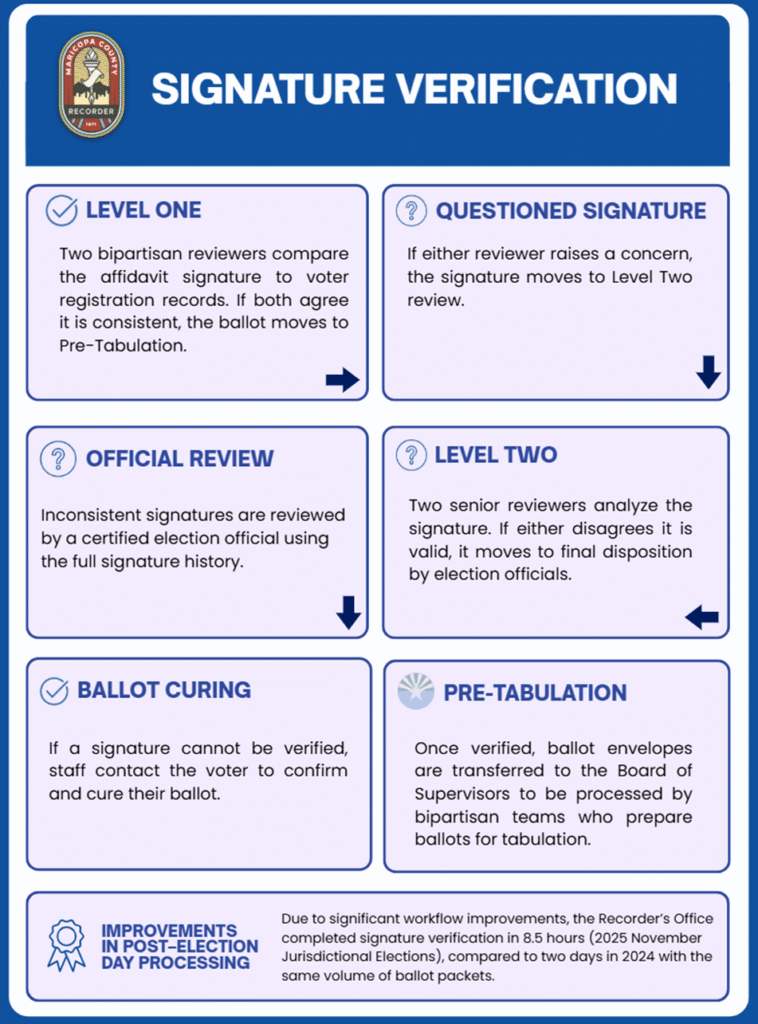
According to detailed metrics provided to AZ Free News by the Maricopa County Recorder’s Office, the November election included 117,664 ballot packets returned via mail or drop box on Election Day. Signature verification on those packets began at 6:00 a.m. on Wednesday, Nov. 5, and the office says the final file review was completed by 2:33 p.m., for an 8.5-hour turnaround on the Election Day returns.
For comparison, the Recorder’s Office pointed to the July 30, 2024, primary, when roughly 114,681 similar packets took about two days to clear signature review under then-Recorder Stephen Richer. In an emailed statement to AZ Free News, Maricopa County Director of Communications Judy Keane wrote:
“This represents a dramatic acceleration in post–Election Day processing: completing in 8.5 hours what previously required two days in the 2024 Primary, despite similar packet volumes. This outcome demonstrates the effectiveness of process improvements and the exceptional performance of the team.”
Two-Reviewer System and Quad-Screen Interface
Heap campaigned on tightening signature verification and has spent much of his first year in office overhauling the workflow while feuding with the Maricopa County Board of Supervisors over funding, control of election IT systems, and a controversial Shared Services Agreement now mired in litigation.
In response to written questions from AZ Free News, the county Public Information Office said that every early-ballot signature in the Nov. 4 election was reviewed by at least two human reviewers of different parties.
The office described the workflow this way:
Level One review uses a “quad-screen” interface on a single monitor:
Bottom left: the affidavit signature being reviewed
Above it: the voter’s latest signature on file
Upper right: second-latest signature
Middle right: third-latest signature
Bottom right: the voter’s registration signature
All signature exemplars can be rotated to the primary comparison position above the affidavit signature so reviewers can align shapes and slants.
According to the county, Level Two reviewers see the same layout. Still, they can also scroll through the voter’s full signature history when Level One reviewers either disagree or cannot comfortably verify a match.
County officials say that the combination of two reviewers of opposing parties and deeper access to a voter’s signature history at the second level was designed to increase both scrutiny and perceived neutrality, after years of partisan conflict over how Maricopa handles early ballots.
For voters whose signatures still couldn’t be confirmed, the office used multiple curing channels tied to identity verification: calls from election staff, text messages (for those who opted in), emails, and a secure online dashboard at BeBallotReady.vote, consistent with state guidance on signature curing windows.
Record Processing Claims Tested by Ballot Mishap
Heap’s announcement of “shattering” past performance landed just as Maricopa County was forced to acknowledge another election-administration black eye: the discovery of two sealed transport boxes with 2,288 returned ballot affidavit envelopes that had not been included in the initial post-Election Day processing.
On Nov. 7, county elections officials disclosed that poll workers had mistakenly placed the sealed transport boxes inside a blue drop box instead of returning them to the county’s election center on Election Night. Local outlets reported that the boxes bore intact tamper-evident seals and matched election-night serial numbers, but the ballots inside had not been counted, according to AZ Family.
Heap’s office responded with its own update, saying signature verification on all 2,288 ballot packets had been completed and that every voter whose signature needed curing had been contacted before the statutory deadline.
RECORDER'S ELECTION UPDATE:
The County Recorder’s Office has completed signature verification on all 2,288 of the missing ballot packets we received from the Board this morning. In the last hours, we have contacted all remaining voters with signatures requiring additional… pic.twitter.com/M1PGHj6Tkw
— Maricopa County Recorder's Office (@RecordersOffice) November 7, 2025
Jennifer Liewer, Deputy Elections Director, issued a statement following the report saying:
“Friday, Nov. 7, 2025: This morning, as part of standard post-election protocols, elections workers inspected equipment that had been returned from voting locations. This process includes unpacking and logging equipment.
“During this inspection, two sealed transport boxes of returned ballot affidavit envelopes were found inside a blue drop box. While the transport boxes did have tamper evident seals, ensuring the security of ballots, poll workers had mistakenly placed the sealed boxes inside a blue drop box rather than returning them on Election Night. Immediately after the discovery, a bi-partisan team of election staff took custody of the sealed bins and worked quickly to ensure chain of custody was followed. The green affidavit envelopes will now be signature verified and processed for tabulation.
“Per statute, green affidavit envelopes are to be counted at the close of voting on Election Night. Counted envelopes are then placed in a large bin, sealed, and returned to the Maricopa County Tabulation and Election Center.”
As previously reported by AZ Free News, Recorder Heap has been embroiled in a lengthy legal battle with the Maricopa County Board of Supervisors over funding to modernize and provide technical support for the county’s election equipment, and centered on the division of responsibilities created in a Shared Services Agreement (SSA) agreed to by Heap’s predecessor, Stephen Richer.
Heap sought a Temporary Restraining Order against the Board’s planned assessment of election systems and databases in early October, per KJZZ. However, on November 6th, Maricopa County Superior Court Judge Scott Blaney denied the motion, writing “The Recorder’s concerns regarding the assessment’s potential interference with the 2026 Primary Election are speculative at this point in the litigation,” according to the court order.
The Arizona Court of Appeals is set to hear oral arguments on August 19 in a closely watched lawsuit challenging the state’s early ballot signature verification process—one that could reshape how election officials authenticate mail-in ballots. The case, Arizona Free Enterprise Club v. Fontes, will be heard by Division Two of the Court of Appeals, which lifted a prior stay in the case following a joint request by all parties to move forward on the merits.
At the heart of the dispute is whether the Secretary of State’s Elections Procedures Manual (EPM) has unlawfully expanded the scope of documents used to verify a voter’s signature on early ballot envelopes. The plaintiffs—Arizona Free Enterprise Club, Restoring Integrity and Trust in Elections, and Yavapai County voter Dwight Kadar—argue that Secretary of State Adrian Fontes and his predecessor, now-Governor Katie Hobbs, enforced EPM guidance that violates state law.
Under Arizona statute A.R.S. § 16-550(A), election officials are required to compare a voter’s early ballot envelope signature to the one in their “registration record.” However, the current EPM—originally authored by Hobbs in 2019 and maintained under Fontes—permits election officials to validate signatures by comparing them to any election-related document on file, such as early ballot requests, provisional ballot envelopes, or Active Early Voting List notices.
“The current election procedures manual adopted by the Secretary of State has rewritten state law regarding signature verification for mail-in ballots,” said Arizona Free Enterprise Club President Scot Mussi. “The result is a process that invites questionable methods and opportunities for abuse during the signature review process. It’s time for the courts to bring this illegal EPM practice to a halt.”
The case has had a turbulent procedural history. In 2023, Yavapai County Superior Court Judge John Napper initially ruled that the EPM violated state law, stating that the definition of “registration record” is neither vague nor ambiguous. Napper rejected the Secretary of State’s argument that the term could include any number of election-related documents. However, in a surprising reversal later in the proceedings, Napper ruled in favor of the state—prompting the plaintiffs to appeal.
The outcome of this case could have major consequences for how Arizona handles the verification of early ballots in future elections. Arizona is a state with widespread early and mail-in voting, and signature matching is often the sole method for confirming voter identity on ballots returned by mail. Early ballot voters are not required to provide other identifying information, such as a driver’s license number, date of birth, or the last four digits of a Social Security number.
After months of delays—including a stay prompted by a separate ruling that invalidated the 2023 EPM for procedural reasons—the Court of Appeals has agreed to resume the case. All parties have urged the court to issue a ruling on the merits, regardless of the Arizona Supreme Court’s handling of a related challenge filed by the Republican National Committee.
The court’s decision will help clarify the balance of power between Arizona’s elected officials and its election laws, especially in the increasingly scrutinized area of early voting.
Jonathan Eberle is a reporter for AZ Free News. You can send him news tips using this link.
Election volunteers will be allowed to observe signature verification processes in Maricopa County up close for the first time.
Maricopa County Recorder Justin Heap announced the “common-sense” policy change on Monday. The recorder said the observers won’t have access to the party affiliation of voters.
“This change allows bipartisan election observers into the Signature Verification room to more directly observe the Signature Verification process,” said Heap. “This is one of the first of many commonsense improvements to make Maricopa’s election processes more trustworthy and transparent.”
This change allows bi-partisan election observers into the Signature Verification room to more directly observe the Signature Verification process. The new policy ensures Signature Verifiers are not able to see the Party Affiliation of the voters whose signatures are going… https://t.co/boxwqisUjG
— Maricopa County Recorder Justin Heap (@azjustinheap) February 4, 2025
In order to protect the party affiliation of voters, Maricopa County won’t display political parties or any “personally identifying data” on the signature verification screen. This change will take effect with the May 2025 elections, per the recorder’s office.
Heap revealed in Monday’s press release containing the policy change announcement that previous recorder administrations hadn’t been fully honest about election workers’ abilities to access voters’ party affiliations and personal identifying information. Per Heap, all election workers had to do to access that information was scroll down on their screens during signature verification processes.
“Previously, voters were assured by election officials that no party or personally identifying data was available to signature verifiers,” said Heap. “In my review of our election processes I have discovered this was not the case. Signature verification workers who scrolled down the page would still see this information on the scans of older ballots.”
Prior to Heap’s administration, election volunteers weren’t permitted to observe signature verification processes. In the accompanying press release issued on Monday, the recorder’s office claimed that the previous policies requiring signature verification observation to take place from an adjacent hallway some distance from the work “made meaningful observation of the process impossible.”
“Removing that data will accomplish two important things: it brings bi-partisan observers back into the room to scrutinize the process and ensures that verifiers do not know the party affiliation of the voters whose signatures they are verifying. This will be the first of many commonsense improvements we will be making to ensure that future elections in Maricopa County are run in a trustworthy, transparent, and efficient manner,” concluded Heap.
Ahead of the presidential election last year, the state established the first legally binding signature verification rules as part of necessary modifications to election dates made to comply with the shortened electoral count deadline.
Those signature verification rules (contained within HB 2785) require the rejection of early ballot envelopes bearing signatures that don’t match the voter’s registration or records. Beginning next year, voters may bypass the signature verification requirement by showing their ID while returning their early ballot in person. Other Republican-led aspects ensuring stricter signature verification were stripped from the bill following negotiations with Democratic lawmakers and Governor Katie Hobbs.
Improving signature verification processes was a top priority for Heap during his campaign to oust then-incumbent Stephen Richer. Heap attested during his campaign that the county’s standards for signature verification were too lax based on his personal experiment with the process.
We recent has bond elections all over the state. Bond elections are "Mail-in only" and the ONLY security measure we have on mail-in ballots in signature verification. So I decided to test the system. I signed my ballot with an old signature that I haven't used sign high school…
— Maricopa County Recorder Justin Heap (@azjustinheap) February 7, 2024
AZ Free News is your #1 source for Arizona news and politics. You can send us news tips using this link.
Another election has come and gone, and unsurprisingly, Arizona is yet again the butt of national jokes for taking weeks to process ballots and tabulate votes. While some in the corporate media still attempt to defend our vote counting circus, most everyone is in agreement that big changes are needed. It doesn’t take being an election expert to recognize that states with far greater populations, who also experience large rates of early voting, somehow get their votes counted on election night or near to it.
It’s a fix that is long overdue, yet for over five years the reform has continued to run into a political meatgrinder at the state Capitol. Since 2019, our organization, the Arizona Free Enterprise Club, has supported, championed, and authored bills to ensure we get results on election night. And while Democrats in the legislature have been an obstacle to reform (they have universally opposed any reforms geared toward getting faster results), they have not been the only impediment to fixing the problem.
The real culprit is opposition from county “election officials,” or more precisely, their taxpayer-funded lobbyists. For years, our so-called election experts have worked overtime to stop any reasonable reforms to Arizona’s mail-in voting system. Their tactics are incredibly disingenuous. When people express their frustration about the glacier pace of vote counting, they clap back (usually with dripping condescension) that their hands are tied by existing law. But when lawmakers introduce bills to change those laws, those same election officials send their army of lobbyists down to the Capitol to fight reform at every turn…
Secretary of State Adrian Fontes appears to be in a tug-of-war with Governor Katie Hobbs to determine who is worse at their job. It’s been well-documented that since she took office, Hobbs has been off to a rough start with high-profile staff exits, breaking the veto record after killing the bipartisan “Tamale Bill,” and alienating many Democrats by signing the Republican budget. But over the past eight months, Fontes has been working just as hard in the battle to see who’s more incompetent. Not only has he failed to perform the necessary voter list maintenance—leaving 14 Arizona counties in violation of Section 8 of the National Voter Registration Act—but he rushed through a version of the Elections Procedures Manual (EPM) that is filled with unlawful provisions.
Now, Secretary of State Fontes has been dealt another major blow after a superior court judge ruled against him…