As another legislative session begins in Arizona, Republicans and Democrats are again bringing the all-important issue of school choice to the forefront of the public debate.
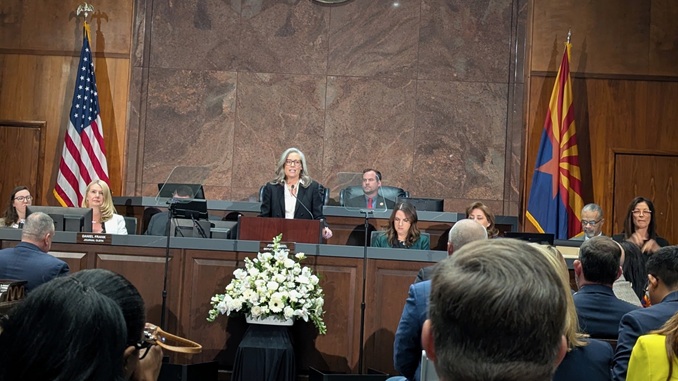
On Monday, Governor Katie Hobbs ushered in the start of the 57th Regular Session of the Arizona Legislature with her State of the State address, where she took time to criticize the Empowerment Scholarship Accounts (ESA) program. In her speech, Hobbs said, “The current program is unchecked, flawed, and rife with exploitation. Three years ago, it went far beyond its original purpose, which was to support kids with special needs and military families. Today, it has ballooned into a billion-dollar boondoggle increasingly scamming Arizonans. Other entitlements funded by taxpayers have strict oversight and income requirements. Yet the ESA program has the privilege of virtually no safeguards.”
Other entitlements funded by taxpayers have strict oversight and income requirements. Yet the ESA program has the privilege of virtually no safeguards. My executive budget offers a balanced solution that supports families and finally brings real and effective guardrails to ESAs.
Hobbs proposed changes to the ESA program for a “balanced solution that supports families and finally brings real and effective guardrails to ESAs.” Her solution was to “institute responsible income caps, ensure taxpayers know where their money is going, and create real accountability for taxpayer dollars.”
The governor’s remarks were met with immediate criticism from Republicans and others who support the expanded ESA program. Superintendent of Public Instruction Tom Horne said, “Under my leadership, the department has done a full-court press against waste and fraud. I hired both a program auditor and an investigator, which had not been done before. I require that every expenditure be for a valid educational purpose and have been attacked for doing that. The Governor needs to pay more attention to what is going on. She gets an ‘F’.”
Senate President Pro Tempore T.J. Shope added, “We will also protect parental choice, so that every child in the state has the ability to succeed in the classroom, no matter their zip code or financial status.”
Common Sense Institute Arizona wrote, “In her State of the State address, Governor Hobbs asked lawmakers to compare Arizona’s ESA program to other government entitlement programs with respect to accountability and transparency. Luckily, we already did! And it turns out that improper payment rates in the Arizona ESA program are a fraction of those in other government programs like Medicaid, Unemployment Insurance, and SNAP.”
In her State of the State address, @GovernorHobbs asked lawmakers to compare Arizona's ESA program to other government entitlement programs with respect to accountability and transparency.
Luckily, we already did! And it turns out that improper payment rates in the Arizona ESA… pic.twitter.com/XAfMKzaPmS
— Common Sense Institute Arizona (@CSInstituteAZ) January 13, 2025
Jason Bedrick said, “The voters made their will clear by re-electing those who supported ESAs and expanding their legislative majority. The legislature should reject Gov. Hobbs’ attempts to undermine ESA families.”
Once again, AZ Gov. @KatieHobbs is attacking families who use Empowerment Scholarship Accounts.
In her State of the State address, she called for income caps that would kick thousands of families out. Is she going to impose income caps on district schools too?
On the flip side, Governor Hobbs’ comments received support from her allies, who have long attempted to shrink, regulate, or eliminate the historic ESA expansion program in Arizona. Save Our Schools Arizona Executive Director Beth Lewis responded, “It is time to end the rampant waste, fraud, and abuse in the universal ESA voucher program. We commend Governor Hobbs for championing public education and pushing for much-needed voucher reform. We sincerely hope legislators like Senate President Petersen who name ‘fiscal responsibility’ their top priority will bring long-overdue guardrails to this irresponsible program, which now costs taxpayers nearly $1 billion annually.”
Hobbs and legislative Republicans will continue to bicker about the future of school choice in Arizona, but not much – if anything – will be done this year (and likely the next) to regulate ESAs per the governor’s insatiable desire. Over the past two years, Arizona Senate President Warren Petersen successfully fended off ferocious political attacks that targeted ESAs and other school choice opportunities for Arizonans. He will again be counted upon, along with his Republican colleagues in the Arizona House and Senate, to protect one of the top states in the country for school choice.
Daniel Stefanski is a reporter for AZ Free News. You can send him news tips using this link.
The 2025 Free Enterprise Report from the Common Sense Institute Arizona (CSI) was released Monday and ranked the state of Arizona amongst the states in education as well as the new indexes of economic performance and economic momentum.
According to Katie Ratlief, Executive Director of CSI Arizona, “Arizona continues to lead the way in key areas like tax policy, state budgeting, and educational choice, proving the impact of data-driven, common-sense policies.”
“However,” she added, “challenges in housing, public safety, and homelessness are beginning to slow our momentum. While Arizona remains a top destination for growth, addressing critical issues like crime and the housing crisis will be essential to sustaining our competitiveness. Fortunately, the policies that fueled much of Arizona’s success are still in place, and with a renewed focus on data-driven solutions to address issues like crime and housing, Arizona can solidify its position as one of the most competitive states in the nation for years to come.”
The report details Arizona’s positioning in the emerging recovery of 2025, particularly highlighting the success of the state and its persistent momentum. In an overall measure, the state ranked 27th in “free enterprise competitiveness,” with CSI emphasizing advances in taxes, state budgeting, energy and education, but noting the heavy limitations imposed by housing shortages and rising costs.
In education, Arizona ranked second in the nation in share of students enrolled in school choice options, seemingly ratifying the state’s first-in-the-nation universal Empowerment Savings Account (ESA) program which now provides financial support to over 83,000 families.
Arizona is leading the charge in school choice. Arizona ranks 2nd in school choice enrollment and 1st in education spending efficiency, according to CSI's 2025 Free Enterprise Report. While there's still room to improve graduation rates and test scores, the future of education in… pic.twitter.com/JNK1pbEOwC
— Common Sense Institute Arizona (@CSInstituteAZ) January 13, 2025
The report noted, “Arizona today has the most open K-12 educational market in the country, and hosts a diverse network of District, Charter, and private school options. Since the pandemic, its home- and microschool space has expanded rapidly. Today, about a third of Arizona’s K-12 students are not enrolled in the traditional District school system.”
The report also highlighted Arizona’s Energy situation, noting in a post to X, “Arizona remains a top 20 state for energy competitiveness, boasting one of the most reliable electricity grids in the nation.”
Arizona remains a top 20 state for energy competitiveness, boasting one of the most reliable electricity grids in the nation. Learn more about the state's energy competitiveness in CSI's 2025 Free Enterprise Report.
— Common Sense Institute Arizona (@CSInstituteAZ) January 14, 2025
CSI explains, “Thanks to maintaining the nation’s largest nuclear power plant and the moderate and deliberate pace of adoption of wind and solar energy sources (supplemented by robust investment in natural gas), the state’s electrical grid remains reliable and affordable.”
Finally, Arizona’s advantageous tax system was highlighted with the 2.5% flat income tax and property tax instant depreciation of business investments cited in particular for contributing to an extremely competitive tax and regulatory system. Arizona ranked 7th in the nation on the Taxes & Fees Competitiveness Index.
The report observed, “Arizona has significantly reduced its tax burden in recent years, most notably by adopting a 2.5% flat personal income tax rate. This reform cut the top marginal tax rate from 4.5% to 2.5%, simplifying the tax code and making Arizona one of the most competitive states for income taxation.”
Looking to the future, CSI pointed to the steps Arizona legislators have taken to insulate the state against capricious tax hikes, explaining “this tax structure is well protected. Rules requiring supermajorities for statewide tax increases by the State Legislature were extended in 2022 to initiatives and referendums that would have voters approve the tax increases.” The report continues, “Arizona’s competitive ranking for its tax structure is not only unlikely to get worse but may improve (even if further reform is more incremental) due simply to the relative erosion of the position of other states that lack these structural protections.”
Shortly before his death in 2006, I had the privilege of interviewing Milton Friedman over dinner in San Francisco. The last question I asked him was: What are the three things we had to do to make America more prosperous?
His answer I have never forgotten: “First, allow universal school choice; second, expand free trade; third and most importantly, cut government spending.” That was long before Presidents Barack Obama and Joe Biden came along.
There are not too many problems in America that cannot be traced back to the growth of big and incompetent government.
It is notable that the two big bursts of inflation during modern times both occurred when government spending exploded. The first was the gigantic expansion of the LBJ “war on poverty” welfare state in the 1970s with prices nearly doubling, and then the post-COVID era spending blitz in the last year of Trump and then the Biden $6 trillion spending spree with the CPI sprinting from 1.5% to 9.1%.
Coincidence? Maybe. But I doubt it.
The connection between government flab and the decline in the purchasing power of the dollar is obvious. In both cases the Washington spending blitz was funded by Federal Reserve money printing. The helicopter money caused prices to surge. (I still find it laughable that 11 Nobel prize-winning economists wrote in the New York Times in 2021: Don’t worry, the Biden multi-trillion-dollar spending spree won’t cause inflation.)
The avalanche of federal spending hasn’t stopped even though COVID ended more than three years ago. We are three months into the 2025 fiscal year and on pace to spend an all-time high $7 trillion and borrow $2 trillion. If we stay on this course, the federal budget could reach $10 trillion over the next decade.
This road to financial perdition cannot stand. It risks blowing up the Trump presidency.
Upon entering office, Trump should on day one call for a package of up to $500 billion of rescissions — money that the last Congress appropriated but has not been spent yet. Cancelling the green energy subsidies alone could save nearly $100 billion. Why are we still spending money on COVID?
We could save tens of billions by ending corporate welfare programs — such as the wheel barrels full of tax dollars thrown at companies like Intel in the CHIPS Act. The Elon Musk Department of Government Efficiency is already identifying low hanging fruit that needs to be cut from the tree.
Along with extending the Trump tax cut of 2017, this erasure of bloated federal spending is critical for economic revival and for reversing the income losses to the middle class under Biden.
This is especially urgent because the curse of inflation is NOT over. Since the Fed started cutting interest rates in October, commodity prices are up nearly 5% and the mortgage rates have again hit 7% — in part because the combination of cheap money and government expansion is a toxic economic brew — as history teaches us.
Nothing could suck the oxygen and excitement out of the new Trump presidency more than a resumption of inflation at the grocery store and the gas pump. Trump’s record-high approval rating will sink overnight if the cost of everything starts rising again.
Cutting spending won’t be easy. The resistance won’t just come from Bernie Sanders Democrats. Trump will have to convince lawmakers in his own party — many of whom are already defending green-new-deal pork projects in their districts.
This is why Trump should make the case in his inaugural address that downsizing government is the moral equivalent of war. Borrow a line from Nancy Reagan: just say no — to runaway government spending. Say yes to what Friedman titled his famous book: “Capitalism and Freedom.”
Stephen Moore is a contributor to The Daily Caller News Foundation and a visiting fellow at the Heritage Foundation. His new book, coauthored with Arthur Laffer, is “The Trump Economic Miracle.”
Here is my wish list for the incoming Trump administration to make America healthy and prosperous and great again in 2025.
1.Slash Job-Killing Regulations
The regulatory state is a $2 trillion tax on the American economy. We all want worker safety, a clean environment and consumer protections, but in too many cases the costs of regulations far outweigh the societal benefits. President-elect Donald Trump has promised to slash 10 rules for every new rule. Just do it, Mr. President.
2. Make The Trump Tax Cuts Permanent
As JFK, Ronald Reagan and others have proven throughout history, lower tax rates lead to more growth, more investment and more jobs. The Trump tax cuts meant that a typical family of four earning $75,000 a year saw their tax bill fall by half — a benefit valued at more than $2,000. And the corporate tax rate fell from 35% — the highest in the world — to 21%, bringing jobs and capital to America. Trump has promised to make all these tax cuts permanent. Why? Because they worked almost exactly as we anticipated they would.
3. Replace Welfare With Work
Growth will require more able-bodied Americans getting off welfare and into jobs. Welfare — which includes cash assistance, public housing, food stamps, disability payments, unemployment benefits and Medicaid — needs to be a hand up, not a handout.
4. Use America’s Abundant Natural Resources
America has well more than $50 trillion of natural resources that are accessible with existing drilling and mining technologies. This is a vast storehouse of wealth that far surpasses what any other nation is endowed with. We can use the royalty payments and leases to reduce our national debt while creating hundreds of thousands of jobs.
5. Cut Medical Costs by Demanding Health Care Price Transparency
One of many ways to bring health care costs down to consumers (and taxpayers, who pay half the costs) is to require hospitals, pharmacies, doctors and health clinics to list prices for what they are charging. The Committee to Unleash Prosperity estimates that $1 trillion to $2 trillion could be reduced from health care costs, with no reduction in the quality of care, by allowing consumers to shop around on the internet for the best price — just as we do when we buy groceries, a home or a car. This will foster free market competition and lower prices.
6. Allow School Choice for All Families
Test scores in America have been plummeting. Kids are graduating from high school — if at all — without even being able to read the diploma. America no longer ranks in the top 10 in many academic achievement ratings.
A child can get a better education at half the cost in the Catholic school system and in many charters.
Trump has endorsed universal school choice for all children regardless of income or ethnicity or race. This is the civil rights issue of our time.
7. Implement A Pro-America Immigration Policy
Trump’s committed to securing our border, but we also need legal immigrants through a merit-based immigration system. This visa system would select immigrants based on their skills, talents, investment capital, English language ability and education level. These characteristics all presage success in America.
8. Revive America’s Great Cities
Our once-great cities in America — from New York to Chicago to Detroit to San Francisco to Seattle — have come to look like war zones. Crime has run rampant. Businesses and people and capital are fleeing and leaving the poorest Americans — mostly minorities — stranded with tragically limited opportunities other than working at Walmart or McDonald’s for minimum wage. Since 2020, our major cities have lost nearly 1 million residents. And tens of thousands of businesses.
Trump wants to revitalize our cities and abandoned rural areas through deregulation, reduction in tax rates, changes in zoning policies and infrastructure investments.
9. Pull the U.S. Out Of The Paris Climate Change Treaty And Other Anti-America Agreements
We must end American participation in globalist treaties that hurt America most. This includes the Paris Climate Accords — a treaty with which most other nations have failed to comply, yet which places huge burdens on American companies and workers. Trump also has pledged to end global taxation — such as Treasury Secretary Janet Yellen’s global minimum tax. Do we even need a United Nations?
10. Finally, Drain The Swamp
There is a reason why three of the five wealthiest counties in America are in or around Washington, D.C. Washington is getting rich at the expense of the rest of us. Fewer than 10% of overpaid federal workers (of which there are more than 2 million) are working full time in the office even though COVID-19 ended three years ago. These are swamp employees that often get paid $150,000 or more a year. Fire them if they don’t show up. And relocate federal agencies in other cities.
These are admittedly bold aspirations for an economic transformation toward freedom and free enterprise. But the one person who can get it done is Trump.
Stephen Moore is a contributor to The Daily Caller News Foundation and a visiting fellow at the Heritage Foundation. His new book, coauthored with Arthur Laffer, is “The Trump Economic Miracle.”
When President-elect Donald Trump named Linda McMahon as the next secretary of Education, he said McMahon “will fight tirelessly to expand ‘Choice’ to every State in America, and empower parents to make the best Education decisions for their families” via a statement issued on Truth Social.
During Trump’s first term, McMahon led the Small Business Administration (SBA), where she favored pragmatic pro-growth policies that emphasized merit-based job opportunities and reducing government intervention in business practices with a nod towards no forced diversity, equity and inclusion measures.
With the selection of McMahon as education secretary, states should demand this administration make true educational freedom attainable, protect our female athletes by returning “girls only” to their sports teams and hold our public schools accountable against child predators.
States like Arizona eagerly await this changing of the guard to truly help protect women. While an enraged Michelle Obama spewed hate-filled propaganda in the last few weeks leading up to the November election by suggesting “women will become collateral damage” if Trump was to return to the White House, thankfully, voters did not buy that.
McMahon understands the importance of bringing education back to the states where it belongs and into the hands of parents, not government bureaucrats relying on zip codes to fill school buildings. While McMahon led the America First Works (AFW), the organization’s main goal was to achieve universal school choice across the country. Over the last several years, the school-choice movement has seen a dozen states achieve this status, but it cannot stop there. McMahon’s leadership role at the helm of AFW illustrates that she adamantly supports competition among our schools, including charter schools, private-school tuition scholarships, education savings accounts and homeschooling. Above all, McMahon believes supporting all educational options will lead to better outcomes for students from all socioeconomic backgrounds.
McMahon’s appointment couldn’t have come at a better time. Future Secretary McMahon could halt the Biden administration’s attack on women by rolling back its faulty rulemaking that was forcing publicly funded schools to allow transgender men to participate in women’s only sports by threatening to defund their Title IX funding if they refused. Hopefully, this war on women can end on Trump’s first day back in the White House. Women’s only sports face near extinction if we don’t prohibit biological men from competing in women’s sports. It is truly unfair for biological girls to have to compete with biological males in sports. Not only do males have bigger muscles than females, but males have the advantage of testosterone that no amount of training or talent can enable biological female athletes to overcome.
Safety in our sports is not the only area this next administration needs to lead. All children should feel safe on their school’s campus. Sexual abuse cases in our public schools continue to generate headlines. Even though teachers and school-district employees are mandatory reporters, they don’t always appropriately record allegations of sexual abuse.
The Trump administration needs to step up in protecting the safety of our kids by requiring all public-school districts and charter-school districts to record all sexual abuse allegations and share these written reports with its state education department. The Department of Education should centrally house a database documenting sexual abuse allegations in our schools so that when district and charter schools are conducting background checks on future employees, they can consult this much needed resource. The teachers’ unions will push back against this proposal. We should all agree, all students should be free from predators, especially in their individual learning environments. Each year public schools report their campuses’ crime data to the Office of Civil Rights under the Department of Education. Schools should be committed to keeping our kids safe and want to be held accountable by reporting any sexual abuse allegations.
Shawnna Bolick is a contributor to The Daily Caller News Foundation and has served in the Arizona Legislature since 2019. She served four years in the Arizona House until 2022. In July 2023, she was appointed to the State Senate, District 2, to fill a vacancy. Bolick has signed onto an amicus brief supporting both Idaho’s Fairness in Women’s Sports Act and Arizona’s Fairness in Women’s Sports Act. She has sponsored or cosponsored legislation pertaining to weeding out sexual predators in our public schools.