by Pastor Drew Anderson | Mar 24, 2021 | Education, Opinion
By Pastor Drew Anderson |
“School Choice is the civil rights issue of today.” These powerful words are from a powerful civil rights icon named Reverend HK Matthews. Rev. Matthews made this statement on a video he recently provided in his support for Senate Bill 1452 which is legislation that will help low-income families receive the best education possible through a school choice program called Empowerment Scholarship Accounts or ESA’s.
Rev. Matthews marched in Selma, Alabama in 1965, demonstrated with Martin Luther King Jr., was beaten, and was jailed 35 times in his advocating for equality, so if anyone is qualified to speak on civil rights, it is Rev. Matthews. At 93 years old, he is considered a living legend and is still fighting for civil rights, and that fight is for school choice.
I agree with Rev. Matthews because I was a product of school choice myself and know personally what a lifesaving tool it is. As a poor black kid from the south side of Chicago, I was able to attend one of the best private schools on a football scholarship and going to that school allowed me to achieve my dreams of playing in the NFL.
Education is the one great equalizer that can provide the best way out of a bad situation, it was for me and I know that this is especially true for our low-income and minority children.
Some people ask me, ‘What is school choice?” and put simply, it is the freedom for parents to have their child receive whatever education they think is best. We know that all children don’t learn the same, so having different education options is crucial. Options include district, charter, and private schools, online/virtual options, in-home tutoring, micro schools, pods, or whatever helps with each child’s individual learning needs.
Remember, education dollars are really just tax dollars from parents, so parents ought to be able to have a say on how their dollars are spent on their kids’ education.
Rev. Matthews and I are not alone in supporting school choice for our students especially during this dire time where students of color are failing at record numbers due to distance learning. In committee, Senator Paul Boyer referenced a very recent poll conducted in Arizona by Cygnal (named by the New York Times the most accurate pollster in the nation) which had irrefutable results:
- 77% of Arizonans believe that COVID has caused students to fall behind in their learning because of the mass school closures and distance learning.
- 75% said they support school choice.
- 73% said low-income kids in Arizona should have access to an ESA to help them catch up in their learning loss (only 12% disagreed).
The poll shows that minorities and Democrats, of which I am both, support school choice and ESA’s even more so than Caucasians and Republicans. This only reinforces what we are seeing both nationally and in Arizona, that people of all parties and race support low-income and black and brown students (who are now about 12 months behind their white counterparts) to receive the help they desperately need. While this disparity has always been a problem in the minority community, COVID has made it even worse.
All of this brings me to the recent vote on Senate Bill 1452, legislation that would provide ESA’s to low-income families which will allow them to use their tax dollars to provide the best education for their children. Even though Democrats like myself (and the 73-75% of Democrats surveyed that support school choice and ESA’s for low income kids), not one Democrat has yet to vote for this needed legislation.
On top of that, the Democrat Superintendent of Public Instruction Kathy Hoffman even sent her lobbyist (paid by public tax dollars) to oppose this bill when it was heard in Committee last week.
They keep saying they want to increase funding to schools, but we should care more about students rather than buildings, that’s why it’s called per-pupil funding, not per-school funding. We need to get out of the mindset that we need to prop up and support physical schools ahead of supporting kids.
This leads to my disappointment of the anti-school choice group Save Our Schools, who also testified against the bill. Their problem starts with their name as they are more interested in supporting brick and mortar schools and the funding that goes to them then they are in supporting or “saving” our students.
In closing, to address those who will not support giving low-income and minority kids every option possible to make up learning losses from COVID, I once again refer to the words of Rev. Matthews and say, “Shame on you!”
(Drew Anderson currently serves as Lead Pastor of Legacy Christian Center in Phoenix and the Chaplain of the NFL Alumni Association in Arizona, and played linebacker in the NFL for the Denver Broncos and Arizona Cardinals)
by B Hernandez | Mar 21, 2021 | Education, News
By B. Hernandez |
A scathing ad campaign was launched on Sunday by the Club For Growth targeting Sen. Mark Kelly for his decision to vote against a student’s right to an education. Specifically, Kelly voted against Senator Ted Cruz’s Amendment #969, which would have helped students find open classrooms.
The amendment, which would have expanded parental choice in education, narrowly failed, with 49 Republicans voting in favor and all 50 Democrats voting against.
The Club for Growth announced the launch of the issue ads to be aired in Arizona, Georgia, Nevada, and New Hampshire, as part of its effort to support parental educational choice.
The Club noted in a press release that it hopes to “hold Senators Catherine Cortez Masto (D-NV), Maggie Hassan (D-NH), Mark Kelly (D-AZ), and Raphael Warnock (D-GA) accountable for siding with education bureaucrats and voting against Senator Ted Cruz’s Amendment #969.”
The amendment, according to the Club, “would have allowed our taxpayer dollars to follow students and parents, not education bureaucrats and would have provided children with an option for in-classroom education instruction if the child’s local public school does not commit to reopening.”
The Covid pandemic initially forced many K-12 schools closed. Across the country, many public school classrooms still remain closed due to pressure from the teachers unions.
by AZ Free News | Feb 3, 2021 | News
UPDATE: Senate Bill 1452 passed out of the Senate Education Committee along party lines on a 5-3 vote on Tuesday.
PHOENIX – Prominent leaders from the valley’s Black Community gathered at the state capitol today in a call-for-action to support minority children when it comes to education in the wake of the pandemic.
They’re supporting Senate Bill 1452, introduced by Senator Paul Boyer, which would expand the state’s Empowerment Scholarship Account program to include low-income students.
“The time for equal opportunity in education is now,” Boyer said before today’s committee hearing on the issue.
A recent study shows that low-income and minority students nationwide are up to 5 months behind their peers and could be as far as 16 months behind academically by the end of the school year.
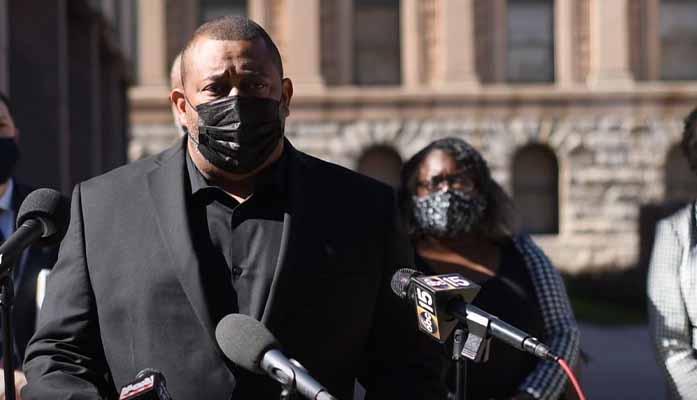
Pastor Drew Anderson, from the Legacy Christian Center in South Phoenix, led today’s group of SB 1452 supporters. Anderson, a former NFL player, says his success in life would never have come about had it not been for the educational opportunities he was given growing up in Chicago.
Anderson is attempting to unite party lines, saying, “We are in a battle not of Republicans, not of Democrats, but we are in a battle for young souls. As a registered democrat I support this bill, as a registered democrat I support anybody who supports making sure all minority children are given an opportunity to be properly educated.”
Since the pandemic began and schools across America were closed, one report puts the number of missing children, students who have not been getting any type of schooling, mostly from low-income families, at three million children. The challenges to low income families are many including poor to no internet access for virtual learning. Anderson tells of seeing families in McDonalds restaurants so their children could have access to their school work.
In addition, a survey from the Urban Institute found that 75 percent of low-income parents were unable to work from home. Which in many families means no one is available to help these students with distance-learning. Aggravating that statistic is Arizona’s ranking of 14th in the nation for single parent households.
In an effort off-set these disadvantages, Black Leaders believe lawmakers need to take action through the expansion of the existing ESA program. The proposal introduced today would help low income parents overcome disadvantages from the digital divide to unsupervised distance learning.
The measure under consideration would make funding available for a parent to pay for tutoring, educational materials, homeschool and micro-schools or money for private schools.
Janelle Wood, with the Black Mothers Forums in Arizona says she’s fought the battle for supportive and safe learning environments for “our sons and daughters”. Speaking out today, she said, “Our children deserve and opportunity, their parents, their mothers, deserve an opportunity to find a place where those children are safe and supported.”
The group contends letting minority students fall behind will create issues for the state for years to come. Right now, by expanding the established ESA program, the state’s Black Leaders say Arizona’s legislature has the option to change the course of what could be an educational disaster. Hoping to offset what is known as the prison pipeline because of a lack of education, Reginald Steele, a Pastor from Kingdom in the Valley said a better use of our monies would be investing in education, especially the school choice option.
“I would rather see us building more Penn States then Penitentiaries,” Steele said.
Senate Bill 1452 would give parents up to $7000 in ESA funds to spend on their children’s education, and cut the approval and waiting time for parents to 30 days instead of 100.
“School Choice is no longer something that can be on the back-burner,” Drew says, “but it’s actually the Civil Rights Movement of this era.”