by Corinne Murdock | Dec 16, 2022 | News
By Corinne Murdock |
Governor-elect Katie Hobbs reaffirmed that she will hold to her campaign promise to abolish Arizona’s universal school choice program.
Hobbs issued the remarks last week in an interview with Arizona PBS, about two weeks after appointing two longtime teachers’ union lobbyists to her transition team. Marisol Garcia is a longtime lobbyist for and the current president of the Arizona Education Association (AEA); Stephanie Parra was a former lobbyist for the AEA, is a registered lobbyist for her nonprofit “All in Education,” and serves as a Phoenix Union High School District board member.
“I can tell you that the voucher scheme that we have set up is going to end up as an Alt-Fuels 2.0,” stated Hobbs. “It’s going to bust our budget. We can’t afford to do more.”
In a video shared within an AEA meeting reviewing the upcoming legislative session on Wednesday, Hobbs pledged to be the biggest ally of public schools in the state’s history.
“I’m ready to get to work as the most pro-public education governor in Arizona,” said Hobbs.
Garcia expressed confidence that Hobbs would be an ally to their teachers’ union. She also said that she and the AEA were completely against the state’s school choice program, the Empowerment Savings Account (ESA) Program.
“We have always been against any sort of vouchers, not just expansion but vouchers in essence,” said Garcia.
In September, Garcia stated that it wasn’t possible to support both public schools and private schools when it comes to funding.
“Funding AZ public schools & then being pro private schools vouchers is hypocritical,” wrote Garcia. “Union members have ALWAYS been against vouchers. They hurt our communities & funnel tax payer $ to private companies.”
Hobbs has been forthright about her opposition to universal school choice. Her education plan published through her campaign revealed that she would scale back the program to bolster public school funding.
Hobbs declared that universal school choice was an “attack” on public schools, reflecting an intent to eventually “do away with” them. Hobbs also claimed that the ESA Program lacked any accountability and oversight.
About 32,000 children applied for the ESA Program, according to the Arizona Department of Education. Students may qualify for up to $6,500 each — totaling about $208 million.
Save Our Schools Arizona (SOSAZ), an activist group opposed to universal ESAs, attempted to reverse the universalization through a ballot measure. In September, SOSAZ overreported its signature count to qualify for the ballot — something hawkeyed pro-school choice parents discovered immediately. However, Hobbs delayed counting the signatures for about five days.
Corinne Murdock is a reporter for AZ Free News. Follow her latest on Twitter, or email tips to corinne@azfreenews.com.
by AZ Free Enterprise Club | Dec 11, 2022 | Opinion
By the Arizona Free Enterprise Club |
The public school system in Arizona is a complete mess. But during the past few years, it really hit a new low.
Attempts to indoctrinate children with Critical Race Theory and radical gender theory have been spreading throughout our public school districts. COVID shutdowns have wreaked havoc on students’ education—especially low-income parents and children. In the meantime, public school spending surged during COVID while teacher pay didn’t keep pace. But that didn’t stop failed teachers’ unions like Red4ED from trying to use the “low teacher pay” narrative in their attempts to push more ridiculous tax increases on taxpayers like you.
Of course, all of this is only more infuriating when you consider that the majority of Arizona students continue to fail the statewide assessment. And ACT scores for Arizona students have fallen below the standards for our state universities. That’s why the Club made it a priority to drain the public school swamp in this past November’s election. And we saw some great success…
>>> CONTINUE READING >>>
by Kevin Gemeroy | Nov 16, 2022 | Opinion
By Kevin Gemeroy |
I was born and raised in Seattle, Washington. I went to high school, and college, and started my business there. We were the fourth generation of our family to live in West Seattle where we founded and operated local businesses. Over the last 80 years, my family has founded four companies, employed hundreds of people, and created opportunities for many others to grow and succeed.
On August 5, 2020, we made the gut-wrenching decision to leave. That was the day that Washington’s Governor, Jay Inslee, proclaimed that it was “unsafe” for children to attend school in the state, extending our school closures indefinitely. Our school reopening guidelines were the among the strictest in the nation, and even most private schools (including our son’s) remained closed until further notice. Our boys were three and six at the time, and we expected another lockdown through the winter would do far more damage to our collective mental and physical health than COVID ever would.
Shortly after Governor Inslee’s press conference ended, we started packing. A few days later, we put 14 suitcases and duffle bags on an airplane and headed out to spend a year in the Sonoran Desert. As our son started in Scottsdale Public Schools, the battle between the districts, unions, and Governor Ducey were in full swing. After yet another week of “iPad school,” we began frantically looking for a private school that would guarantee an in-person education to our first grader.
We found an opening at a nearby for-profit private school and enrolled our boys on the spot. Within a few weeks, we heard from our older son’s teachers that he wasn’t learning normally. Initially, we dismissed their concerns, assuming they were caused by the impacts of Seattle’s hard lockdown and our extended school closures.
They gently pressed, and we agreed to seek a reading evaluation through a local clinic. The results were all over the place, so we were referred to a local neuropsychologist. Our son underwent two days of intensive testing which finally led us to the answer: he is gifted, has mixed dyslexia, and an ADHD (inattentive type) diagnosis would likely follow after he turned seven.
The number one recommendation was that our son would need to be in a private school long-term. The neuropsychologist described the challenges involved in getting an Individualized Education Program (IEP) and 504 plan, especially with a twice-exceptional child, where the giftedness often hides the disability. Our son would need small class sizes and individualized attention, as he would likely struggle in a public school classroom.
Our for-profit private school bent over backwards to accommodate his needs. They allowed him to continue to attend school through his eight-week, half-day intensive dyslexia treatment program so he could maintain the relationships in his class and participate in Spanish, PE, and STEM. His teacher taught his classmates about learning differences, so they’d approach our son with acceptance and curiosity instead of judgment. They approved his providers’ recommended accommodations without hesitation. They welcomed, loved, and supported our child, regardless of his learning differences.
One year later, our son is reading a grade level above his age thanks in part to the three weekly sessions with a reading specialist provided by his school. Three months into third grade, he no longer needs specialized support and is able to operate independently in an accelerated classroom environment.
Our journey was a privileged one. We had school choice, albeit across state lines. We had access to top private clinics and specialists. We used a combination of health insurance, HSA funds, and savings to cover the over $50,000 cost to remediate our son’s dyslexia and provide him with a private school education that met his unique needs. Very few families can afford this on their own.
Washington State has the exact education system that the teachers’ unions advocate for: strong and well-funded public schools. Seattle spends over $23,000 per child per year on school and teachers make around $100,000 on average. Every bond measure placed on the ballot gets approved overwhelmingly.
But choices are strictly limited – well-funded public school or very-expensive private school. Teachers’ unions have unfettered power to lobby the politicians for whatever they want. In response, over 30 percent of parents have pulled their kids out of Seattle Public Schools in neighborhoods where their families can afford to in just the past three years.
My family came to Arizona because of school choice. We stayed because our kids’ needs were met here. We’ve seen a union-first school system firsthand, and COVID revealed its shortcomings. In Arizona, we are leading the nation in building a child-first system, founded on universal ESAs.
As we hear Governor-Elect Katie Hobbs repeat her union supporters’ lines about Arizona’s school system and her criticism of the ESA program, please remember my family’s story of how a great Arizona private school and our school choice programs changed our son’s life and story for the better.
Every family should be able to choose the school that meets their kids’ unique needs, just like we did.
Kevin Gemeroy was recognized as Washington State’s Mr. Future Business Leader in 1998 and as a Puget Sound Business Journal’s 40 under 40 honoree in 2018. He and his wife reside in Scottsdale during the school year with their two twice-exceptional boys. You can follow Kevin on Twitter here.
by Corinne Murdock | Oct 28, 2022 | Education, News
By Corinne Murdock |
Parents attempting to call the Arizona Department of Education (ADE) helpline for the school choice program are met with an automated voice that rejects their call due to “excessive call volume” and promptly hangs up.
No indication of wait times, and no promise of a call back.
It’s just another day of Empowerment Scholarship Account (ESA) Program administration under ADE Superintendent Kathy Hoffman, who hasn’t exactly been shy about her disdain for school choice programs. Hoffman proclaims loudly and often that the ESA Program lacks accountability and remains dysfunctional, even well over three years into her administration.
AZ Free News asked ADE about the ESA Program helpline. They didn’t respond by press time.
Christine Accurso, one of the ESA parents on the frontlines advocating for universal school choice, criticized the ADE for taking in an additional $2.2 million to hire 26 new workers this summer, yet still can’t manage the universal school choice program.
Last month on her reelection campaign trail, Hoffman insisted that universal school choice doesn’t help children with unique learning needs. She declared that it was a “taxpayer-funded coupon for the wealthy.” She then advocated for voters to sign an initiative to refer universal school choice to the 2024 ballot.
Hoffman has fought consistently to eradicate the ESA Program.
Corinne Murdock is a reporter for AZ Free News. Follow her latest on Twitter, or email tips to corinne@azfreenews.com.
by Corinne Murdock | Oct 12, 2022 | News
By Corinne Murdock |
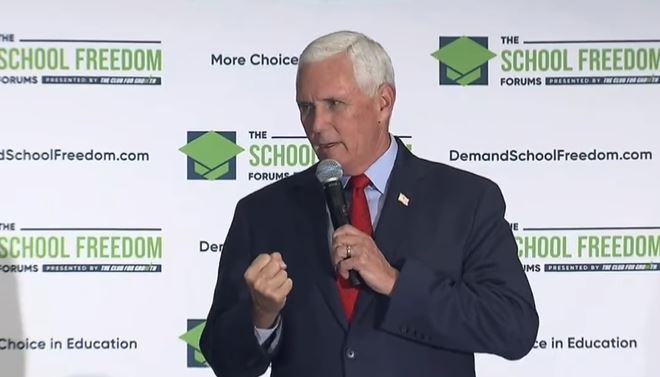
On Tuesday, former Vice President Mike Pence came to Phoenix to celebrate Arizona’s universal school choice.
Pence attended a forum hosted by the Club for Growth, a conservative nonprofit based out of Washington, D.C. The forum was the third in their “National Campaign for School Freedom” series. Pence praised Ducey for making universal school choice possible. He predicted that universal school choice would be the standard for all states.
“I don’t think you can overstate or over-commend the leadership of Governor Doug Ducey in creating universal school choice in America for the first time,” said Pence.
Ducey also spoke at the event, explaining that the experiences of parents and students throughout the pandemic accelerated the growth in support for school choice. Ducey stated that it took 8 years to achieve universal school choice. He thanked activists who pushed for school choice expansion, including the Black Mothers Forum and Love Your School founder Jenny Clark.
Ducey compared the refusal of school choice opponents’ refusal to empower families with educational freedom to the refusal of the anti-segregationists in the 1950s.
“50 years ago, politicians stood in the schoolhouse door, and wouldn’t let minorities in. Today, union-backed politicians stand in the schoolhouse door and won’t let minorities out,” said Ducey. “These children are trapped in failing schools.”
That explanation by Ducey was backed by data presented by Chris Wilson, CEO of an Oklahoma-based market research agency called WPA Intelligence. Wilson explained that a poll of over 4,000 voters from last July to last August determined that COVID-19 shutdowns changed attitudes on public schools and teachers’ unions.
Wilson explained further that voters had a negative perspective of the phrase “school choice” on its own, but adopted a positive view once a definition of the phrase was provided. He explained that those activists and unions opposed to school choice successfully branded the word “choice” as a negative. Wilson suggested that politicians adjust their presentation and terminology concerning school choice, though cautioned that there was no single “silver bullet” for phrasing.
Wilson pointed out that terms like “school freedom,” “school choice scholarships,” and “education freedom” had positive feedback, whereas “parental choice” and “school choice” had negative feedback.
Wilson added that advancing school choice requires identifying the right opponents and avoiding rhetoric around the wrong ones.
READ THE FULL SCHOOL CHOICE POLLING REPORT
Republican Senate candidate Blake Masters also came to the event. Masters discussed how he and his wife chose homeschooling for their children. Masters derided modern education for prioritizing equity-based curricula like the 1619 Project and Critical Race Theory (CRT).
“That feeling of being in charge of your child’s education, that is a feeling that I wish for every parent in this state and every parent in this country,” stated Masters. “When parents are left free to choose — surprise, surprise — parents will choose reading, and writing, and arithmetic, and history. Guess what they won’t choose? Critical race theory, are you kidding me?”
The forum also featured several testimonies from young adults and their families who benefited from school choice.
Saturday is the deadline to apply for universal school choice through the Empowerment Scholarship Account (ESA) Program.
Corinne Murdock is a reporter for AZ Free News. Follow her latest on Twitter, or email tips to corinne@azfreenews.com.