After several years of inflated budgets propped up by trillions in unsustainable COVID cash flowing to the states from the federal government, Arizona lawmakers will be coming into the new year and the new legislative session facing a potential shortfall for the budget year in excess of $400 million. Naturally, the left and their sycophants in the media have for months been decrying this to be the result of 1) historic tax cuts enacted by Republicans in 2021 and 2) the successful universal expansion of school choice in 2022. This couldn’t be further from the truth, and there are three key facts that need to be remembered when discussing the state budget and a potential funding gap.
1. The Shortfall Is a Fraction of the Arizona Budget, Nothing Like California’s Crisis
The projected $400 million shortfall represents less than 5% of the total state budget, which spends $17.8 billion this year. Far from catastrophic. Compare this to our neighbor California, facing a $68 billion dollar deficit (nearly four times the size of our entire budget), which represents 22% of their $308 billion bloated budget – up from less than $200 billion only four years ago.
Opposite to our approach, California has continuously increased taxes, having one of the highest income tax burdens in the country. They also don’t provide choice to parents and families to make educational decisions themselves. Surely, if Arizona taking less of the people’s hard-earned money and providing ESAs to all families is the cause of our small funding gap, California, doing the exact opposite, should place them in tip top shape, right?
Arizona’s historic universal school choice program has seen significant growth in its first full year of operations.
Last month, the Executive Director for Arizona’s Empowerment Scholarship Account (ESA) program, John Ward, sent three emails to give a comprehensive update to families about the state of the program at year’s end. Ward first noted that the ESA program had grown from 13,400 students to 72,500 students over 15 months since the Arizona Legislature approved the expansion and then-Governor Doug Ducey signed the bill into law.
Director Ward also highlighted the economic efficiency of ESA, stating that “ESA parents educate their students for 27 percent less funding than students in traditional public schools.” According to the email from Ward, “State taxpayers currently spend approximately $9,800 per ESA student on average” compared to $13,400 from “federal, state, and local taxpayers to educate students attending traditional public schools on average.” Ward also pushed back on one of the main attacks against the program, sharing a projection from the Department of Education that the “State will end fiscal year with a $57M education budget surplus,” adding that “a surplus is not an indication of bankruptcy.”
In the second email to ESA families, Ward offered helpful tips to ensure that account holders would be compliant with their submissions. Those tips included “reviewing state law and the ESA Parent Handbook to become familiar with program requirements, submitting complete purchase documentation and curricula when required,” and refraining from purchases of unallowable items.
Ward’s final email gave a look at the future of the ESA program. The focus for the ESA program in 2024 would be further enhancements to the ClassWallet platform to improve user experience and to reduce times of approval for purchases and reimbursements. Fixes to the ClassWallet Marketplace are expected to occur first, followed by tweaks to DirectPay, reimbursements, and debit cards.
The new ESA Director inherited the program in a strong position thanks to the work of Superintendent Tom Horne’s first director, Christine Accurso, who did not have that luxury at the start of the year. Accurso, who has been one of the state’s leading pro-life and school choice leaders for years, joined the Horne administration after thwarting a ballot challenge to the universal ESA program. Horne and Accurso were tasked with bringing the expanded program under compliance with the law and eliminating the significant backlog of requests left by the previous administration. She resigned her position in July, expressing her grateful heart “to have had the opportunity to get the ESA program back on track and functioning well.”
As the Arizona Legislature returns to session in a matter of weeks, the ESA program will be under even more scrutiny as Democrat Governor Katie Hobbs and her legislative allies may attempt to gut or trim school choice in the state. Horne, though, has proven to be a relentless defender of the program, as have Republicans in the Legislature. This issue will undoubtedly be one of the top points of contention between the two sides – especially in an election year, when both Democrats and Republicans believe that they can use ESAs and school choice to their political advantage with undecided voters.
Daniel Stefanski is a reporter for AZ Free News. You can send him news tips using this link.
A controversial post on social media from southern Arizona Democrats was deleted after attracting significant outrage from around the country.
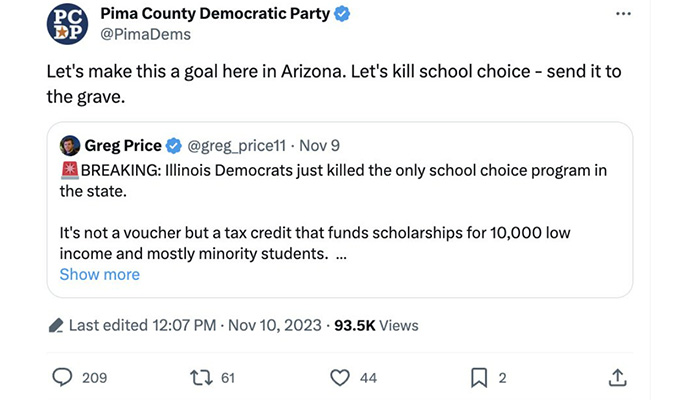
Last week, the Pima County Democratic Party responded to a post on the platform “X,” calling for the end of school choice in Arizona.
The post that the Pima County Democrats chose to react to was from Greg Price, who, according to his bio, is involved with communications with the State Freedom Caucus Network. Price was alerting his more than 326,000 followers about the news out of the Illinois Legislature, where the state house there adjourned without extending the Invest in Kids program, which gives scholarship tax credits to almost 10,000 low-income children.
Pima County Democrats wrote, “Let’s make this a goal here in Arizona. Let’s kill school choice – send it to the grave.”
People were quick to respond to the post. Senate President Pro Tempore T.J. Shope stated, “Let’s be clear about what this tweet means. School Choice in AZ really blossomed in the 1990s and times prior in AZ. @PimaDems want to end school choice options like Open Enrollment within a school district, charter schools, abolish private schools, eliminate home schooling. Basically have the government tell families what to do with their kids cuz the government knows best. Nope. Not gonna happen as long as I represent Pima County!”
Let’s be clear about what this tweet means. School Choice in AZ really blossomed in the 1990s and times prior in AZ. @PimaDems want to end school choice options like Open Enrollment within a school district, charter schools, abolish private schools, eliminate home schooling.… https://t.co/LSjDM3YaVy
Arizona House Speaker Ben Toma weighed in, saying, “The Democrats’ desparate attacks on school choice do nothing but reveal their own desire to indoctrinate children with their radical leftist ideologies. They couldn’t stop charter schools or other school choice programs despite decades of trying. School choice is here to stay.”
Even a journalist from the Arizona Republic, Laurie Roberts, added her thoughts about the post. Roberts said, “Pima County Democrats want to kill charter schools, as well as universal ESAs? Genius plan if your goal is to remain the minority party at the Legislature.”
Pima County Democrats want to kill charter schools, as well as universal ESAs? Genius plan if your goal is to remain the minority party at the Legislature. https://t.co/UwnqQJHbVG
Despite the pushback on their post and the subsequent deletion of it, the county party continued to attack school choice over the weekend, focusing its ire on the state’s universal ESA program. The southern Arizona Democrats wrote, “Did you know that even though Arizona private and charter schools are fueled by our ESA/Voucher tax dollars, they can turn away kids for any reason they want. School choice isn’t your choice, it’s the school’s choice. 92% of AZ kids attend public schools. Fund them.”
Did you know that even though Arizona private and charter schools are fueled by our ESA/Voucher tax dollars, they can turn away kids for any reason they want. School choice isn't your choice, it's the school's choice. 92% of AZ kids attend public schools. Fund them. pic.twitter.com/GD4WVBxA8D
Their account added, “Private schools and Charter Schools are virtually non-existent in rural Arizona. The ESA and Voucher scam, robs rural public schools of their already dire funding, and gives it to parents in wealthy Scottsdale zip codes. It’s a scam folks.”
Private schools and Charter Schools are virtually non-existent in rural Arizona. The ESA and Voucher scam, robs rural public schools of their already dire funding, and gives it to parents in wealthy Scottsdale zip codes. It's a scam folks.
With the start of the Arizona legislative session just two months away, these sentiments from Democrats in the state’s second-largest county are instructive to ascertain how party activists will attempt to steer the policy movements on school choice issues. In the 2023 session, Democrat Governor Katie Hobbs failed to achieve any cuts or increased regulations on ESAs, angering members of her base who felt that she abandoned her campaign promises. After signing the budget she negotiated with Republican legislators, however, Hobbs turned up the dial on her attacks on the ESA program, attempting to smooth over the frustrations of Democrats around the state. The uptick in political bickering with ESAs will be a factor in navigating critical boxes to check, including the completion of the next fiscal year budget.
Daniel Stefanski is a reporter for AZ Free News. You can send him news tips using this link.
The nation’s second-largest teachers union, American Federation for Teachers (AFT), awarded its Arizona chapter an undisclosed cut of $1 million to end school choice and fight climate change in classrooms last Friday.
The AFT funding was part of its Powerful Partnerships Institute (PPI) initiative Real Solutions for Kids and Communities campaign, which aims to boost grassroots efforts that “rejects the culture wars and the toxic attacks against teachers” while making “real solutions for kids.” AFT PPI issued $1 million total in funds to 38 AFT state and local affiliates.
“The Arizona Federation of Teachers will work with partners in immigrant and Latinx [sic] communities to increase culturally relevant books and curricula in classrooms,” stated the AFT Arizona initiative snapshot. “Together, they will push back against the privatization of public education through vouchers and charters [sic] schools.”
In April, BASIS Tucson North became the first charter school in the state to unionize with AFT. They declared themselves a branch of AFT Arizona: the Arizona Federation of Teachers Arizona Alliance of Charter Teachers and Staff (AFT-AZACTS).
In a press release, AFT noted that this year’s funds would also go toward “tackl[ing] climate readiness in school buildings” to make them safer for learning. AFT President Randi Weingarten rejected the notion that student success hinged on prevailing culture war issues, calling proponents “extremists” that haven’t offered solutions.
“It’s these programs—not book bans, censoring history and demonizing teachers—that will help young people succeed. As extremists try to divide Americans, attempting to destroy public schools and the opportunity that brings, we know that public schools unite us—it’s why 90 percent of parents send their children to public school,” said Weingarten. “The ruthless and brutal attacks on teachers and schools are in clear contrast to the reality that educators work every day to help students get and stay on track and thrive. While we are promoting and investing in real solutions, the other side hasn’t offered a single suggestion to meet the needs of kids or families.”
This $1 million made up the second year of the PPI funding initiative.
The AFT Arizona president, Ralph Quintana, has consistently opposed the state’s school choice program over the years. In a 2019 statement expressing dissatisfaction with the state legislature’s funding for public education, Quintana said that low funding to public education was the only reason that the Empowerment Scholarship Account (ESA) Program was a preferred option for parents.
“We must stop the flow of public tax dollars to the privatization of education around the country,” said Quintana. “Perhaps, if ALL state leaders were actually properly funding our public schools there would be NO NEED for ESA vouchers.”
AFT-AZ Pres. Ralph Quintana said in a statement, “We must stop the flow of public tax dollars to the privatization of education around the country. Perhaps, if ALL state leaders were actually properly funding our public schools there would be NO NEED for ESA vouchers.”
For the Democrats and their sycophant media allies, the problem is always too much parental choice in education and letting taxpayers keep more of their hard-earned money. Yet this narrative couldn’t be further from the truth. A closer look at Arizona’s budget and the projected budget deficit reveals that we have a spending problem, not a revenue problem…
Projected Budget Shortfall Is a Spending Problem
Just 5 years ago, the legislature enacted the FY 2019 budget that included $10.1 billion in on-going spending, plus $500M in “one-time” expenditures ($10.7 billion total). By last year, that number had exploded to nearly $15 Billion in ongoing spending, a 50% growth in ongoing spending in 5 years! The most recent budget negotiated with Democrat Katie Hobbs earlier this year kept ongoing spending at a lower trajectory but included “one-time” outlays that brought the total budget cost to $17.8B…