A Deer Valley USD (DVUSD) parent, referred to as “Amy,” contacted my organization to report that her children were questioned about their morning and bedtime routines. It turns out Stetson Hills School administrators had engaged students in an “Attendance Reflection Activity” during lunch on November 6, 2025. Parents weren’t notified about the event until the end of the school day.
“Our school utilizes a system called CUTS (Chronically Absent and Truant Students) to proactively identify students who are missing more than 10% of instructional days by the end of the quarter…During the session, students participated in fun discussions about:
Their current nighttime routines,
Their current morning routines [and]
Developing a goal or plan for one small, positive change they could make to improve their attendance moving forward.”
Walter ended the communication by thanking parents for their “partnership and support in encouraging consistent daily attendance.” In her zealousness to combat chronic absenteeism, I think Walter forgot that elementary students are not responsible for transporting themselves to school.
Stetson’s attendance survey can be viewed here. Note that in addition to answering questions about sleep schedules and household activities, students were required to sign the document as if it were a contract between them and the school district.
Amy said her kids were probed about their eating habits and family relationships, but those questions were not included on the survey. She also said her children described feeling anxious and “targeted” during the attendance reflection session.
According to Amy, her children haven’t missed more than a few days since the 2025 school year began, and every absence was excused due to illness or doctor’s appointments. Assistant Principal Walter confirmed that parents only need to notify the school, and doctors’ notes are not required in these instances.
Amy emailed her concerns about the district’s lack of transparency to DVUSD Superintendent Curtis Finch. Instead of responding to Amy, Finch forwarded her email to the School Operations and Safety Coordinator, Valerie Bullis. Bullis claimed the truancy probe was intended to be a “proactive approach in addressing student attendance patterns” and that school administrators were now “reviewing the process.” Meanwhile, Amy insisted that she and other parents she talked to were never informed about the student interrogation “process” to begin with. Amy also believes most parents are not aware of the CUTS program.
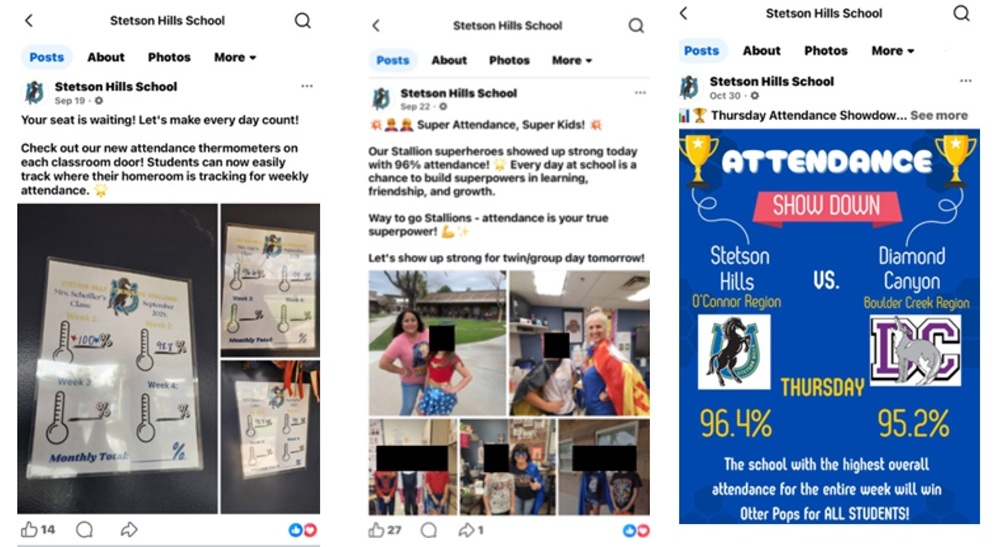
Screenshots from the Stetson Hills social media account show educators and other DVUSD schools engaging in attendance competitions. Amy said these activities promote unhealthy rivalry among students who are totally dependent on their parents for transportation and life decisions.
Deer Valley taxpayers are using their properties as collateral for failing schools. By passing the 15% override, constituents empowered government employees to keep pushing the boundaries of parental controls as they advance a State-sponsored agenda. “We got the override! We got your money!” was the overarching theme of the November 18 school board meeting.
The Glendale Star quoted Superintendent Finch, stating, “We’re pretty excited that we got the okay from the public to move forward.” When commenting on potential budget cuts, he said, “If it didn’t pass, I would be using a chainsaw, but now I can use the scalpel.” Finch also predicted “another explosion of enrollment in the next three to five years.” Wrapping up a discussion about DVUSD’s successful override campaign, he declared:
“The students are the winners when this happens. The community saw how far we’ve come and responded accordingly. It’s very gratifying for everyone involved.”
Cue the laugh track.
Finch’s million-dollar “scalpel” will never be used to dissect his compensation package, and most promises made during override campaigns are never kept. It’s no secret that Arizona public schools are losing students to the school choice movement. DVUSD’s decision to host intramural attendance games only proves that government education can’t compete with superior learning methods and institutions. Parents are waking up and moving on.
“The anti-public school movement is growing here in the state of Arizona, which is a crime against humanity. And it’s unfortunate that we’re caught in that web.”
— Superintendent Curtis Finch, ABC 15 News
For the record, there’s nothing inherently negative about finding creative and fun ways to encourage classroom attendance. The CUTS program mentioned in Assistant Principal Walter’s email may have attracted some families back to the district. Alas, the planning and execution were botched, and the interrogation activities left some parents feeling gaslighted.
I will never understand why school districts are so opposed to (or ignorant of) parental rights legislation. If you want students to enroll and attend, why wouldn’t you appeal to and listen to parents? If parents want a safe, academic-focused environment that’s free from politics, why not invest in that instead of engaging in a power struggle over their kids? In other industries, when a company loses business, board members and directors will research competitors and come up with ways to recapture the market by providing quality products and services.
This concept is simple when applied to education: If public schools don’t want parents to withdraw their children and go to private schools, then they should do what private schools do. Adopt their academic model and offer it at a lower cost. Stop waving rainbow flags and talking about gender and skin color. Stop asking intrusive questions and forming inappropriate bonds with other people’s kids. Give parents a reason to trust you. Or is that too much common sense for government folk?
School board elections are not magic. Ideally, we’d like to “get our guy in office,” trust that they have our best interests in mind, and carry on with our lives. This is not reality. More often than not, time reveals that “our guy” will say whatever needs to be said to gain our support and then turn on the dime of sleazy administrators, radical union leaders, and leftist community members. Unfortunately, this pattern emerges even in school districts that many consider as having a “conservative majority.”
Despite all the online drama that erupted over those attendance surveys, I was the only one who attended and spoke about it at the last Deer Valley school board meeting. Digital outrage accomplishes absolutely nothing in real time, and virtual group therapy has no power to shift this situation. DVUSD is corrupt. The school board is dysfunctional, the superintendent is shady, and educators are lacking real leadership. Now that they have your money, what’s their incentive to do right by your children? Who will hold them accountable, if not you?
Tiffany Benson is the Founder of Restore Parental Rights in Education. Her commentaries on education, politics, and Christian faith can be viewed at Parentspayattention.com and Bigviewsmallwindow.com. Follow her on socials @realtiffanyb.
A new report on Arizona’s Empowerment Scholarship Account (ESA) from the Common Sense Institute (CSI) shows a robust jump in ESA enrollment of nearly 15,000 students since last year.
According to the detailed report, the school choice program has reached a milestone with 92,362 students enrolled as of September 15, 2025. Projections indicate that ESA numbers will reach 103,000 this fiscal year.
The report from CSI is released on a quarterly basis to address “a lack of reliable and consistent data about who is using the program and how.” CSI noted, “Applying scrutiny to hundreds of thousands of individual transactions on an almost real-time basis has made the program vulnerable to exaggeration, misinformation, and mischaracterization. No comparable program is subject to this kind of examination.”
The quarterly findings indicate the program is maturing from an initial stage of rapid growth to a more steady-state. Universal eligibility, rolled out in 2022, has fueled the fire, but the real story now is “switchers”—57% of new enrollees ditching public schools for tailored options like private academies, therapies, or homeschooling setups. The report underscores how shrinking school-age cohorts (down 20,241 since 2021) aren’t slowing the momentum.
Glenn Farley, Director of Policy & Research at CSI and the report’s author, explained, “Arizona’s ESA program is reaching a point of steady participation. The rapid expansion is behind us, and future growth will be shaped more by broader demographic trends and the choices families make across an increasingly competitive K–12 landscape.”
The key questions that CSI seeks to address include the ultimate cost of the program at full expansion, the steady-state count of how many people are using the ESA program, its ultimate extent, the demographic characteristics of its users, and the efficiency and good operation of the program.
CSI found that total ESA costs are on track to reach $1.0369 billion in FY 2026, with an average award of $10,349 per student. Notably, 88% of funds have already been spent, the highest percentage ever recorded. Administrative approval rates are at a peak of 88.8%, and reimbursements are processed in just 13 days on average, with a whopping 455,142 orders handled in the last quarter alone.
As far as budgetary impact is concerned, a common complaint from opponents like Governor Katie Hobbs, the CSI projects that “state K–12 Basic State Aid costs will exceed appropriations by $35 million in FY 2026, due largely to higher ESA participation and lower-than-expected district enrollment.”
The report also offers a firm, authoritative rebuke to allegations that the program is most used by “the wealthy.”
“Nearly 57% of ESA recipients live in ZIP Codes with a median family income of between $75,000 and $150,000 – up slightly since our last report. A quarter of ESA users may be lower-income, 13% reside in rural areas, and nearly 20% are estimated to be nonwhite,” the report states.
Farley concluded the CSI report’s findings, writing, “Administrative reform throughout 2025 by the Department of Education has improved various high-level metrics: the Department is approving purchases faster and at greater volume and embracing its statutory authority (risk-based auditing, Handbook language noting use-tests for technology purchases and not limiting the purchases directly, etc.). However, the ESA environment often remains narrative rather than fact driven. We remind users: ESA enrollment costs are offset by reduced enrollment in other K-12 programs; ESA misuse rates are lower than comparable programs; ESA growth is slowing and increasingly driven by students switching from traditional public options.”
Arizona is one of the nation’s leading states in offering families education choice—and families are loving it.
Three out of four parents support the state’s Empowerment Scholarship Accounts program, which enables families to choose the learning environments that work best for their children. Parents can use these funds to pay for private school tuition, tutoring, textbooks, homeschool curricula, online courses, special needs therapy, and more.
The typical student in this program receives about $7,500 per year, less than half the $15,300 per pupil at Arizona’s district schools.
But Democrat Attorney General Kris Mayes wants to put a stop to even that.
Yet again, Mayes is waging lawfare against the more than 90,000 students using the state’s education choice program.
Earlier this year, Mayes ordered the Arizona Department of Education to adopt an extra-statutory regulation—one she invented from thin air—that undermined the ability of the department to approve education savings account expense requests in a timely manner. Now, she’s using exaggerated concerns over misspending to achieve the same end: throwing sand in the program’s gears.
Late last month, Mayes sent a letter to Arizona Superintendent of Public Instruction Tom Horne ordering him to cease automatically approving account purchases under $2,000, a practice Mayes argued “has led to ESA [Empowerment Scholarship Account] holders purchasing prohibited items […] with taxpayer funds.”
Horne, a former attorney general, responded that Mayes’s issue lies not with him but with the state Legislature, which modified the program’s statute last year to require the education department to adopt “risk-based auditing procedures” for the program. The revision was signed into law by Gov. Katie Hobbs, a Democrat.
The risk-based auditing provision seems like a boring, in-the-weeds detail. But such details can make or break a program like the Empowerment Scholarship Accounts—and Mayes knows it.
Before the Legislature revised the statute, the Arizona Department of Education was manually approving every single account purchase or reimbursement request. This “review every penny” approach was causing massive backlogs and delays.
There were nearly 11,000 transactions in Quarter 3 of this year alone. It’s impossible for the department’s small staff to review each transaction in a timely manner. Instead, families were forced to wait over two months to purchase things like books or curricular materials.
But families can’t wait months just to buy a textbook or pay their child’s tutor or school. Those who couldn’t wait had to pay out of pocket—and it took nearly five months to be reimbursed.
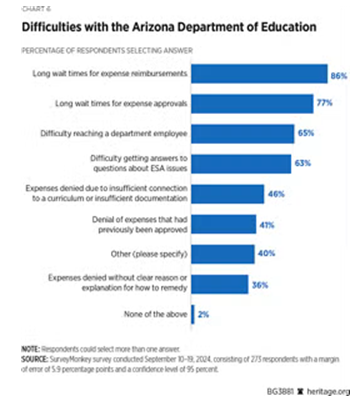
The delays caused families considerable frustration. A survey of families using the accounts found that two-thirds were dissatisfied with how the program was being administered, and about 8 in 10 were frustrated by long wait times for expense approvals and reimbursements.
It wasn’t supposed to be this way. ClassWallet, the vendor that operates the program, promised in its 2023 contract with the state “to automate the approval of platform transactions and reduce the [department’s] reliance on manual reviews of platform purchases,” claiming that the artificial intelligence it was developing “provides the State a path to a zero-approval queue, minimizing staffing and costs.”
Unfortunately, ClassWallet has thus far failed to deliver on that promise. And while artificial intelligence might one day allow parents to instantly access their funds while reducing fraud to zero, it’s not there yet.
In the meantime, the department needed a practical solution that simultaneously maximized user-friendliness while minimizing fraud.
That’s where risk-based auditing comes in. In response to parental frustration with the manual review process, the legislature modified the statute, ordering the Arizona Department of Education to adopt a risk-based auditing approach.
To comply with legislative intent, the department decided to automatically approve spending requests below $2,000, then audit accounts on the back end.
The new approach has been a stunning success. Parents can get most items immediately, and wait times for purchase requests above $2,000 dropped from two months to just three or four days. And the risk-based auditing system produced a high degree of financial accountability.
Unfortunately, though, the media seized upon the tiny percentage of ESA holders who are taking advantage of the looser rules. Sensationalist “journalists” with a long history of factually challenged attacks on school choice programs breathlessly reported that account holders purchased a variety of ineligible expenses, including diamond rings and necklaces, flights and hotel stays, and even lingerie.
What they neglected to report was the scale of the misspending.
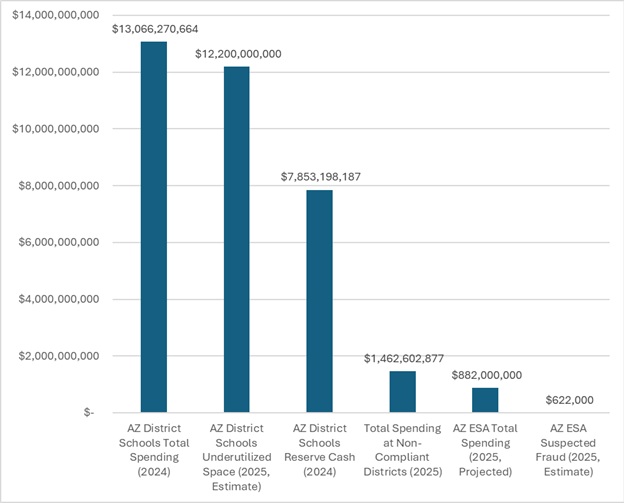
Last month, the Arizona Department of Education revealed that its internal audit of two years’ worth of ESA spending had turned up $622,000 in ESA funds that are “possible fraud or misuse.” That’s less than 0.05% of total ESA spending from 0.4% of account holders.
More than that, anyone engaged in misspending will be forced to pay the money back and could face prosecution. The department reports that it is “in the process of collecting more than $600,000” in improper spending, and it’s already suspended 400 accounts. Some have been referred some to the attorney general for further investigation and prosecution.
One would think that the attorney general would be impressed by this high level of accountability. But instead, she’s demanding that the Education Department abandon risk-based auditing in favor of the failed manual-review process that produced months-long wait times.
Clearly, accountability is not the goal here. Arizona’s attorney general is using misspending as a pretext. If accountability were her real concern, she’d be raising alarms about all the waste, fraud, and abuse in the district school system—such as the $12 billion worth of unused and underutilized buildings that Arizona school districts are sitting on, or the record $7.8 billion they’re holding in cash reserves.
Mayes says she is concerned with stopping the 0.4% of account holders committing fraud. But her demands would make the program unworkable for the over 99% of families who are just trying to do right by their children.
Punishing fraud is necessary. Every government program has some amount of fraud and abuse, and public officials have a duty to implement rules that keep fraud to a bare minimum. But undermining a program’s effectiveness does not serve the public interest, especially when that program is helping kids get access to a better education and a brighter future.
The attorney general’s demands are unreasonable and pretextual. Acceding to her demands would not fix the state’s education choice program—it would break it. Horne was right to tell the attorney general to go pound sand.
Jason Bedrick is a Research Fellow at The Heritage Foundation’s Center for Education Policy.
The Department of Education (ED) announced a significant new investment in school choice.
On Monday, ED pledged “historic” investments into charter schools, American history and civics programs, Historically Black Colleges and Universities (HBCUs), and Tribally Controlled Colleges and Universities (TCCUs).
The department repurposed funding from Diversity, Equity, and Inclusion programs to fund these investments.
ED Secretary Linda McMahon said the funds were reserved for programs “which support student success.”
“The Department has carefully scrutinized our federal grants, ensuring that taxpayers are not funding racially discriminatory programs but those programs which promote merit and excellence in education,” said McMahon. “The Trump Administration will use every available tool to meaningfully advance educational outcomes and ensure every American has the opportunity to succeed in life.”
ED also pledged over $160 million to the American History and Civics Education National Activities — Seminars for America’s Semiquincentennial program. 2026 will mark the 250th anniversary of the founding of the United States of America.
ED will award American history and civics grants for seminars that “directly commemorate the 250th anniversary of the Founding of the United States.” Eligible seminar programming must make a feature study of American political tradition: the ideas, institutions, and texts instrumental to this nation’s constitutional government and history. The seminars must also be based on “the first principles of American founding.” Eligible seminars must include the Declaration of Independence, Constitution, and Bill of Rights.
$500 million in grants will be distributed to charter schools for the 2025 fiscal year. Another total of nearly $500 million collectively will be sent as one-time investments to HBCUs and TCCUs.
As justification for the reallocation of millions in government grants, ED cited the poor student outcomes exhibited by the 2024 National Assessment of Educational Progress (NAEP) scores released earlier this month. Student NAEP scores reached “historic lows” throughout K-12.
Nationally, average NAEP scores were lower across all three assessments: science at grade 8, mathematics at grade 12, and reading at grade 12.
Arizona students scored lower across the various subjects than the average national scores for both fourth and eighth graders. Fourth grade math scores averaged 232, compared to the national average of 237; fourth grade reading scores averaged 208, compared to the national average of 214; and fourth grade science scores averaged 149, compared to the national average of 153.
Eighth grade math scores averaged 270, compared to the national average of 272; eighth grade reading scores averaged 254, compared to the national average of 257; and eighth grade science scores averaged 148, compared to the national average of 153.
McMahon called the NAEP results “devastating,” and indicative of a trend of generations unprepared for adult life. McMahon questioned the spending of billions annually with such dismal results, and pledged to claw back some of those funds to invest in individual states and educational choice.
“At a critical juncture when students are about to graduate and enter the workforce, military, or higher education, nearly half of America’s high school seniors are testing at below basic levels in math and reading. Despite spending billions annually on numerous K-12 programs, the achievement gap is widening, and more high school seniors are performing below the basic benchmark in math and reading than ever before,” said McMahon. “If America is going to remain globally competitive, students must be able to read proficiently, think critically, and graduate equipped to solve complex problems. We owe it to them to do better.”
In May, ED pledged to increase charter school funding by $60 million for a program budget total of $500 million.
AZ Free News is your #1 source for Arizona news and politics. You can send us news tips using this link.
Richie Taylor, Communications Director for Arizona Attorney General Kris Mayes, was called out on social media earlier this week. The Democrat staffer allegedly launched “vicious ad hominem attacks” against Jenny Clark, founder of Love Your School, a nonprofit that advocates for parental rights, school choice, and resources for Empowerment Scholarship Accounts (ESA) and special education students.
Clark sat on the State Board of Education, appointed by former Gov. Doug Ducey in 2022, as a public member known for her advocacy for ESAs and School Tuition Organizations (STOs), and for vocally opposing Governor Katie Hobbs on both topics. She was ousted from the role by Hobbs in March after her term expired.
Following an August 27th segment on KTAR’s Outspoken, which featured Clark, AZGOP Chairwoman Gina Swoboda, and KTAR Legal Analyst Barry Markson, a terse exchange between Taylor and Clark began.
More from ESA Debate on @OutspokenKTAR:@ClarkRimsza provides important context that more than 99.9% of ESA purchases are proper educational spending.@BarryMarkson1: I think 99% of the parents using the program probably are using it right. I absolutely agree with you! pic.twitter.com/zfpLMTfDlO
The disagreement appeared to arise when Taylor referred to Clark as a “grifter” and put her name in quotation marks, which led Clark to point out Taylor’s collaboration with her during his time as Communications Director for the Arizona Department of Education. She wrote, “Why is my name in quotes, Richie! How weird! Remember when you were at the AZ Dept. of Ed. and we partnered to get flyers out about the ESA program in 2021? Here’s a screenshot for reference! Feel free to keep attacking the Arizona ESA program – right into 2026, please!”
Why is my name in quotes, Richie! How weird! Remember when you were at the AZ Dept. of Ed. and we partnered to get flyers out about the ESA program in 2021?
The exchange escalated with Taylor posting, “lol indeed. You caught me acting in good faith. Wow impressive. Again, you had a dem superintendent wanting to work with you and you f***ed it over at every turn because it would have ruined your grift.”
Why is the Head of Communications for @AZAGMayes posting in my X account, totally unprovoked, and cussing me out?
We have had cordial exchanges before when he was at ADE and I worked to get flyers out for them on ESAs (which I shared in screenshots).
In response, Clark shared the post and asked: “Why is the Head of Communications for @AZAGMayes posting in my X account, totally unprovoked, and cussing me out? We have had cordial exchanges before when he was at ADE and I worked to get flyers out for them on ESAs (which I shared in screenshots). Inappropriate and odd.”
Responding to another now-deleted post, she asked, “Why is the Head of Communications for an elected Attorney General @AZAGMayes personally attacking a working mom, who started a non-profit on school choice, and is helping families? I mean, is this the type of class and leadership we have come to expect from democrats? Odd!”
She replied to the post, writing, “It’s such an abrupt and unprofessional personal attack. I’m not sure what prompted it! I’ve never had issues with @richietaylor before, all of a sudden today they’re attacking me personally on my X threads. It’s actually very concerning, on a few different privacy levels, too.”
Taylor then doubled down replying “Cry more and get used to it.”
In the most recent post in the social media clash, Clark shared a screenshot of the now-deleted post in which Taylor allegedly wrote to her, “lol. You make so much money off the program and you know it[.] Why don’t you tell people how much? And you also know you torpedoed any real reform because you were trying to get your preferred vendor the contract to manage it.”
According to ProPublica, citing public tax records, Clark drew a salary of $102,000 in her role as Executive Director of Love Your School. No public record of her applying for “preferred vendor status” was found in the State Board of Education’s available online records.
In her post, Clark wrote, “Update: the Head of Communications for @AZAGMayes, @richietaylor- has deleted posts against me which were extremely aggressive, untrue, unprovoked and vicious ad hominem attacks. I make policy arguments supported by available facts, they prefer to personally attack people.”