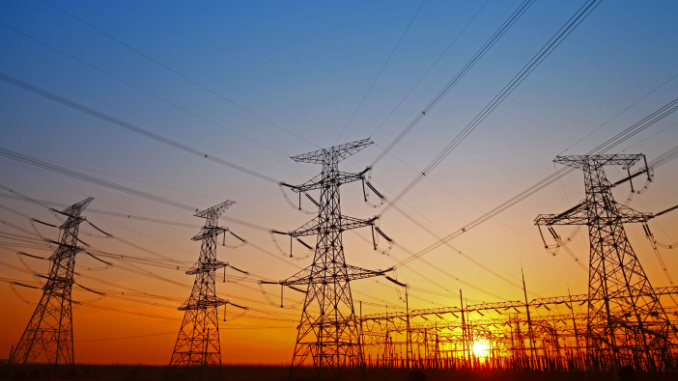
It didn’t make a ton of news in the United States media, but a new study published by the International Energy Agency in mid-October emphasizes the enormous potential roadblock to a successful energy transition posed by a projected need to refurbish and double capacity on global electricity grids.
The study, titled, “Electricity Grids and Secure Energy Transitions,” advises governments that investments in expanding and refurbishing power grids must “nearly double by 2030 to over USD 600 billion per year after over a decade of stagnation at the global level, with emphasis on digitalising and modernising distribution grids.” That level of new investment in just this single piece of the overarching plans for a complete re-tooling of the global energy system is not currently a part of existing policies around the world. Given that most developed countries are already saddled with overwhelming public debt and the lack of means in developing countries, the prospect for a doubling of current grid investments seems dubious at best.
But, if anything, the goals laid out in this IEA missive only become more implausible as one reads through the list. Perhaps the most extraordinary among them is the agency’s estimate that reaching the UN’s goal of net-zero greenhouse gas emissions by 2050 would require the refurbishment, upgrading and build-out of 80 million kilometers of new transmission lines by 2040. For those who struggle with conversion factors, 80 million km is roughly the equivalent of 50 million miles, or 2,000 times the Earth’s circumference.
That is the equivalent of all the transmission capacity built by mankind in history, and the IEA says it must be accomplished in just 17 years for this energy transition to succeed. IEA notes that achieving this extraordinary goal – among other improbable propositions laid out in the report – will require “secure supply chains and a skilled workforce,” neither of which currently exists.
How will this massive expansion in necessary skilled workers be achieved? The report doesn’t really say.
How will those supply chains – almost all of which are currently dominated by a single country, China – be secured? The report says only “Governments can support the expansion of supply chains by creating firm and transparent project pipelines and by standardising procurement and technical installations.” Sounds easy, right? But the U.S. congress has a hard time just agreeing what day of the week it is: The thought that it will suddenly develop the ability to engage in that sort of complex thinking and legislating in a constructive way is absurdly unlikely.
The report then somewhat hilariously points to another elephant residing in the energy transition’s living room, noting that governments all over the world need to streamline their energy permitting processes to accommodate this massive grid expansion. Again, using the U.S. congress as an example, West Virginia Senator Joe Manchin has spent the last 19 months trying to put together enough votes to approve legislation that would address just a small portion of what is really needed in this realm and had no success, with no real prospects of that changing until, at best, 2025, when the next congress will be sworn into office.
Think about this in the context of a story I wrote in June about the TransWest Express transmission project, which had finally received its final permits from the federal government. This is a line that is about 1300 miles long, designed to carry electricity generated by Wyoming wind farms to customers on the West coast. The punch line on this single transmission project is that the permitting process took 17 years to achieve. Assuming no new litigation arises, it will now take about another 3 years to complete and place into service.
Like so many of the work products published by the IEA in recent years, this report’s findings seem to be motivated mostly to help achieve political goals based mainly on wishful thinking, with little consideration given to long-ingrained dynamics at play in the real world. Even if overwhelming debt burdens and resource and supply chain challenges could be just wished away, the political impediments to achieving these unrealistic goals seem destined to force a day of reckoning for the entire energy transition plan.
David Blackmon is a contributor to The Daily Caller News Foundation, an energy writer, and consultant based in Texas. He spent 40 years in the oil and gas business, where he specialized in public policy and communications.
Arizona State University President Michael Crow believes we are in such danger that we should amend the U.S. Constitution to empower the government to deal more expansively with climate change. Dr. Crow’s view that constitutional protections of our liberties should be eliminated when they become inconvenient wouldn’t square with the founders’, but his estimate of the dangers and required remedies for our changing climate are quite mainstream.
“Net-zero by 2050” has become an article of faith among our corporate and academic elites, no longer requiring proof or intellectual defense. The notion that we must eliminate all carbon emissions by mid-century if we want to save the planet is the organizing principle for environmental, social, and corporate governance (ESG) investing. In 2022, it was mentioned more than 6,000 times in filings with the Securities and Exchange Commission (SEC).
The SEC has helpfully proposed climate disclosure rules to help investors “evaluate the progress in meeting net-zero emissions and assessing any associated risk.” Skeptics are sidelined as “climate deniers.”
But mounting scientific evidence suggests that net-zero is wildly impractical and probably not even achievable. In September, the Electric Power Research Institute, the research arm of the U.S. electric power industry (which would seem to be naturally inclined to support proposals which increase reliance on electricity), released a sober report on the practicality of net-zero.
Their study concluded that “clean electricity plus direct electrification and efficiency…are not sufficient by themselves to achieve net-zero economy-wide emissions.” Translation: it can’t be done. No amount of wind turbines, solar panels, battery power, fossil fuel, or other available technologies will achieve net-zero by 2050.
Furthermore, even “deep carbonization”– drastic reductions in atmospheric carbon levels – is an impossible dream. With natural gas and nuclear generation forced to the sidelines, that would require options like carbon removal technologies, which would cost a quadrillion (million billion) dollars, which would…well, you get the picture.
Finally, the report concludes that living in a net-zero world may not be all that great. Supply chains operating only on electricity and the reliability and resiliency of a net-zero electricity grid could be highly problematic.
The response to this nonpartisan and obviously consequential report was silence. There has been essentially no media coverage. No climate activists rushed to dispute the methodology nor challenge the conclusions.
This is a significant tell. You could assume if the eco-activists were genuinely concerned about our climate future, they would have some interest in responding to this major challenge to their assumptions. But they ignored it to cling to their groupthink.
Yet other indications that the transition to renewable fuels is already off the tracks keep coming. The government-certified North American Electric Reliability Corp recently issued its 2022 Long-Term Reliability Assessment. NERC concluded that fossil fuel plants were being removed from the grid too quickly to meet electricity demand, putting us at risk for energy shortages and even blackouts during extreme weather.
But wait, there’s more. PJM Interconnection, a large grid operator in the Northeast, recently released projections indicating it will soon lose 40,000 MW, 21% of its generation capacity. The looming plant closures are mostly “policy driven” by onerous EPA regulations and mandatory ESG commitments.
Renewables, although lavishly subsidized to replace the lost electricity, consistently underperform and will be able to produce, at most, half of the electricity lost. Meanwhile the government is perversely mandating electric vehicles, appliances, and whatever.
Finally, the repeated assertions of settled science were unsettled by 1,609 scientists and professors worldwide signing a “No Climate Emergency” declaration. The document was issued by Climate Intelligence or Clintel, a nonpartisan self-funded, independent organization of scholars whose only agenda is “to generate knowledge and understanding of the causes and effects of climate change and climate policy.”
They point out that there is no basis for claiming an upcoming existential crisis. Carbon dioxide is not primarily a pollutant but a necessary basis for life. Moreover, there is no statistical evidence that global warming is intensifying natural disasters. Panic is dangerous, with the potential to plunge us into perpetual poverty.
They charge that climate science has degenerated into a discussion based on beliefs, not on “self-critical science.” Historians of the future, reflecting on our era of hyper-politicized science, will undoubtedly agree.
Dr. Thomas Patterson, former Chairman of the Goldwater Institute, is a retired emergency physician. He served as an Arizona State senator for 10 years in the 1990s, and as Majority Leader from 93-96. He is the author of Arizona’s original charter schools bill.