Gov. Katie Hobbs selected as her spokeswoman a leader of two leftist dark money organizations and supporter of an FBI Most Wanted terrorist.
Hobbs’ spokeswoman, Josselyn Berry, served as leadership in two organizations that managed funds from Democratic dark networks. Berry served as the program manager for Arizona Wins from 2015 to 2016, and executive director for ProgressNow Arizona (now Progress Arizona) from 2016 through 2019.
Progress Arizona’s sponsor, Way to Win, launched in response to former President Donald Trump’s 2016 victory as a national donor network for defeating Republicans. It spent $110 million in key states, including Arizona, to ensure Democratic victories in 2020. Its major funders include George Soros’ Open Society Foundations and family, Stryker Corporation heiress Patricia Stryker, prominent D.C. consulting firm Arabella Advisors’ Sixteen Thirty (1630) Fund, and the Tides Foundation-backed One Arizona.
Specifics about Progress Arizona’s financials (filed under “ProgressNow AZ”) aren’t publicly available. IRS public documents for the 501(c)(4) nonprofit only include the organization’s tax-exempt notification letter. ProPublica, a nonprofit newsroom site, was only able to obtain the extracted financial data for their fiscal year 2020 filing, but no specific details to reflect the $3.9 million revenue. An initiative of Progress Arizona, ProgressNow AZ Institute, had revenues of over $500,000 in 2020, but source documents weren’t available for that filing, either.
Of note, Hobbs’ campaign shared the same mailing address as ProgressNow and Arizona Wins: a UPS store in Phoenix shared over the years by several other Democratic political action committees (PACs), activist organizations, and even candidates. These groups also have ties to the political operative behind at least 50 political action committees or candidate campaigns over the last five years.
That operative, Dacey Montoya, had the email for her consulting firm, The Money Wheel, listed as a contact for Hobbs’ secretary of state and gubernatorial campaigns, and received about $188,500 over the past four years. Montoya’s PAC received $37 million from fallen crypto giant FTX leader Sam Bankman-Fried, as well as over $1 million from committees for Sen. Mark Kelly (D-AZ) and Governor Katie Hobbs.
While serving as the communications director for the Arizona State Senate Democratic Caucus, Berry quoted FBI Most Wanted Terrorist Assata Shakur in a tweet following George Floyd’s death. The Senate Democrats also shared the quote on their Twitter feed, but were forced to delete it and issue an apology after it stoked controversy.
The Senate Democrats claimed ignorance of Shakur’s criminal history and terrorist status. Shakur was a Black Liberation Army member sentenced to life in prison for murdering a cop and committing armed robbery, among other crimes. She escaped prison in 1979 and fled to Cuba; the FBI has a $2 million reward for her apprehension.
Berry, who was hired as an Arizona Democratic Party spokeswoman last year, never deleted the tweet.
Berry graduated from Arizona State University (ASU) Walter Cronkite School of Journalism, where she was also in the Barrett Honors College.
Corinne Murdock is a reporter for AZ Free News. Follow her latest on Twitter, or email tips to corinne@azfreenews.com.
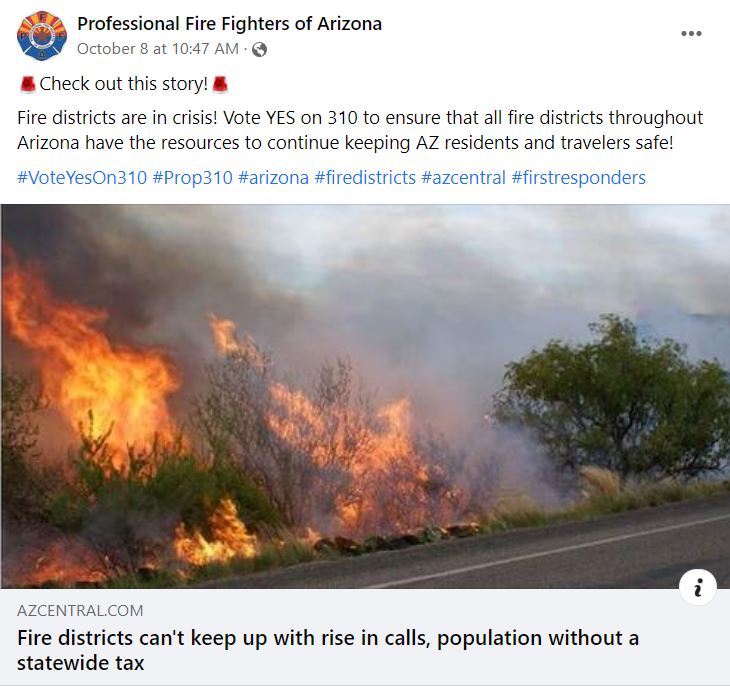
Approximately 1 in 5 Arizonans reside in a fire district, but a new sales tax proposition wants all Arizonans to foot the bill. Firefighter union leaders say that it’s only fair, given the massive amount that tourists spend in the state. Yet, opponents of Proposition 310 warn that the sales tax generating hundreds of millions every year not only avoids transparency of expenditures — they say it also would set a precedent for all Arizonans to continue footing the bill, even when they don’t benefit.
Proponents of Prop 310 insist that it will help underfunded rural fire departments and improve response times. However, unlike a specific allocation by the state legislature from the general fund, a sales tax wouldn’t require fire departments to disclose how they spent those funds.
One concerned resident of Yavapai County, Dwight Kadar, relayed this information during three live town hall meetings hosted by the Arizona Secretary of State on October 1, 3, and 4. Kadar told AZ Free News that, at most, rural fire districts would see 25 percent of that sales tax revenue.
“Instead of the legislature working with the union to identify what’s a troubled fire district and appropriate from the $5 billion surplus in the current budget that was just approved, they do a one-size-fits-all from a sales tax. Had the state appropriated money targeted to those districts, those districts would’ve been required by law on how they spent the money,” said Kadar. “They have gotten the citizens of Arizona in the corner. Any shortfall in their pensions, we taxpayers have to make up.”
Kadar also revealed that Professional Fire Fighters of Arizona (PFFA) union members were telling residents, especially the elderly in assisted living homes, that their response times would be slower if Prop 310 doesn’t pass. Kadar said he rejected that claim, and likened PFFA rhetoric to extortion.
“They’re basically saying, ‘If we don’t get money, well, our response time is tied to how much money you give us,’” stated Kadar. “That’s the classic definition of extortion.”
In response to his concerns presented during two of the town halls, Kadar relayed that PFFA President Bryan Jeffries told him that he had no business talking about Prop 310. A representative of Jeffries’ reportedly even falsely accused Kadar of not living in Yavapai County.
Kadar said that the PFFA members ignored proposed alternatives to a sales tax that exist in other states, such as billing non-district residents for services.
Last Saturday, Jeffries published an opinion piece with the Arizona Republicadvocating for Prop 310. Jeffries stated that the sales tax cost was low, a penny for every $10, and would combat inflation burdening fire districts.
“In this time of crisis, each Arizona voter has the opportunity to act as our first responders do when they face an emergency,” wrote Jeffries. “Together, we can move toward the crisis and solve it, doing everything in our power to help those in need.”
PFFA endorses Democratic candidates Katie Hobbs for governor and Kris Mayes for attorney general.
The Arizona Free Enterprise Club (AFEC), another group that opposes Prop 310, says that the tax increase would come out to $200 million — not PFFA’s estimation of $150 million. AFEC argued that fire districts’ financial woes originated from years of budget mismanagement, not the recent inflation crisis.
“Prop 310 is not the solution, as it increases taxes on all Arizonans to subsidize a few and does not include reforms to ensure responsible and accountable use of taxpayer money in the future,” stated AFEC.
Kadar insisted that Prop 310 would have a snowball effect on the cost to taxpayers, not only with fire districts needing more funding but other groups looking to implement similar sales taxes to meet their needs.
“Who’s going to be the next group that’s going to want to have their own issues paid for by the whole of Arizona citizens?” said Kadar. “It’s only a penny. That’s how it always starts.”
Corinne Murdock is a reporter for AZ Free News. Follow her latest on Twitter, or email tips to corinne@azfreenews.com.
A superior court judge rejected Arizona Attorney General Mark Brnovich’s complaint against Secretary of State Katie Hobbs’ election manual last Friday because he filed it too close to ongoing elections.
Yavapai Superior Court Judge John Napper expressed concern that siding with Brnovich would disrupt this year’s elections.
Napper acknowledged that Hobbs’ 2021 Elections Manual and Procedures (EPM) required editing and revision. However, he declared that Brnovich’s refusal to work with Hobbs on the proposed EPM didn’t mean that Hobbs didn’t fulfill her lawful duties, noting that Brnovich had from October 1 to December 31 to work on the EPM with Hobbs, as prescribed by statute.
“The parties’ failure to properly work with one another to improve the Secretary’s initial draft of the EMP [sic] does not mean she failed to perform a ministerial or discretionary act requiring a mandate from the Court,” wrote Napper. “At this point in the game, there is no mechanism for the Court to assist the parties in constructing an EMP [sic] which complies with A.R.S. § 16-452 within the timeline of the statute. The Complaint was filed far too late for this to occur without disrupting elections that have already begun.”
The Elections Procedures Manual ensures that elections throughout AZ are run uniformly.
Unfortunately, it appears AG Brnovich prefers political posturing over performing his duty to review and approve the Manual. It’s time for him to work in good faith on behalf of all voters. pic.twitter.com/7ImW91mS6V
That doesn’t mean that Hobbs’ latest EPM will be used in current elections. Napper noted that election officials are following the EPM from 2019 since it was submitted and approved properly by both the governor and attorney general.
Hobbs celebrated the ruling. She characterized Brnovich’s complaint as “an attempt to rewrite the election rules” for political gain. Brnovich didn’t issue a public statement on the ruling.
Today, Judge Napper (Yavapai) denied AG Brnovich’s attempt to rewrite the election rules based on his own political preferences.
This is a win for the rule of law—and for Arizona’s voters. I’ll never stop defending our democracy against those who would undermine it. pic.twitter.com/ofurBuavbN
— Secretary Katie Hobbs (@SecretaryHobbs) June 18, 2022
Hobbs’ criticism paralleled those of opponents to her 2021 EPM, who argued that she was incorporating certain changes — such as allowing certain votes to be cast at the wrong precinct — to benefit her gubernatorial campaign.
Brnovich filed his complaint against Hobbs for the 2021 EPM at the end of April.
We are suing the AZ Secretary of State to produce an Elections Procedures Manual in accordance with state statutes. Lawful & accurate elections must never be compromised. Read more here: https://t.co/nM9CMbMx2l
Current Secretary of State Katie Hobbs and former Phoenix-area television news anchor Kari Lake are nearly even in a favorability, according to a survey released Monday by Phoenix-based OH Predictive Insights (OHPI) about the top 8 candidates for the 2022 gubernatorial race.
The six-day Arizona Public Opinion Pulse survey of Arizona registered voters started July 6 and revealed Hobbs, a Democrat, rated a combined 40 percent for very or somewhat favorable. Lake, a Republican, came in at 39 percent very or somewhat favorable.
The next closest was Kimberly Lee, Arizona’s Treasurer and a Republican, with a 32 percent very or somewhat favorable rating.
In a head-to-head rating of the 5 Republican gubernatorial candidates, Lake topped Salmon with 60 percent to 51 in the very and somewhat favorable, with Yee coming in at 39 percent. Robson garnered 37 percent and Gaynor at 34 percent.
However, all 8 announced candidate have ample opportunity to generate favorable opinions among voters, according to the survey. Hobbs had a 34 percent rating for “no opinion / never heard of” while those surveyed gave Lake a 39 percent no opinion / never heard of (NHO).
The survey also shows the other 6 candidates had ratings which broke down into three groups, starting with Republicans Kimberly Yee and Matt Salmon closely matched up at 32 percent very or somewhat favorable for Yee and 31 percent for Salmon. The no opinion / NHO ratings for the two came out at 48 percent Yee and 46 percent Salmon.
The next group, Democrats Aaron Liberman and Marco Lopez, both rated at 25 percent in the favorable categories, with Lieberman at 53 percent no opinion / NHO and Lopez at 54 percent.
The last group, both Republicans, was not all that far behind, with Karrin Taylor Robson at 23 percent favorable, edging Steve Gaynor by one percentage point. Both also rated at 57 percent no opinion / NHO.
On the flip side, AZPOP found Hobbs with the highest percent of very or somewhat unfavorable rating at 27, while all 7 other candidates were at only 20 to 22 percent.
In a move strongly supported by Arizona’s 15 elected county recorders, the House Government & Elections Committee approved a bill Thursday which greatly limits the powers of the Arizona Secretary of State (SOS) when it comes to responding to and settling some election lawsuits.
HB2302 stipulates that the SOS cannot settle “or otherwise compromise” an election-related civil action without first consulting the state’s 15 county recorders if the proposed settlement materially affects a county recorder. It also gives any county recorder standing to join an election-related lawsuit and object to a settlement by putting forth evidence that the settlement is impractical or difficult to comply with.
The bill, sponsored by Rep. Walt Blackman, is supported by the Arizona Association of Counties. It passed the committee on a 7 to 6 vote, and is expected to pass the House Rules Committee next week.
That, according to Cochise County Recorder David Stevens, is a good thing, as the county recorders are the people legally responsible for registering voters.
Stevens says HB2302 is “a direct result” of Secretary of State Katie Hobbs’ actions prior to the 2020 General Election when she was named in a federal lawsuit which sought to extend Arizona’s voter registration deadline past Oct. 5. Hobbs never informed the 15 recorders about the case, even as she negotiated a settlement that directly impacted the recorders and their staffs.
“The recorders who actually do voter registration were not notified of the federal court case and were not able to present a defense against the extension to Oct. 23,” Stevens told Arizona Daily Independent. “To make it worse, when the extension was later ruled ‘illegal and an abuse of discretion’ and it was thrown out, the SOS provided her opinion as to when the last day of voter registration should be.”
None of the recorders were involved in reaching that opinion, Stevens says.
Eventually the U.S. Ninth Circuit Court of Appeals voided an Oct. 23 extended deadline ordered by a district judge in Phoenix. The result was a revised deadline of Oct. 15, 10 days after recorders had expected to be done with voter registration.
Stevens pointed out that because early voting began Oct. 7, the extended deadline created several problems as recorders who were facilitating actual voting were suddenly forced to handle inquiries about the ever-changed deadline and register voters for an election that was already underway.
Blackman’s bill is opposed by Secretary of State Katie Hobbs. Which disappoints Stevens.
“To be clear, NOT ONE voter has ever been registered to vote by the Secretary of State,” he said. “It is solely the function of the recorders, and not to involve the ones who actually do the work is malfeasance.”
Hobbs’ handling of the registration deadline case also got her sideways with Arizona Attorney General Mark Brnovich, who contended the SOS has no authority to bind the state or the county recorders to a change in state election law. As a result of that split, Hobbs retained private legal counsel while Brnovich vigorously defended the Oct. 5 deadline, which is set by state law since 1990 at 29 days prior to the general election.