Democrat Governor Katie Hobbs is attempting to showcase her policy initiatives in the first 100 days of her fledgling administration, but her efforts are quickly being overwhelmed by her veto threats and lack of transparency surrounding her nominees to lead state agencies.
This week, the Arizona Senate’s Committee on Director Nominations held its second meeting since President Warren Petersen commissioned the panel to vet and provide recommendations to the full chamber. According to Senate sources, the governor’s office has only transmitted eleven of her nominees to the Legislature and continues to withhold a number of individuals from the required constitutional consideration at the present time. Earlier this month, the Director Nominations Committee took up the nominations of two of Hobbs’ appointees, recommending Angie Rodgers for the Department of Economic Security, and disapproving of Dr. Theresa Cullen for the Department of Health Services. The Senate later rejected Dr. Cullen’s nomination after an extensive vetting process.
The second meeting featured two more of the governor’s nominees – this time for the Department of Transportation (ADOT) and the Department of Administration (ADOA). On January 6, during Governor Hobbs’ first week in office, she announced Jennifer Toth and Elizabeth Alvarado-Thorson to lead ADOT and ADOA, respectively. Hobbs introduced these nominees in a press release, saying, “The expertise represented in this group makes me excited about the bright future we will be able to build together.”
Jennifer Toth was previously the Director for the Maricopa County Department of Transportation, and she also served as the State Engineer and Deputy Director of ADOT. After facing questions from lawmakers on the committee, she earned a favorable recommendation with a 5-0 vote.
The Governor’s Office was very pleased with this progress and issued a statement following the hearing, stating, “Jennifer Toth’s nomination to lead the @ArizonaDOT is moving forward to a full vote in the Senate. She is the perfect person to help lead Arizona toward becoming one of the most reliable transportation systems in the nation.”
Jennifer Toth’s nomination to lead the @ArizonaDOT is moving forward to a full vote in the Senate. She is the perfect person to help lead Arizona toward becoming one of the most reliable transportation systems in the nation. pic.twitter.com/mFKcbiU5l9
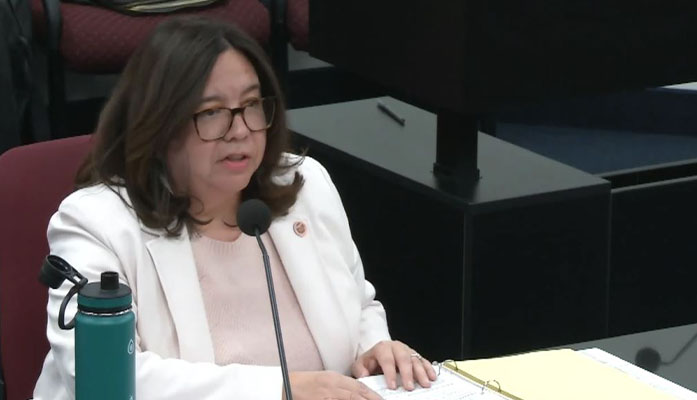
Much like the first hearing, though, the second nominee of the day brought the greatest controversy and an unfavorable result for the Ninth Floor. Alvarado-Thorson, the Deputy Director of ADOA since 2018, was accused by lawmakers of evading their questions and displaying a lack of knowledge about- Hobbs’ agenda for ADOA. President Petersen was clearly tuning in to the hearing, releasing the following statement after the questions and (non)-answers were complete: “Looks like the new tactic of the 9th floor is to tell their nominees to evade or not answer questions. Glad the committee made it clear that no one will advance who does not directly answer questions. Citizens deserve direct and honest answers.”
Looks like the new tactic of the 9th floor is to tell their nominees to evade or not answer questions. Glad the committee made it clear that no one will advance who does not directly answer questions. Citizens deserve direct and honest answers.
The lack of advancement that President Petersen was referring to was Chairman Jake Hoffman’s decision at the end of the meeting to hold Alvarado-Thorson’s nomination from an official recommendation. When addressing his decision, Senator Hoffman told AZ Free News, “Katie Hobbs’ nominees should not expect to disrespect the confirmation process by dodging legitimate questions and still gain the approval of the committee. Hobbs needs to appoint nominees who will give honest and truthful answers during their confirmation hearing, instead of playing political games.”
In a release sent a day after the hearing’s conclusion, Senator Hoffman listed the issues uncovered from the questioning of Alvarado-Thorson, including that Alvarado-Thorson “does not know what the Hobbs Administration’s vision is for ADOA,” that she “was not included in the conversations about the decision to block $210 million in federal COVID grants authorized by former Governor Doug Ducey,” and that during her gubernatorial campaign, Hobbs had “made it abundantly clear that she wanted specific pro-abortion directors to oversee the Department of Administration.”
On Tuesday, Toth was confirmed by the Arizona Senate by voice vote, making her the first Hobbs’ nominee to cross the finish line of a transparent constitutional process spearheaded by President Warren Petersen and Chairman Jake Hoffman.
Daniel Stefanski is a reporter for AZ Free News. You can send him news tips using this link.
Last week, the bipartisan Arizona Senate Government Committee accomplished something that will be a rare feat under the divided government between the State Legislature and the Governor’s Office: a unanimous 8-0 vote.
The panel, chaired by Senator Jake Hoffman, met on February 19, to consider one of Senator Wendy Rogers’ bills, SB 1299, which deals with the governor reporting inauguration expenses. According to the Arizona Senate’s purpose for the bill, SB 1299 “requires the Governor’s office to publish on its website, within 15 days after the inauguration ceremony, information detailing each organization that organized, supported or funded the ceremony.”
This issue rose to importance earlier this year as Arizona lawmakers received murky and incomplete information about Hobbs’ inaugural fund, which totaled more than $1.5 million in the lead-up to her inauguration at the State Capitol on January 5. After multiple weeks of questions, Hobbs’ campaign manager released the donor list, showing 120 contributors to the fund. Arizona Public Services (APS) gave $250,000, Blue Cross Blue Shield sent $100,000 – as did both the Realtors Issues Mobilization Committee and Sunshine Residential Homes.
But even with the uncovered donor list, lawmakers still wanted more transparency from Hobbs – and so far, they haven’t received full cooperation from Arizona’s new chief executive. Reports showed that the inauguration cost $207,000, which was a fraction of the funds received from the Hobbs Inaugural Fund. With knowledge of how much was raised and spent from the fund, Senate President Warren Petersen and House Speaker Ben Toma sent a letter to the Governor on January 26, asking her to “commit the balance of her $1.3 million inaugural fund proceeds to the state, as past governors have, for the sake of transparency & accountability to the people of Arizona.”
The legislative leaders wrote that “Given….the Inaugural Fund’s own descriptive title, Arizonans would have reasonably anticipated that any excess funds would be used for state interests. In any event, given the public resources that were utilized to solicit funds for the Inaugural Fund and to host the inauguration, it would be inappropriate to utilize any monies in the Inaugural Fund to influence an election.”
More than two weeks after the receipt of the Petersen-Toma letter, House Appropriations Committee Chairman David Livingston fired off his own letters to Governor Katie Hobbs and her campaign manager, “asking for a complete accounting of the funds, as well as any documents and other records associated with their solicitation.” Representative Livingston’s press release stated that the Governor has so far refused to follow in her predecessors’ footsteps and transfer the leftover money in the Inaugural Fund to the state’s Protocol Fund, as the Petersen-Toma letter broached – nor, as Livingston added, has she responded to their letter. Livingston’s letter came just before SB 1299 was considered before – and passed – by the Senate Government Committee.
SB1299, which would require more transparency for inauguration funds, passed by a unanimous vote today of 8-0 in the Senate Government Committee. I'm looking forward to reviewing the information I requested from Governor Hobbs and her campaign manager relevant to this bill. https://t.co/epjxxlPMQV
Senator Rogers’ legislation would require the Governor’s office to post the name of each committee or entity or entity that is organizing, supporting, or funding the inauguration; the name and address of the chair and treasurer of the organization; the name and address of an individual that donates anything of value to the organization; the name and address of any corporation or business entity that donates anything of value to the organization; and an itemized list of the amount and type of goods and services purchased by the organization.
Democrat Senator Juan Mendez voted to approve SB 1299 in the Government Committee, but wanted the public to know that he didn’t want his “yes vote to legitimize the irrelevant discussion that we all just had to sit through,” adding his wish that “the bills we focused on were bills that would actually address real Arizona problems and weren’t clearly a waste of public resources for the use of political theater to fundraise off of.”
Chairman Hoffman had the last word on the bill, saying that “we want to prevent state elected officials from breaking the law by misusing public funds to influence the outcome of elections.”
Daniel Stefanski is a reporter for AZ Free News. You can send him news tips using this link.
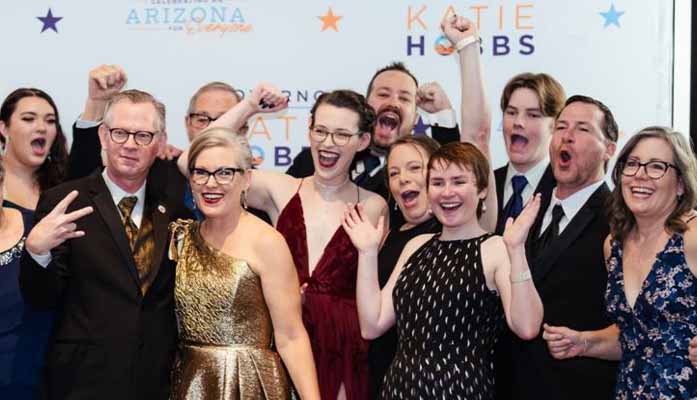
The public relations and legal fallout continues after the nonprofit which accepted donations for Gov. Katie Hobbs’ public inauguration ceremony released the names of donors and the amount of each donation.
Hobbs was officially sworn in Jan. 2 during a private ceremony. She then held a public inauguration ceremony on Jan. 5. The information about who paid for that ceremony via the Katie Hobbs Inaugural Fund was finally released several days later, after attorney Tim La Sota threatened to sue Hobbs for violating public records laws.
The Katie Hobbs Inaugural Fund was registered with the Arizona Corporation Commission on Dec. 13 by Hobbs’ campaign manager Nicole DeMont as a 501(c)(4) nonprofit social welfare organization. DeMont is currently listed as the only director on ACC records.
DeMont and Hobbs have come under scrutiny for accepting $1.5 million from roughly 120 donors, including $250,000 from utility giant Pinnacle West Capital Corp., the owner of Arizona Public Service Co. (APS). But the event cost less than $210,000, according to public records.
Government transparency watchdogs are calling for an investigation into whether Hobbs’ inauguration team had a pre-event budget worked out and whether more money was intentionally accepted than needed. But La Sota says there also remains a question of whether Hobbs violated another Arizona law by using the state’s website to solicit money for her inauguration.
“That’s definitely a no-no,” La Sota told KFYI’s James T. Harris this week. “That’s no different hardly than just putting a link on the governor’s official state website to her campaign account and saying, ‘hey you know do you want to support me politically, go to my campaign.’”
La Sota also told Harris that donations to DeMont’s nonprofit reportedly entitled donors to preferred access and seating at Hobbs’ inauguration event held on public property.
Questions surrounding the inaugural fund have also led some Democrats across Arizona to express dismay, behind the scenes, that Hobbs put them in the position of having to publicly ignore the $1.5 million controversy, just years after leaders of the Democratic Party called for an investigation into the funding of Donald Trump’s inauguration.
There is also growing pushback to utility companies like APS getting so heavily involved in politics; public records show APS donated $850,000 to the failed gubernatorial campaign of Kari Lake.
APS responded to criticisms about its donation to the Katie Hobbs Inaugural Fund with a statement that the money came from shareholder funds and not from customer payments. However, the company’s image has taken a hit in the court of public opinion given the fact APS is currently seeking a rate increase.
Another large donor to the inauguration was Blue Cross Blue Shield, which anted up $100,000, as did the lobby arm of the National Association of Realtors along with Arizona Realtors. There was also $100,000 donated by Sunshine Residential Homes Inc., a for-profit company that contracts with the State of Arizona to provide some child welfare services.
The rest of the donations ranged from $10 to $50,000; several were from entities like Union Pacific, the Arizona Dispensary Association, and Salt River Project which have dealing with various state agencies.
So what happens to the $1 million plus left on the books of the nonprofit created for Hobbs inauguration?
According to the IRS, the money can be spent on anything DeMont desires, provided it falls under the very broad category of promoting social welfare within the IRS code for a 501(c)(4).
“To be operated exclusively to promote social welfare, an organization must operate primarily to further the common good and general welfare of the people of the community (such as by bringing about civic betterment and social improvements),” according to the IRS.
In addition, seeking legislation germane to the nonprofits programs is a permissible means of attaining social welfare purposes.
“Thus, a section 501(c)(4) social welfare organization may further its exempt purposes through lobbying as its primary activity without jeopardizing its exempt status,” the IRS rules state.
There has been much public consternation that DeMont will use some of the inaugural fund donations for political activities. This is permissible under IRS rules provided engaging in politics is not the “primary activity” of 501(c)(4).
The only other stated restriction under IRS Code is that the political activity cannot involve “direct or indirect participation or intervention in political campaigns on behalf of or in opposition to any candidate for public office.”
The code makes no mention of restrictions to referendum or initiative measures that might come before voters.
Therefore, it is possible that donors to the Hobbs’ inauguration could end up seeing DeMont use their money against own their political interests.
Terri Jo Neff is a reporter for AZ Free News. Follow her latest on Twitter, or send her news tips here.
Gov. Katie Hobbs wants to ensure that illegal immigrants get a taxpayer-funded college education; she proposed an initial $40 million investment to realize this goal.
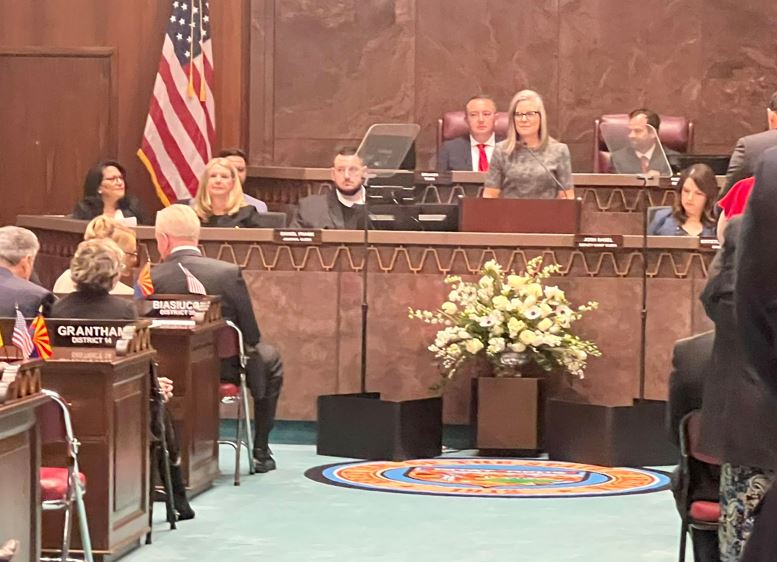
Hobbs issued the proposal during her State of the State Address on Monday in the Capitol. She named the proposed investment after those qualified to remain in the country under former President Barack Obama’s Deferred Action on Childhood Arrivals (DACA) program.
“In line with the will of Arizona’s voters in passing Proposition 308 this past November, my budget allocates $40 million to create the Promise For Dreamers Scholarship Program to cover all students, regardless of immigration status,” stated Hobbs.
Hobbs’ proposal brought some of the loudest cheers from the Democrats on the floor.
In a subsequent statement on Twitter, Hobbs described opposition to Prop 308 and outrage over illegal immigration as “politicized.” She relieved President Joe Biden of much of his responsibility for the border crisis, instead insisting that both Democrats and Republicans were to blame.
“Unfortunately, immigration has been politicized for far too long. Arizona voters told us in November they don’t want or need political stunts designed solely to garner sensationalist TV coverage and generate social media posts,” stated Hobbs.
When I speak to leaders in Arizona’s border communities, they agree they need real solutions after decades of failed leadership by both parties. #HobbsSOTS#SOTS2023pic.twitter.com/EbOBUHaAyJ
Hobbs’ remarks follow the narrow passage of Proposition 308, which awards in-state college tuition rates to Dreamers. The proposition was backed by at least $1.2 million of out-of-state dark money network funding.
Following Prop 308, the state’s universities moved quickly to offer scholarships to illegal immigrant students. Northern Arizona University (NAU), one of the latest, partnered with a scholarship program fund operated by the New Venture Fund, one nonprofit arm of one of the nation’s leading leftist dark money networks, Arabella Advisors. Those eligible for these scholarships include illegal immigrant students eligible for deportation.
Arizona voters don’t just vote on people, we vote on policy too!
Prop 308 gives AZ Dreamers equal affordability if they attend a state school, has bipartisan support, and puts no additional costs on the taxpayer.
Hobbs proposes this additional $40 million, though Arizona already spends hundreds of millions on K-12 illegal immigrant children’s education. In 2020, illegal immigrant students cost Arizona public schools over $748 million. 99 percent of those funds come from local and state taxes, not the federal government.
Some Republicans have supported improving tuition affordability for illegal immigrant students. Last summer, the Arizona House awarded a proclamation to an illegal immigrant activist group for advocating for in-state tuition and education for illegal immigrants. The group, Aliento, was co-founded by a DACA recipient or “Dreamer,” Reyna Montoya.
Montoya graduated from Arizona State University (ASU) with degrees in political science and transborder studies, with recognition as “Most Outstanding Undergraduate Student,” before earning a master’s degree there in secondary education.
During Hobbs’ address, members of the Arizona Freedom Caucus staged a walkout in protest of Hobbs’ agenda. The caucus criticized Hobbs, claiming that she failed to address the real concerns facing Arizonans. State Sen. Jake Hoffman (R-LD15), the caucus chairman, claimed that Hobbs was exploiting her executive power to a tyrannical degree.
“We’re seeing a new breed of Democratic Fascism take hold of the Governor’s office,” stated Hoffman.
State Rep. Jacqueline Parker (R-LD15), vice chairwoman of the caucus, said that it was wrong for legislators to remain before Hobbs while she spoke, claiming it was complicity in Hobbs’ use of office for activism.
“We could not sit idly by while she repeatedly declared her intention to advance her woke agenda that stands at odds with the people of our state,” said Parker.
Her office says Gov. Katie Hobbs intends to unleash “Arizonan innovation” in order to grow the State’s workforce. This includes the first executive order of Hobbs’ term along with a 100 Day Initiative which was announced Tuesday.
“Right now, Arizona’s working families face ongoing economic uncertainties,” a statement by Hobbs’ office reads. “Governor Hobbs knows what’s possible when leaders work together to improve the lives of those they represent. That’s why she will work with the legislature to put more money in pockets and provide meaningful relief for so many working families in Arizona.”
According to the statement, Hobbs plans to prioritize lowering the costs for families with children through state level child tax credits, sales tax exemptions for diapers, and a sales tax holiday for back to school shopping.
She also intends to push for sales tax exemptions to help working families, and to help Arizonans secure good-paying jobs by creating more career and technical education opportunities and expanding child care assistance.
But how the governor intends to pay for her plan has not yet been announced.
In the meantime, concerns are being raised about Hobbs’ first Executive Order which was promoted by the governor’s office as “protecting employment opportunities” for Arizona’s workers.
As previously reported by AZ Free News, much of the emphasis of Executive Order 2023-01 involves barring gender identity discrimination.
Yet Hobbs appears to be trying to expand discrimination protection by dictating how religious organizations must operate if they want to contract with the State. It is a sort of reverse discrimination which Arizona law actually prohibits, according to critics of the governor’s effort.
EO 2023-01 directs the Arizona Department of Administration to establish procedures for use by all State agencies to ensure that hiring, promotion, recruitment, compensation, and tenure “is on the basis of merit and qualifications” is in accordance with all existing federal, state, and local laws, rules, policies, or executive orders.
It also mandates that “all new state contracts or subcontracts” include the same provisions to prohibit discriminatory practices based on race, color, sex, pregnancy, childbirth or medical conditions related to pregnancy or childbirth, political or religious affiliation or ideas, culture, creed, social origin or condition, genetic information, sexual orientation, gender identity or expression, national origin, ancestry, age, disability, military service or veteran status, or marital status.
But many state agencies, like the Department of Child Safety and the Department of Health Services, heavily rely on religious organization such as Catholic Charities and other faith-based groups to provide much needed services, particularly for Arizona’s at-risk children.
Cathi Herrod, president of the Center for Arizona Policy, expressed concern that the anti-discrimination effort of Hobbs’ first executive order might actually violate Arizona law and the rights of non-secular agencies.
“The question is does the state want to continue to have faith-based agencies providing such critical foster care and adoption services?” Herrod says. “Because if they didn’t award the contract because of the religious entity’s beliefs, then they’re violating their constitutional and statutory rights.”
EO 2023-01 does not address how Hobbs will ensure those critical social services remain available nor how competing discrimination arguments would be resolved. But state law generally trumps an individual governor’s wishes.
And while the executive order will apply to thousands of state jobs, all state offices headed by one or more statewide elected officials—such as the Attorney General, Treasurer, and Secretary of State—are exempted from compliance. This likely leaves hundreds of other state jobs outside the scope of Hobbs’ order.
“Although these organizations are not included they are encouraged, along with all private employers operating in Arizona, to adopt similar employment opportunity protections,” Hobbs noted in EO 2023-01.
EO 2023-01 does not confer any legal rights or remedies upon any persons and “shall not be used as a basis for legal challenges to a State Agency’s refusal to consider an applicant for employment, the removal of an applicant from consideration for employment, the denial of an employment application, or any inaction of a State Agency.”
Terri Jo Neff is a reporter for AZ Free News. Follow her latest on Twitter, or send her news tips here.