by Ethan Faverino | Dec 4, 2025 | Education, News
By Ethan Faverino |
Eight Arizona state lawmakers have joined Superintendent of Public Instruction Tom Horne in demanding immediate action to revise the Structured English Immersion (SEI) framework, warning that the current language, loaded with Diversity, Equity, and Inclusion (DEI) ideology, violates state law, undermines classroom neutrality, and jeopardizes $866 million in federal education funds.
In a November 25 letter to the State Board of Education, Representatives Michele Peña (LD-23), David Marshall (LD-7), Michael Carbone (LD-25, Majority Leader), James Taylor (LD-29), Leo Biasiucci (LD-30), Lisa Fink (LD-27), and Senators Hildy Angius (LD-30) and Tim Dunn (LD-25), threw their full support behind the Arizona Department of Education’s (ADE) proposed revision.
The legislators accused universities and institutions of exploiting “vague and permissive language” to inject “ideological, divisive, and race-based content” into mandatory SEI coursework—material that has no place in research-based English language instruction.
The lawmakers cited constituent complaints that SEI courses, intended solely for neutral English acquisition methods under A.R.S. § 15-756.01, have instead become vessels for racialized theories that divide classrooms, distract educators, and shift instructional time away from statutory requirements.
The letter also highlighted a direct threat to federal funding. President Trump’s recent Executive Order explicitly prohibits the use of federal dollars for DEI programming. The existing SEI Endorsement Course Framework is not compliant, and keeping it as-is exposes Arizona to unnecessary and avoidable risk, the legislators warned, urging the Board to authorize ADE to open the rulemaking process immediately.
Superintendent Horne echoed the urgency in a statement released December 2, praising the legislative coalition. “I am very thankful to the eight lawmakers who sent a letter calling on the Board to start the process to revise Arizona’s teaching standards and remove DEI language,” Horne said. “This is essential not just because DEI language improperly emphasizes race over individual merit, but it threatens $866 million in federal education funds under the President’s recent Executive Order.”
He added, “Removing DEI terms from state teaching standards is the right thing to do. We must rid race-based ideology from the classroom and ensure teachers spend their time teaching math, science, language, history, and the arts. The support of these legislators is especially helpful to convey the importance and urgency of this task, and I urge my fellow board members not to further delay this process.”
The lawmakers criticized the Board’s decision to table the issue at its October 27 meeting and form a study committee, calling the move a delay tactic designed to slow or obstruct needed reforms. They insisted that the question before the Board was never about voting on specific changes but simply whether to begin the public stakeholder process to restore instructional neutrality and legal compliance.
ADE has prepared to launch the month-long rulemaking process covering teacher standards at Arizona’s three public universities. The State Board of Education is scheduled to revisit the proposal at its December 8, 2025, meeting.
Ethan Faverino is a reporter for AZ Free News. You can send him news tips using this link.
by Matthew Holloway | Nov 29, 2025 | Education, News
By Matthew Holloway |
Arizona lawmakers are urging the State Board of Education to fix the state’s Structured English Immersion (SEI) Endorsement Course Framework at its December 1st meeting, according to a letter from Rep. Michele Peña (R-LD23).
A group of State Representatives and Senators cosigned the letter from Peña, warning that existing rules risk placing Arizona out of compliance with federal funding mandates and allow the insertion of politics and racial rhetoric into courses designed to prepare educators, in violation of state law.
“Parents expect English-language instruction to focus on English-language instruction,” Peña said in a statement. “Instead, they’re finding courses with ideological material that has nothing to do with helping students learn English. The Board can’t ignore federal requirements, and it shouldn’t look the other way while universities inject political content into SEI training. The framework needs to be corrected now, and delays only create further problems for students, teachers, and the state.”
Peña warned the board that the present rule set “is harming instructional quality and undermining classroom integrity statewide.”
As noted by Peña, A.R.S. § 15-756.01 requires that the Board of Education “shall adopt and approve research-based models of structured English immersion.” In the letter, Rep. Peña adds, “SEI is intended to be a model focused only on research-based English language acquisition. That is all.”
She continued:
“The insertion of DEI-aligned language, political ideology, or racialized theories is not only outside the scope of the statute, but it also actively undermines the purpose of SEI by introducing content that divides classrooms, distracts educators, and shifts instructional time away from what the law actually requires. Arizona’s students deserve better than to have their language instruction diluted by ideological philosophies and turned into a political debate…
… We expect the Board not to delay corrective action or hide behind process barriers that were never required when these controversial provisions were inserted. Our students, teachers, and districts deserve a framework grounded in objective, research-based instruction, not ideological experimentation.”
The legislators who cosigned the letter include State Representatives David Marshall (R-LD07), James Taylor (R-LD29), Leo Biasiucci(R-LD30), Lisa Fink (R-LD27), and House Majority Leader Michael Carbone (R-LD25), as well as Senators Hildy Angius (R-LD30) and Tim Dunn (R-LD29).
As previously reported by AZ Free News, Arizona Superintendent of Public Instruction Tom Horne issued a similar statement in October, calling upon the Board to strip Diversity, Equity, and Inclusion (DEI) language from Arizona’s teaching standards.
Note: As of this report, the State Board’s public calendar shows the meeting scheduled for Dec. 1, 2025, as a meeting of the Accountability Technical Advisory Committee, while the regular State Board of Education meeting is scheduled for December 8th; this conflicts with the December 1st date provided in Rep. Peña’s statement.
Matthew Holloway is a senior reporter for AZ Free News. Follow him on X for his latest stories, or email tips to Matthew@azfreenews.com.
by Staff Reporter | Nov 2, 2025 | News
By Staff Reporter |
Maricopa County continues to house a diversity and inclusion initiative page.
According to the dedicated page for the diversity and inclusion initiative, Maricopa County continues to align the county’s workforce to complement constituent demographics. The county page declares that diversity yields net benefits culturally, socially, and economically.
“Maricopa County’s diversity and inclusion strategies are focused on creating an engaged workforce representative of the citizens we serve and reflective of the changing demography of our communities,” states the initiative page. “The significant cultural, social and economic dividends arising from our diverse employee base will ensure in the future our ability to provide sound government to the residents of Maricopa County.”
The page also credits differences among employees in terms of cultures, backgrounds, beliefs, and abilities as points of strength.
“Diversity and inclusion are global visions in today’s marketplace and Maricopa County realizes that by understanding, respecting and using creatively the differences of our employees, we will continue to meet the needs of the citizens we serve,” stated the initiative page.
Per the county, supporting diversity and inclusion among its workforce also consists of recognizing, rewarding, and compensating employees — specifically, based on the merits.
“The foundation of our diversity and inclusion strategies are to clearly articulate to both our employees and the general public our intention to create a culture that enhances our ability to hire, retain, develop, manage and promote a diverse, engaged workforce,” added the initiative page.
According to the page, the diversity and inclusion initiative is housed within the county’s Human Resources Department, and falls under the county’s “Government Operations” strategic priority: one of five within the 2023-2026 fiscal year strategic goals and performance measures.
This strategic priority focuses on improving infrastructure to improve government services and the county workforce.
However, on the performance dashboard page for the “Government Operations” strategic goal, the policy initiative of diversity and inclusion is not mentioned. The page mentions only three goals within the overarching strategic goal: optimizing technology by creating and launching a governance committee with the Office of Enterprise Technology; building trust by developing an online county data and services portal for residents; and developing a performance dashboard.
Nowhere else in the county’s current strategic plan is there mention of diversity and inclusion, or diversity or inclusion.
With the page remaining active as a seemingly standalone initiative, it is unclear the role diversity and inclusion plays within county governance — especially since the strategic plan it purportedly exists within doesn’t mention it at all.
Available archived versions of the diversity and inclusion page date back to 2017. The 2019-2022 fiscal year strategic goals and performance measures did not mention diversity and inclusion, and neither did the 2015-2018 version.
Earlier this year following President Donald Trump’s crackdown on diversity, equity, and inclusion (DEI) within the public sector, Maricopa County Community College District dropped its DEI policies and moved to repurpose or offload entirely individuals or groups previously dedicated to DEI.
In addition to the expected removal of its diversity page online, the district disbanded Equality Maricopa, its largest identity-based group (LGBTQ+ individuals), and advised the removal of specific identity-based groups across its campuses, like the Black Student Union.
Maricopa County School Superintendent Shelli Boggs also put the K-12 schools on notice to drop their DEI policies.
AZ Free News is your #1 source for Arizona news and politics. You can send us news tips using this link.
by Ethan Faverino | Oct 31, 2025 | Education, News
By Ethan Faverino |
Arizona Superintendent of Public Instruction Tom Horne issued a statement opposing the State Board of Education’s decision to postpone the rulemaking to strip Diversity, Equity, and Inclusion (DEI) language from Arizona’s teaching standards.
The issue will now be taken up at the Board’s December meeting—a delay Horne warns risks $866 million in federal education funding and violates clear federal civil rights directives.
“I respectfully but strongly disagree with the vote to postpone opening the rule-making process,” declared Horne. “The President issued an Executive Order requiring DEI language to be removed from programs funded by federal dollars. It made it abundantly clear that federal education funding is at risk if DEI language remains in education programs. Failure to comply with federal guidance may result in the loss of an estimated $866 million to Arizona schools. That is a major funding cut to our schools, and we need to begin dealing with this as soon as possible.”
Horne pointed to a letter from the U.S. Department of Education’s Office for Civil Rights (OCR), signed by Acting Assistant Secretary Craig Trainor, which reaffirms that discrimination based on race, color, or national origin is illegal under Title VI of the Civil Rights Act of 1964, the Equal Protection Clause, and controlling Supreme Court precedent.
The guidance explicitly condemns race-based preferences in admissions, financial aid, hiring, training, discipline, housing, and graduation ceremonies, and warns that DEI programs often “preference certain racial groups and teach students that certain racial groups bear unique moral burdens that others do not.”
The OCR letter also cites the Supreme Court’s 2023 ruling in Students for Fair Admissions v. Harvard (SFFA), which states that the use of racial preferences in school testing and admissions is unlawful. Their message is simple: “If an educational institution treats a person of one race differently than it treats another person because of that person’s race, the educational institution violates the law.”
“Not only is the $866 million at risk, but there is a philosophical issue at stake, too,” continued Horne. “All people should be judged based on their character and ability, not their race or ethnicity. DEI language and programs promote the exact opposite, and they have no place in the classroom. The teaching standards, unfortunately, include DEI references, and they need to be removed.”
The teaching standards at issue direct educators to teach “equitably,” with “responsiveness to the cultural backgrounds and differing perspectives learners bring to the learning environment,” and to address the “social, emotional, and cultural needs of students.”
“These terms do not belong in teaching standards,” Horne concluded. “The standards are meant to direct educators on the most effective ways to teach students’ core academics. Every instructional minute is precious, and DEI efforts distract from that essential mission.”
Ethan Faverino is a reporter for AZ Free News. You can send him news tips using this link.
by Mike Bengert | Oct 23, 2025 | Opinion
By Mike Bengert |
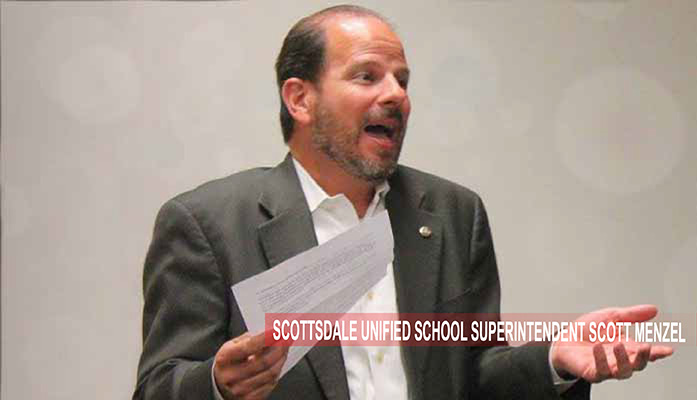
Scottsdale Unified School District (SUSD) is entering a period of upheaval, one that is very concerning to parents, teachers, and taxpayers. Superintendent Dr. Scott Menzel recently announced that the district staff will bring forward proposals for consideration by the Governing Board to deal with the impact of declining enrollment in SUSD, which will reshape several campuses and alter the educational landscape of Scottsdale for years to come.
The first recommendation by district staff under consideration is for Echo Canyon K–8, Pima Elementary schools, and Desert Canyon Elementary and Middle Schools to be repurposed. Dr. Menzel has not made clear exactly what repurposing means. The official explanation for this is straightforward: declining enrollment and a need for “operational efficiency.” But as anyone who has followed SUSD’s trajectory over the past several years knows, declining enrollment is not isolated to a few schools. It is a district-wide problem — one that has deep roots in leadership decisions, cultural conflicts, and misplaced priorities.
A District in Decline
Beyond these four schools, six others have been placed on a “watch list.” These campuses, too, are being monitored for potential closures or repurposing as enrollment continues to fall. Since Dr. Menzel’s arrival in July 2020, the district has lost more than 2,500 students, dropping from over 22,300 to 19,700, an 11% decline in just five years. This decline represents not only a fiscal crisis for the district but also a crisis of confidence among Scottsdale parents.
So, how did we arrive here?
The Menzel Philosophy: Disrupt and Dismantle
If you want to understand how we got here, you need to understand Dr. Menzel’s philosophy of education. In a 2019 interview titled “Public Schools and Social Justice: An Interview with Dr. Scott Menzel,” he explained that understanding how systems operate gives leaders “the opportunity to dismantle, disrupt, and then recreate something that’s socially just and more equitable.”
This wasn’t a throwaway line. It was a mission statement.
Since arriving in Scottsdale, Menzel has followed this blueprint:
- He has recommended firing respected teachers while hiring unlicensed social workers and “wellness” staff.
- He has proposed cutting classroom budgets while expanding administrative overhead.
- He has recommended reducing opportunities for public comment at board meetings.
- He has directed teachers not to inform parents about students’ gender transitions unless asked directly.
- He has consolidated power and minimized accountability, all while using district communications, podcasts, and social media to promote his leadership as a success story.
- He has championed the elimination of valedictorian honors and class rank.
Unfortunately for the students and parents, the board has approved every recommendation made by Dr. Menzel.
At board meetings, Menzel regularly dominates the discussion, often interacting with the board president as though he were chairing the meeting himself. He highlights a few exceptional student achievements as evidence of district success, perhaps a few hundred students out of nearly 20,000, while ignoring the systemic academic underperformance that affects the majority.
The Illusion of Success
The numbers tell a sobering story. In 2024, SUSD reported a 92% graduation rate (down from 94% in 2022) and a 98% promotion rate. Yet proficiency in core academic subjects remains around 52%. In other words, nearly half of all students graduate or advance to the next grade level without mastering reading, writing, math, or science at grade level.
When questioned about these numbers, Menzel points out that SUSD still outperforms the statewide average of roughly 30% proficiency. But comparing yourself to the bottom of the barrel isn’t a standard of excellence — it’s an excuse for mediocrity.
Despite this record, the Governing Board continues to reward Menzel with pay raises, bonuses, and contract extensions. Two successive boards have failed to impose any meaningful accountability or measurable academic goals.
The “Woke” Agenda and Its Consequences
In Scottsdale, Dr. Menzel’s leadership has been defined by his emphasis on Social Emotional Learning (SEL), Diversity, Equity, and Inclusion (DEI), gender identity programs, and related “woke” initiatives, all fully endorsed by the leftist majority on the current Governing Board. These programs were sold as a way to build empathy, inclusion, and belonging. Instead, they have deepened division, distracted from academics, and driven families out of the district.
At the same time, the district has invested heavily in administrative roles tied to “behavioral health,” “equity,” and “inclusion,” while cutting classroom teaching positions. This inversion of priorities is not only financially unsustainable, it’s academically disastrous.
Parents Are Walking Away
Arizona Superintendent of Public Instruction Tom Horne recently provided a candid explanation for the declining enrollment. In a public statement, he argued that “the promotion of woke ideology is a significant reason behind potential school closures in several school districts,” explicitly calling out SUSD’s efforts to promote gender ideology among elementary and middle school students.
He went further:
“This happens because of the expenditure of a large amount of campaign funds to elect woke school board members who do not represent their communities. Parents have a choice, so they move their children. The school boards in these districts have no one to blame but themselves for allowing the classroom to be corrupted from a place of learning to a venue for indoctrination in woke principles.”
Love him or hate him, Horne’s diagnosis resonates with many SUSD parents who feel that the district has prioritized social engineering over education.
The Voter’s Responsibility
While Dr. Menzel and the Governing Boards are directly responsible for what has happened to SUSD, the truth is that Scottsdale voters bear responsibility as well.
In the last election cycle, three board seats were up for grabs, an opportunity to shift power away from the progressive bloc that rubber-stamps every one of Menzel’s initiatives. Instead, voters elected candidates who reinforced the status quo: one a former superintendent from a failing Phoenix district, another who told parents to effectively butt out and leave education decisions to “experts,” and another whose own child attends private school, since it was a “better fit.”
Can SUSD Be Saved?
It’s a painful question to ask, but one that must be faced honestly: Can SUSD be saved under current leadership?
Dr. Menzel has shown no willingness to shift his priorities. The Governing Board has shown no appetite for holding him accountable. Parents are leaving, teachers are demoralized, and the district is closing schools while insisting that everything is fine.
The future of Scottsdale’s public schools doesn’t depend on clever slogans, glossy podcasts, or PR campaigns. It depends on leadership that values education over ideology and on citizens willing to demand it.
Scottsdale’s parents, taxpayers, and voters have few options. With the three progressive members’ terms extending to 2028 and the remaining two members up for re-election next year, the balance of power will remain firmly in Menzel’s camp for the foreseeable future. The progressive board members will allow Dr. Menzel to continue “dismantling and disrupting” SUSD until there’s little left to rebuild.
If we want to restore SUSD to its rightful mission, educating children in reading, writing, math, science, and the arts, parents need to speak up, and demand change now. Waiting for an election in 2028 will be too late.
You can start by attending the public meeting scheduled for November 13, 2025, at 6:00 p.m. in the Governing Board Room located at Coronado High School. The purpose of this meeting is to obtain public comment regarding the potential closure and repurposing of Echo Canyon K-8 School and Pima Elementary School. Each speaker will be given two minutes to voice their opinion on the closure/repurposing of the schools. Don’t feel constrained; you can also voice your opinion on Dr. Menzel and the board members’ actions that have led us to this point.
All SUSD parents should attend the meeting, even if their child does not attend Echo Canyon or Pima. Remember, as enrollment continues to decline, these schools are just the beginning; your child’s school may well be next.
Mike Bengert is a husband, father, grandfather, and Scottsdale resident advocating for quality education in SUSD for over 30 years.