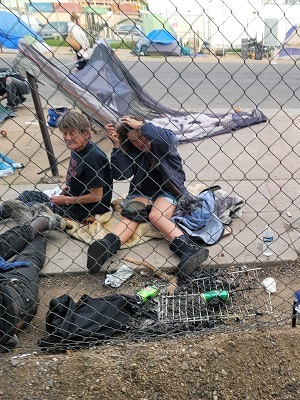
The Trump administration’s recent deployment of National Guard troops and federal resources to major U.S. cities reflects a growing majority of Americans who are fed up with inaction on public safety. After years of unchecked violence and open-air drug use, many see these moves not as overreach but as long overdue.
Fueling much of this primordial decay is a Fentanyl epidemic, which is now the leading cause of death for Americans under 50. Meanwhile, other rampant street drugs like meth and bath salts are inducing or worsening levels of psychosis, unlike anything in history. The result has been broken people, broken homes, broken cities, and unspeakable violence. Tents and waste sprawl across once beautiful urban centers while needles litter children’s playgrounds, and women avoid pumping their own gas after dark.
The United States’ rate of violent crime, such as rape, robbery, and assault, is nearly three times higher than Europe’s. And the homicide rate? That’s seven times higher. Worse still, an alarming number of these crimes are perpetrated by repeat offenders. Our criminal justice system is failing to carry out the duties of its most basic requirement: to protect the public from career criminals. A quick glance at any morning paper on any given day in any city across America will tell the story.
In Charlotte, NC, Ukrainian refugee Iryna Zarutska survived war only to be brutally stabbed to death on a train by a career criminal who never should have been free. The video of this horrific tragedy plays back in our nightmares over and again. We have seen enough.
The Cicero Institute’s new national poll puts numbers to this sadness and frustration:
82% support life in prison or the death penalty for aggravated murder, even when mental illness is involved.
63% want lenient judges removed from the bench.
75% support electronically monitoring transient sex offenders.
60% want automatic federal investigations into states that repeatedly release violent criminals, something the White House is already looking into.
But nothing captures the stakes more vividly than the testimonies of those who have to live with the consequences of failed policy. Stephen Federico, father of 22-year-old Logan Federico, gave emotional testimony before a House Judiciary subcommittee in Charlotte. He recounted how his daughter was “executed … on her knees begging for her life … begging for her hero, her father. Me. And I could not protect her.” He did not lean on political ideology. He called out a broken system that allowed a man with at least 39 arrests and 25 felonies to remain on the streets, serving little time despite a decade of violent and property crime. “There is only one thing that would have kept my daughter alive,” he said. “Putting a career criminal in prison.”
And if you think it ends there, it doesn’t.
In Kentucky, the anguish of one father has come to embody a nation’s rage. Years after his six-year-old little boy was stabbed to death by a man deemed “criminally insane,” that man was granted parole “good behavior.” Dean Tipton has vowed that if the system will not deliver justice for his son, he will. His words are not a threat born of malice, but of despair. Thankfully, proactive law enforcement officials in Florida picked up the murderer on a parole violation, sparing Mr. Tipton further trauma.
But Americans should not have to wait for a technicality to get violent predators off the street. The voice of America is saying, “Enough.”
While we face rising crime, record overdose deaths, and exploding homelessness, bickering and posturing dominate from the local to the federal level by those who are content with the status quo of death, disease, and despair. The average family does not care about partisan brinkmanship. They care about being safe in their own neighborhoods.
In Athens, GA, Laken Riley, a 22-year-old nursing student, was dragged off her morning jog, beaten, and murdered by an illegal alien who had already been arrested in the U.S. and released back onto our streets. This was not an accident or a tragedy of circumstance. It was the predictable result of a government that refuses to protect its citizens, releasing violent men again and again until they finally kill one of our daughters. Riley’s blood, like Iryna’s and Logan’s, cries out against a broken system that values ideology and excuses over human life.
Yet instead of focusing on these failures, Leftists consumed by political theater are eager to offer aid to our enemy rather than save our cities from this terror. America is not asking for cruelty but for safety. Voters are not asking the government to shrug at addiction or mental illness. They want public spaces reclaimed for families and small businesses, not surrendered to chaos.
That is what the poll numbers capture: a public demand for strong consequences that bring peace to our streets. People want dangerous offenders confined and controlled, drug dealers punished, transient sex offenders tracked, and public spaces cleared of disorder.
The new federal deployments mark a turning point. From state houses to our national capital, citizens are signaling to their elected officials that the duty of government is to protect them. And if current leaders cannot find the gumption to deliver security and justice, they should resign and make way for those who will.
Americans have seen enough. The public’s patience has expired. They are eager to support leaders who will match words with courageous action.
Stefani E. Buhajla is a pollster, political strategist, and Sr. Director of Communications at the Cicero Institute.
A new national poll reveals a broad, cross-partisan consensus among Americans for accountability-driven reforms to address rising crime, homelessness, and judicial leniency.
With violent crime perceived as increasing by 75% of respondents, majorities support stricter sentencing, enhanced monitoring technologies, federal oversight of repeat offender states, and responsibility requirements in public assistance programs. The Cicero Institute National Crime Poll surveyed a representative sample of 2,102 U.S. voters, showing a unified public mandate that compassion must be paired with consequences to restore safety and order in communities nationwide.
“Americans are crying out for accountability,” said Stefani E. Buhajla, Senior Director of Communications at the Cicero Institute. “Across the nation, families are watching their neighborhoods decline under the weight of unchecked crime, drug abuse, and untreated mental illness. Homelessness has exploded into public view, violent criminals cycle endlessly through the courts, and too many judges seem more interested in appeasing activists than protecting the people they serve. The result is predictable: citizens feel less safe, less secure, and less confident in the institutions charged with delivering justice.”
Crime and Public Safety
63% support increasing criminal penalties for drug trafficking around homelessness charity facilities, recognizing the exploitation of vulnerable individuals battling addictions.
75% support providing law enforcement with better technology to track transient sex offenders.
75% support electronic monitoring of transient sex offenders’ whereabouts, with 68% more likely to support if informed that over half of transients are registered sex offenders.
Violent Crime and Mental Health
75% believe violent crime is increasing or staying the same.
61% support court-ordered treatment and stabilization for repeat criminals with mental illness.
64% support making it easier to commit individuals with violent tendencies to mental health facilities.
In cases of aggravated murder by mentally ill offenders, 82% back life in prison, the death penalty, or both (46% life in prison, 18% death penalty, 18% both).
60% favor an automatic federal investigation into states with histories of releasing repeat violent criminals.
63% support removing judges with patterns of leniency toward repeat violent criminals.
Homelessness
64% say homeless individuals should be required to participate in addiction, mental health treatment, and job training as a condition of taxpayer-funded housing.
64% oppose allowing homeless individuals to camp on public property.
75% view moving homeless individuals to shelters as more compassionate than unrestricted camping.
70% support temporary structured camping areas with water, sanitation, and police services—located away from residential and business zones—when shelters are unavailable.
Juvenile Justice
73% support shorter probation terms for low-risk juvenile offenders who complete education or job training.
66% support reduced probation for those pursuing mental health counseling or drug treatment programs.
“What we see here is not a thirst for cruelty, but a yearning for justice,” added Buhajla. “Americans want accountability because they know compassion without order collapses into chaos. They understand that responsibility and opportunity must go hand in hand. And they are calling on leaders to have the courage to enforce laws, protect communities, and demand more from the very institutions that too often excuse failure.”
Ethan Faverino is a reporter for AZ Free News. You can send him news tips using this link.
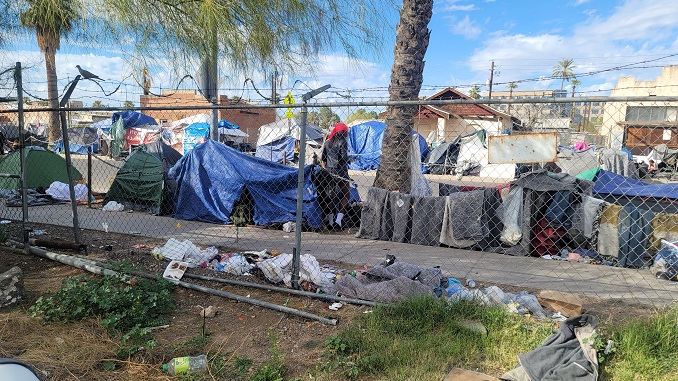
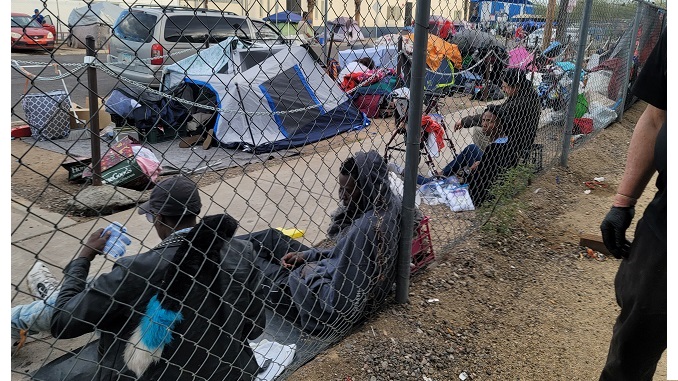
Intense poverty, frequent crime, social instability, high mortality, poor living standards: these qualities describe third-world countries. They also describe “The Zone”: the sprawling encampment of over 1,000 homeless in downtown Phoenix just blocks from the state capitol and amidst what was once a thriving business district. It’s an area where law and order don’t seem to exist; so much so that locals have given the area another, much darker nickname: “The Thunderdome.”
The crisis reached a new high after the discovery of a premature baby’s remains several weeks before Thanksgiving last year, burned in the middle of the street. A month later, a similar grisly fate befell a homeless man.
“That child burned… that was the beginning of the end for me. I don’t know why that hit us so hard,” said Karl Freund, who was leasing a building in The Zone and is suing the city of Phoenix over their handling of the homeless crisis. “Someone set a child on fire, and then two weeks later somebody burned a body just a block away. Then you see the people that are so mentally ill that you can’t place them in society. We walked out a year ago to see a girl masturbating 20 feet away from my car in the parking lot.”
Death and depravity are a common occurrence in The Zone.
Last month, Phoenix police shot and killed a Spanish-speaking homeless man who lunged at them with scissors. Attempts to incapacitate the man with stun guns were unsuccessful. Police had responded to a 911 call from a woman reporting the man approaching her aggressively while attempting to trespass her property.
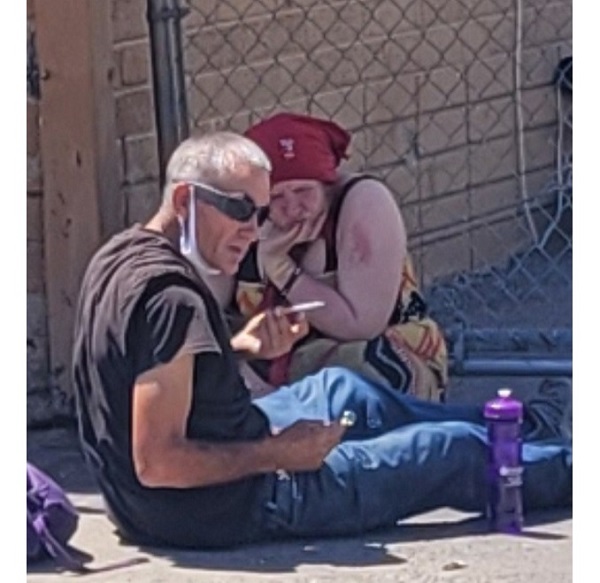
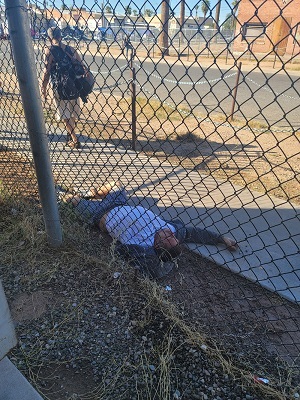
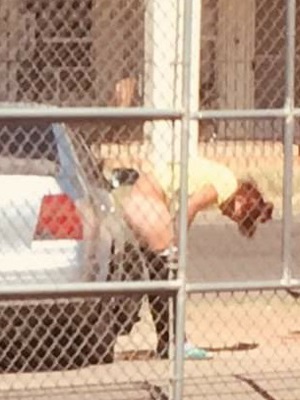
Drug deals, addicts using, defecation and urination, assaults, sexual acts, and rapes are also done out in the open with increasing impunity. Gangs run the streets of The Zone, making the homeless pay for their tent space and beating them up at will. Registered sex offenders roam the streets, having been dropped off in The Zone. Businesses close but must continue paying rent.
Homeless sit outside of Angie Ojile’s business and other businesses in The Zone.
The Zone sprung up outside Central Arizona Shelter Services (CASS) Human Services Campus, an organization that provides food, shelter, and more to the homeless. It’s located in a dense and diverse business district that includes a near-historic sub shop, appliance manufacturer, cabinet manufacturer, steel manufacturer, millworker, textile company, metal supplier, door supplier, ironwork company, glass and mirror shops, counter supply store, air conditioning supply store, funeral supply store, motorcycle shop, RV shop, auto repair store, electrical supply store, art museum, custom printer, waste services, paper company, several recycling services, several automotive stores, and several transportation companies. Business owners neighboring The Zone have seen the homeless population — and attendant crime — grow over the last two years and four months.
Angie Ojile, a commercial designer and realtor in The Zone for over 20 years, said that she sees this and more every day. She said she watched four people taken out of the area in body bags in a one-day period. The level of danger is so prevalent that Ojile says that other businesses refuse to come there: pizza shops won’t deliver, and plumbers won’t service the buildings. Limitations on those services pale in comparison to her other, more pressing problem: retaining employees. Ojile told AZ Free News that one young woman she hired was initially excited to work for her, but left out of fear for her safety after several days navigating The Zone.
Ojile says the city is to blame for these troubles.
“Everything they do defies logic. It’s hurting people — not helping people,” said Ojile.
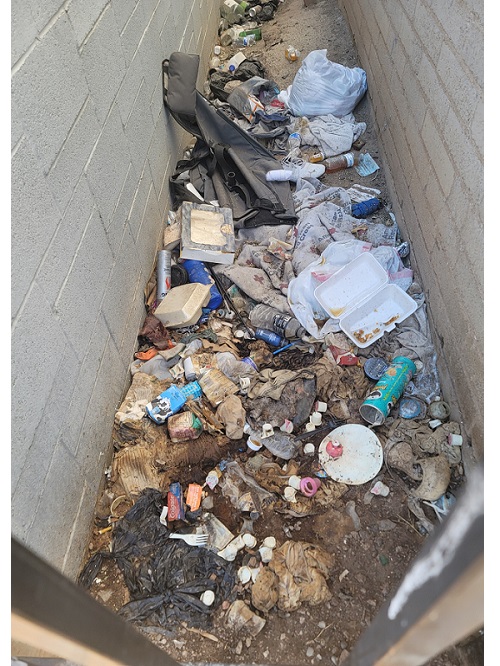
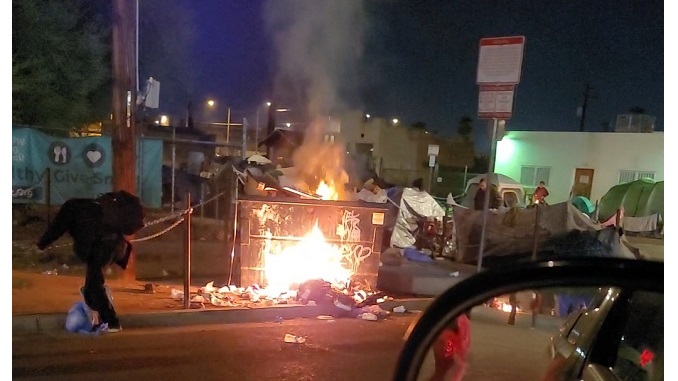
The homeless relentlessly bombard Ojile’s property with human waste, fires, garbage, drug use, assaults, and gang activity. Ojile estimates that she spends more on cleanups around her property than some pay for mortgages.
“The ground is so saturated with feces and urine, I can’t even breathe. We’ve got walls that are so full of feces, it’s disgusting. You can’t even look in that direction,” said Ojile. “We had dreams when we bought this property, and now we’re paying for it.”
Property assessments estimate Ojile’s property to be worth well over $2 million — but only if The Zone didn’t exist. A realtor told Ojile that her property was essentially worth nothing due to The Zone, and that he couldn’t sell the property in good faith due to that. Anyone who bought Ojile’s property — if buyers could be found — would find themselves in the same predicament as Ojile: unable to run her business properly, causing her to fall behind on property taxes.
Ojile said that nobody from the city bothered to return her calls for help. The supervisor representing that district, Steve Gallardo, has never returned her calls. Even an ombudsman wasn’t able to get information for her in a timely manner, something which the ombudsman allegedly remarked was unusual.
“I went to the city immediately for help, but no one would ever get back to me,” said Ojile.
This crisis hasn’t just taken a financial toll on Ojile; it has imposed a great emotional and physical toll. Ojile’s dog has gone missing three times, at least. The homeless have cut her fence to take the dog; she’s had to track down her dog in homeless tents and even an animal shelter.
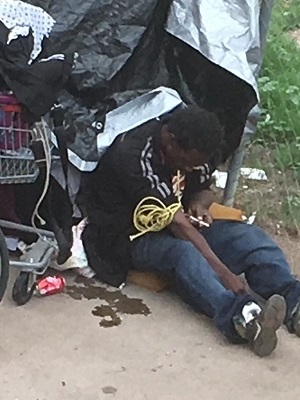
Last week, Ojile became severely ill while working inside her business — a sickness unlike she’d experienced before. The room she was working in wasn’t completely insulated from the outside: she had to board over one of the windows, since the homeless would break it every time she fixed it and the city would fine her for blight over the broken window. Ojile suspected that she’d been exposed to someone smoking fentanyl.
Homeless use drugs inside Phoenix’s sprawling encampment known as The Zone.
Help from law enforcement isn’t always an option for Ojile in situations like that. According to Ojile, officers told her that they wouldn’t enforce the law equally in The Zone for fear of losing their jobs.
Phoenix Police Department (PPD) reported 278 incidents in 2020 and 206 incidents in 2021. There were around 200 incidents last year. There have been well over 4,000 calls from 2019 through last year, with over 1,200 calls for fire department assistance alone last year.
For Freund, the growth of crime in the area has reached a tipping point. He’d hoped to open a real estate office in the building he’d leased, but the state of the area hasn’t made that possible. Freund said that the PPD has not only stopped responding but stopped answering their calls.
“The day-to-day down there is unlivable for anybody and I can’t believe we subject humans to this environment,” said Freund. “Why would you subject humans to that kind of living condition? There’s prostitution, murder, physical beatings.”
Freund fought to open his business in that building, spending hundreds of thousands on property taxes, renovations, and fixing damages caused by the homeless. According to Freund, they’ve attempted to set his building on fire multiple times and stolen all of the copper wiring and pipe. He gave up hope on the property after 20 months; he managed to find another to sublet the property. The thousands he spent in property taxes and beautification wasn’t enough to spur the city to action — just as is the case for so many others in The Zone.
Although these business owners have languished for years, several weeks’ worth of sports fans visiting the city were spared the crisis. Ahead of the lucrative NFL Super Bowl and PGA Waste Management Open that were held in the Phoenix area in February, the city committed to cleanup efforts of homeless encampments. However, these cleanup efforts aren’t permanent. The homeless are free to return to the areas after cleanup ends; they already have. Only 33 of the homeless accepted services during Phase One of the city’s December cleanup, according to the deputy director for the Office of Homeless Solutions, Scott Hall.
Apart from cleanups, the city has directed their millions in funding on a “housing first” or “permanent supportive housing” model, sometimes called “affordable housing.” The theory behind this model is that the homeless will choose to seek employment, become financially responsible, and receive mental health care and/or substance abuse treatment if food and housing are provided. The theory also posits that enabling the homeless to choose their housing and support services will make them more likely to remain in that housing and stick with self-improvement initiatives.
The city has poured millions of funding to create housing; yet available housing hasn’t kept pace with the number of homeless, the retention rates of the homeless in their housing and program participation remains poor, and the crisis is progressively spreading to surrounding areas. Even so, the city allocated another $12 million last October, another $8 million last November, and another $25 million in January to prove the housing first theory correct.
The city recently unveiled their latest attempt at free housing for the homeless on Feb. 8: five shipping containers repurposed for “sustainable” housing. These living structures’ purported sustainability comes at the cost of $200,000 for one-bedroom, one-bathroom’s worth of solar panels providing power, an incinerator toilet, LED lighting, and economical heating and cooling. The Arizona Department of Housing issued a $1.2 million grant for the five units.
Then there was the 24/7, single-stall, $200,000 toilet for the homeless launched in January.
Other city initiatives providing the homeless with more resources also appear to have failed to make a noticeable impact on the crisis.
In December, the city launched an employment program that pays the homeless $65 to work five-hour shifts. However, those directly impacted by or handling the crisis say that these kinds of approaches haven’t led to lasting change.
Ojile said that the homeless she’s known for many years don’t feel like they’re getting help. Some of the homeless she knows in the area have been there for decades. They’re trapped alongside Ojile.
“We can’t get out. They’re crashing our property values,” said Ojile. “There’s people that are homeless that don’t want to be near this.”
A broker estimated the value of Ojile’s property at around $2.4 million. However, the broker informed Ojile that her property is unmarketable due to the state of The Zone.
“[The] values are based ‘as if’ the property was not associated or in proximity to the situation currently occurring adjacent to the Property (i.e. homeless, mental health, drugs, gangs, etc.). Unfortunately, the property is deemed unmarketable at any realistic value at this date due to these issues along with safety concerns that would be perceived by any prospective buyer, tenant or investor that would normally have invested in the property. Further, at this date, the city of Phoenix who is trying to manage a difficult problem, has ‘kicked the can down the road’ and now that ‘can’ is on and surrounding your property. Additionally, since you have disclosed various items to me (break-ins, been threatened, witnessed drug purchases, individuals urinating/defecating on the property, etc.) as a licensed real estate agent held to ADRE Rules and Statutes, I am required to notify all potential buyers, tenants, investors of such. Therefore, as referenced above, post touring the property, which they will see the issues firsthand and my disclosure of all facts I am aware of associated with this property, I again state that the property is unfortunately ‘unmarketable’ at this time.’” (emphasis added)
Angie’s property and others are regularly bombarded with human waste, fires, garbage, and drug use,
Judge Glock, a senior fellow with a Texas-based nonpartisan policy group called the Cicero Institute, said that leaders are gravely mistaken to believe that a housing-first approach works.
“They’re convinced by a very small group that nothing can be done, that anything that moves people off the sidewalk is cruel, and the only option is a house for every single person that costs hundreds of thousands of dollars per person,” said Glock. “It’s an unfortunate mindset, but that’s what a small group of activists have convinced them.”
Jeff Taylor, chairman of the board for the Salvation Army’s western territory, said that residential behavioral health treatment needs to occur before any kind of housing efforts. Taylor shared with AZ Free News just one of many initiatives to house the homeless that failed.
“They took 20 of their star people from the shelter, they got them apartments and they went to Target and got furniture, went to Walmart, got their closets filled with clothes, moved all 20 into apartments and they had employment. Within a week they’d sold everything, and they were running drug dens out of the housing,” recounted Taylor. “The problem isn’t getting someone clean; it’s keeping someone clean. Recovery is measured in years.”
Taylor said that the homeless with mental health or drug addictions were only as good as their treatment programs. What’s more, Taylor expressed concern that the crisis would only worsen due to the newest drug to hit the streets: fentanyl. The potency equivalent of other, more costly hard drugs, such as crack cocaine and heroin, only costs $1 for fentanyl.
“This is a humanitarian crisis that will only get worse,” said Taylor. “Fentanyl is a whole other ballgame.”
Sam Stone, a Phoenix City Council candidate, said that permanent supportive housing wouldn’t incentivize the homeless to get their lives on track. Stone doesn’t live in The Zone, but he’s spent much time there over the years attempting to solve the crisis.
“We have to start from the perspective that chronic street homelessness is not an acceptable lifestyle choice,” said Stone. “What they’re talking about is just warehousing addicts and mentally ill people until they die. Without treatment for their issues, they’re never going to get better. All they ever do is demand we spend more and more money. None of that does anything to change what’s going on. You have to lead with services. You have to switch things around. You have to make it tough to live on the street and easy to get into treatment.”
Stone and others we spoke to referenced Austin, Texas, as a poster child for mitigating homelessness. Austin voters reinstated a public camping ban in May 2021, after the city council ended a similar ban that had been in place for 23 years. Encampments quickly flooded the city, and the homeless were underfoot everywhere. That reality no longer exists: the homeless are few and far between throughout the city, and shelters are operated on a closed-campus basis, meaning that the homeless have to be referred in order to receive services.
Viewing The Zone and Phoenix’s homeless crisis isn’t a partisan issue. Catherine Miranda, a newly elected Democratic state senator representing the district containing The Zone, published a lengthy article last December criticizing the city’s approach to addressing their homeless.
Miranda declared that Phoenix’s housing first dreams had failed her homeless constituents. The freshman lawmaker urged the enforcement of existing street camping bans, prioritization of short-term rather than permanent housing, and treatment of mental health and addiction problems first.
“Phoenix wants to give the homeless permanent homes without addressing the root causes of their homelessness. No wonder it’s been a disaster,” wrote Miranda. “The state and city should refocus on a ‘Treatment First’ philosophy. While the failed ‘Housing First’ model does not require treatment for drug addiction or mental health problems, programs like recovery housing tie to sobriety or mental health checkups.”
Miranda also noted that building houses takes years, resulting in the homeless continuing to live a dangerous, unhealthy lifestyle on the streets.
“While we wait years or decades for these thousands of homes to be built, they want to keep allowing our most vulnerable neighbors, who are struggling with drug addiction and severe mental illness, to live and die on our streets,” stated Miranda.
The Maricopa Association of Governments (MAG) annual point-in-time (PIT) homeless counts over the past few years reflect a historic high in the homeless population, the likes of which haven’t been experienced in well over a decade. Last year’s MAG counted nearly 3,100 unsheltered homeless. That’s a 131 percent increase from 2013, when there were just over 1,300 unsheltered homeless.
The 2022 PIT also reported that 44 percent of homeless were in emergency shelters, transitional housing, or safe haven programs, while 56 percent weren’t. 2020 was the first time in recent years that there were more unsheltered homeless individuals: 49 percent were sheltered homeless individuals, while 51 percent weren’t. However, this decline preceded efforts to mitigate COVID-19 spread, such as reducing shelter capacity.
In 2019, 52 percent were sheltered, while 48 percent weren’t. Even those 2019 numbers reflected a significant decline in the number of homeless seeking sheltered services: the number of unsheltered homeless increased by 22 percent from 2018 to 2019, while the number of sheltered declined by seven percent.
According to the latest Department of Housing and Urban Development (HUD) Housing Inventory Count, Maricopa County and Phoenix had over 12,300 beds available for homeless housing last year. Nearly 8,100 of these were permanent housing, while just over 4,200 were emergency, safe haven, and transitional housing.
A fire burns inside The Zone.
Homeless deaths have also been increasing at a significant rate. The Maricopa County Medical Examiner’s Office reported that homeless deaths more than doubled from over 250 in 2019 to nearly 600 in 2020, with a slight decline to just over 500 in 2021 before skyrocketing to over 700 last year.
Though crimes and deaths have increased in the area, emergency services haven’t been able to keep up. Emails obtained by AZ Free News revealed that the Phoenix Fire Department won’t respond to calls without PPD assistance and assurance that the scene of the incident is secure, due to how dangerous The Zone has become.
Even then, police claims of an incident scene being secure aren’t always accepted by first responders. Emails revealed that the scene could span multiple city blocks and contain crowds likely to assault the emergency responders.
The emails also revealed that first responders considered the Black Lives Matter (BLM) riots of 2020 to pale in comparison to the everyday dangers of The Zone. The first responders noted that they lacked adequate protection and resources to respond in that area.
“At no point during the protests did I feel like our folks were in the potential danger that they face every day responding to the area surrounding CASS,” stated the email.
Freund says he noticed a shift in the city’s handling of the homeless around November 2020. He said that the numbers of homeless in The Zone began to increase greatly around that time, and that the homeless became more resistant to residents’ requests to move. Freund said that law enforcement activity began to slow down around that time as well.
Now, Freund and leaders like Stone are warning that this problem is spreading.
“You walk into The Zone, it’s like you’re walking out of America. It’s a nightmare hellscape that shouldn’t exist anywhere in this country, but it’s also what a lot of our major cities are coming to look like,” said Stone. “Unless we start looking to get our homeless population into treatment or off the streets, The Zone isn’t going to stay in The Zone.”
Click an image in the gallery below for more images:
Corinne Murdock is a reporter for AZ Free News. Follow her latest on Twitter, or email tips to corinne@azfreenews.com.