by Jonathan Eberle | Oct 26, 2025 | News
By Jonathan Eberle |
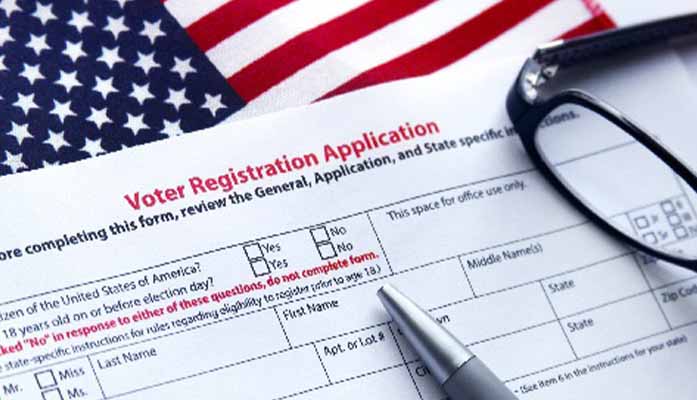
Republicans have expanded their voter registration advantage over Democrats in Arizona to 333,255 registered voters, according to the latest October 2025 report released by the Arizona Secretary of State’s Office.
The newest data shows Republicans now total 1,603,141 registered voters (35.63%), compared to 1,269,886 Democrats (28.23%). Another 1,625,968 voters are registered as “Other,” which includes independents and minor parties such as Libertarians (32,026), No Labels (42,277), and Greens (5,212). Arizona’s overall active voter registration stands at 4,498,995.
Since July, Republicans have added 5,436 new voters, while Democrats lost 421, according to changes noted in the official quarterly report. Historical data compiled by the Secretary of State’s office shows this partisan gap widening steadily in recent years. Republicans led by 295,000 voters in 2024, 166,000 in 2022, and 130,000 in 2020. As of October 2025, that lead now surpasses 333,000 — the largest margin in nearly a decade.
County-level data reveals that Maricopa County, Arizona’s largest, remains a focal point of both parties’ registration efforts. The October report lists 940,727 registered Republicans, compared to 744,804 Democrats, giving the GOP a nearly 196,000-voter advantage in the county. In traditionally conservative counties like Yavapai, Mohave, and Pinal, Republicans maintain commanding leads, while Pima County continues to serve as the Democratic stronghold with 247,221 Democrats to 191,977 Republicans.
The data also shows continued growth in unaffiliated voters, reflecting Arizona’s independent streak. The “Other” category now represents more than one-third of all registered voters (34.37%), and its steady rise across counties — particularly in Maricopa, Pima, and Yuma — highlights how nonpartisan voters could decide close statewide races.
The voter registration update comes less than a year before the 2026 gubernatorial election, in which Republicans aim to unseat Governor Katie Hobbs (D). Political analysts note that while registration advantages can shape turnout dynamics, Arizona’s large share of unaffiliated voters keeps the state in competitive territory.
The report also tracks 409,091 inactive voters, those whose registration may need updating due to address or status changes. Among inactive registrations, Republicans slightly outnumber Democrats — 110,196 to 106,623 — though both parties show similar proportional shares. The next update from the Arizona Secretary of State is expected in early 2026. With voter registration surpassing 4.49 million and growing each quarter, Arizona remains one of the most closely watched swing states in the nation heading into the 2026 election season.
Jonathan Eberle is a reporter for AZ Free News. You can send him news tips using this link.
by Matthew Holloway | Jul 23, 2025 | News
By Matthew Holloway |
Arizona Representative Nick Kupper (R-LD25) has stepped up to the ongoing controversy surrounding the hacking of the Arizona Secretary of State’s website. The lawmaker has requested a formal briefing from Secretary of State Adrian Fontes to account for the attempted breach of security to all members in the legislature, not merely the “select members” already discussing the matter.
The incident was reportedly carried out by Iranian hackers, according to the Secretary of State’s Office, who replaced images of the candidates on the website with images of the late Ayatollah Ruhollah Khomeini.
In a letter to Fontes, Kupper wrote in part: “While I understand your office has communicated with select members of the Legislature regarding this issue, I believe that all lawmakers should be afforded the opportunity to receive a comprehensive briefing on the nature of the attempted breach, any data or system vulnerabilities identified, and the steps you have taken to ensure the integrity and security of our electoral infrastructure.”
Kupper referenced reported failures in the AZSOS candidate portal noted by Turning Point Action’s Tyler Bowyer last week, writing, “Since the incident, the candidate portal has experienced noticeable slowdowns, which have affected accessibility and overall functionality.”
In a statement released alongside the letter to Fontes, Kupper noted, “Arizona’s election systems should never be this easy a target for foreign adversaries. This wasn’t a prank — it was a politically motivated act of cyberwarfare, and we deserve answers. Every legislator has a responsibility to understand what happened and what’s being done to keep it from happening again.”
Kupper has called for “a comprehensive briefing on the breach, including how it occurred, what systems or data may have been accessed, and what steps are being taken to prevent future incidents.”
The Arizona Representative even offered to arrange the logistics of “a full in-person briefing that will be open to all Arizona House Members and State Senators,” with the reservation of a conference room in the Arizona House of Representatives. He added that the briefing should occur in the next two weeks.
Reporting from KJZZ revealed that the images uploaded by the hackers were also linked to social media accounts, including a Telegram account which wrote, “We were not looking for war or adventure. However, President Trump’s flagrant violation of the agreement, through his aggressive attack on the nuclear and civilian infrastructure of the great nation of Iran, has forced us to face a difficult and regrettable confrontation. Now the American people share in the consequences of his risky decision. Our erosion revenge has begun.”
The attacks persisted for approximately a week, according to Arizona Department of Homeland Security Spokesman Aaron Thacker: “What this incident has done is it’s created — it’s not just an attack on the Secretary of State’s Office. It’s also an attack on government as a whole. We are not the only agencies that are being attacked.”
Thacker added, “When it comes to our overall collective security, this isn’t really something we should be playing politics with, and there have been a few folks that are being unnecessarily critical.”
Matthew Holloway is a senior reporter for AZ Free News. Follow him on X for his latest stories, or email tips to Matthew@azfreenews.com.
by AZ Free Enterprise Club | Oct 25, 2024 | Opinion
By the Arizona Free Enterprise Club |
If you can’t get people to like your ideas, change the system. That’s the clear agenda behind the Prop 140 scheme that seeks to bring ranked-choice voting and jungle primaries to Arizona. And there’s no more hiding it.
At a recent news conference organized by the Prop 140 campaign, Kimber Lanning—founder and CEO of a group called Local First Arizona that wants to build “equitable” systems for Arizona’s businesses—let the mask slip. Lanning revealed that when other states have adopted the reforms included in Prop 140, they have been able to move forward on transformational ideas like climate action plans and providing driver’s licenses to illegal immigrants.
Wait. Aren’t ranked-choice voting and jungle primaries supposed to lead to more moderation in the government? That’s what the backers of Prop 140 continue to push. But since when did climate action plans and special benefits for illegal immigrants become moderate?
Therin lies the true motivations behind Prop 140. Liberal billionaires from Colorado and others states around the country are pouring millions and millions into Arizona to pass this initiative in an effort to turn Arizona blue. They envision a system anchored around ranked-choice voting and jungle primaries will put them in charge of the political and policy agenda here in Arizona.
And in their zeal for power and control, they don’t even recognize the underlying hubris and irony of their entire campaign…
>>> CONTINUE READING >>>
by Daniel Stefanski | Sep 9, 2024 | News
By Daniel Stefanski |
Two ballot referrals from the Arizona Legislature may be on thin ice as voters prepare their decisions for November’s General Election.
A poll released this week from Noble Predictive Insights (NPI) showed that both Proposition 135 and Proposition 137 were underwater with respondents, though many voters remain undecided.
According to the Arizona Secretary of State, Prop 135 would “terminate governor’s emergency powers, except for powers relating to war, fire, or flood, 30 days after the governor’s proclamation, unless extended by the legislature; [and] requires the governor to call a special session upon presentment of a petition signed by at least one-third of the members of the legislature.”
The NPI survey shows that 29% of respondents support the measure, compared to 32% who are opposed. Thirty percent of respondents are undecided on how they would vote.
“Many conservatives haven’t forgotten COVID,” said NPI Chief of Research David Byler. “Memories of lockdowns – combined with a Democrat in the governor’s mansion – make sense of the partisan divide we see on this issue.”
The Arizona Legislature referred this proposal to the Secretary of State on June 13, 2023 (HCR 2039).
According to the Arizona Secretary of State, Prop 137 would “eliminate judicial terms and regular retention elections and nullif[y] the results of the 2024 judicial retention elections, for Arizona Supreme Court Justices, Court of Appeals Judges, and Superior Court Judges in counties with over 250,000 persons.”
For this proposition, the NPI poll shows that 31% of respondents would support the measure, compared to 38% who are opposed to it. Twenty-four percent of voters appear to be undecided.
“While about 1 in 10 voters say they wouldn’t vote on Prop 135 or 137, the large shares of voters who are still unsure how they will vote on each measure will determine whether or not these measures pass come November,” said Mike Noble, NPI Founder & CEO.
The Arizona Legislature referred this proposal to the Secretary of State on June 13, 2024 (SCR 1044).
Daniel Stefanski is a reporter for AZ Free News. You can send him news tips using this link.
by Matthew Holloway | Sep 5, 2024 | News
By Matthew Holloway |
On Tuesday, a judge considered the ongoing matter of Prop 140 in April Smith v. Fontes. The case involves a challenge of the validity of Arizona’s ranked choice voting initiative signatures.
At the end of the hearing, the number of challenged signatures was whittled down from over 40,000 to approximately 38,100 to be reviewed by a special master appointed by Maricopa County Superior Court Judge FrankMoskowitz.
Court observers are questioning if the outcome of the case has already been determined in Moskowitz’s mind.
It was evident that there was confusion between the judge and counsels for the plaintiffs, the Make Elections Fair Arizona PAC, and the Arizona Secretary of State on how to determine whether signatures already eliminated by County authorities or the Secretary of State would be present in either the full number of signatures or in “extrapolations.” The extrapolations are created by multiplying a 5% sample by 20 under existing statute to create a “validity rate” that can be applied to the sum total of signatures.
The hearing seemed expressly focused on how much of the evidence of duplicate signatures the court should exclude from consideration, rather than as the Supreme Court directed in Mussi v. Fontes, to “determine whether the exhibits prove any duplicate signatures by clear and convincing evidence.”
Judge Moskowitz appeared more concerned with determining how many exhibits do not prove duplicate signatures, saying, “They’re done. It’s over. It doesn’t matter if the remaining 31,000 or whatever it is are in fact duplicates and maybe double counted, maybe not give ’em credit and say they weren’t double counted. If you can get 4,800 that were double counted, it’s over,” describing what he expects to see in a brief from Make Elections Fair PAC.
Attorney Daniel Arellano, representing Plaintiffs April Smith, Nira Lee, and Joshua Davidian pushed back against this notion saying, “First of all, I just to be clear, I mean these all sound like categorical arguments to me, which I think are precisely what the Supreme Court said not to do. I’ve not seen briefing of this issue. There’s a preview of it. (…) I’ve not actually seen any legal argument on this, but as I listened to this argument here today, judge, I think, again, I forget if it’s Leah v. Hobbs or Leah v. Reagan, but one of the two definitely says that we get to invalidate signatures for reasons other than, in addition to, and outside of the 5% sample. And so if the premise of the committee’s argument is that it is, we have to go with what the county hasn’t validated because that is already multiplied times 20, and we can’t invalidate anything in addition to or separate from that. That is I think a proposition that the Supreme Court has squarely rejected.”
He added, “I think the point is I don’t think we can use this as an avenue to foreclose line by line review of the 38,000 signatures.”
But Judge Moskowitz was quick to retort: “No, I understand that. But even if I said yes, clear and convincing all 38,000, it says proceed accordingly. And my proceed accordingly is my next step is going to be how do I know of whatever number is of duplicates hasn’t been already invalidated. How do I know this signature hasn’t already been invalidated? And I think that would be in the proceed accordingly part of the Supreme Court’s order.”
However, the order from Arizona Supreme Court Chief Justice Ann Scott Timmer made the court’s priority clear, “The trial court must continue with determining whether the initiative is supported by a sufficient number of qualified signatures. This determination should be made as expeditiously as possible to provide the parties and the public certainty.”
In a thread posted to X, the Arizona Free Enterprise Club (AZFEC) paraphrased a comment from the organization’s President Scot Mussi, “This isn’t a debate about dubious matches or concerns of same family members with the same name being confused as a duplicate. All the duplicates submitted to be removed were exact name and address matches that aligned with what was on the voter file. Under state law, you are only allowed to sign a petition once, so they should have been removed. Instead, thousands of people were allowed to sign the initiative petition sheets multiple times, and those signatures were counted.”
In a press release the organization cited from the evidence presented that:
- When the Prop 140 Committee submitted their signatures to the Secretary of State, around 250 people had signed five or more times.
- One individual had signed 15 times.
- All those signatures were included in the final tabulation by the Arizona Secretary of State.
In a status update hearing held late on Wednesday, it was determined that Retired Arizona Superior Court Judge Christopher Skelly will lead the signature verification effort as court-appointed Special Master. During the meeting, Judge Moskowitz again referred to a possible stopping point for the signature review, asking Arellano, “Not to be looking at this for one side or the other, but there is a number of 4,800. And the only reason I say that number is because it’s the lowest number we’re talking about. But if that 4,800 number of duplicates is reached um… Does he stop if he knocks out whatever that number is 4,800 of duplicates? So you don’t get to your 33,000 something, something number Mr. Arellano? Does he just stop?”
Arellano, representing the plaintiffs, responded that the Special Master should be checking in with attorneys from both sides “periodically,” however, he added, “We’ve not set that up as any particular kind of benchmark. Nor do I know that we’d be comfortable doing so, since it sort of sets that up as like a goal of sorts.”
The signature checking effort is expected to run through September 16th with a hearing to discuss legal briefs from both sides on Friday.
Matthew Holloway is a senior reporter for AZ Free News. Follow him on X for his latest stories, or email tips to Matthew@azfreenews.com.