by Ethan Faverino | Sep 10, 2025 | News
By Ethan Faverino |
Arizona Public Service (APS), the state’s largest utility, has submitted a highly questionable new resource plan to the Arizona Corporation Commission, outlining a significant shift in its energy generation strategy through 2028.
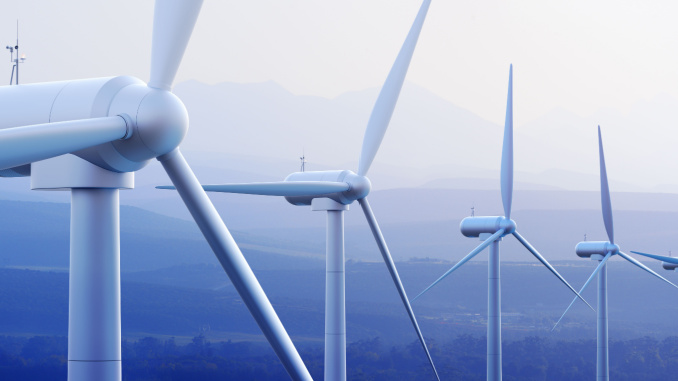
The plan, detailed in a recent filing, reveals APS’s intent to disregard President Trump’s opposition to wind power. It will nearly double its generating capacity by adding 7,200 MW of new power, with 93% coming from expensive and unreliable renewable sources—solar, wind, and battery storage—while natural gas accounts for just 7%.
This marks a dramatic pivot toward renewables, with wind power additions matching gas over the next four years and solar outpacing gas by five times over the next three years.
The plan stems from APS’s 2023 “All Source” Request for Proposals (RFP), which initially sought 1,000 MW of new generation, with at least 700 MW from renewables. Surpassing expectations, APS contracted for 7,200 MW, transforming its energy mix.
By 2028, APS’s generation is projected to shift from 76% reliable dispatchable sources (55% natural gas, 14% coal, 8% nuclear) and 19% renewables (10% solar, 6% wind, 3% battery storage) to 46% reliable sources (35% gas, 6% coal, 5% nuclear) and 52% renewables (22% solar, 7% wind, 23% battery storage). This expansion is equivalent to building two new Palo Verde nuclear plants.
This renewable-heavy strategy comes despite recent emphasis by APS and the Commission on a new natural gas pipeline.
The plan has sparked controversy because it contrasts with President Trump’s criticism of wind energy, as APS doubles down on clean energy investments.
Regarding coal, APS’s filing remains vague on the closure of the Four Corners coal plant, projecting an exit between 2031 and 2038. This aligns with APS’s recent shift from “carbon-free” to a “carbon-neutral” goal by 2050.
The revised commitment addresses concerns about affordability and reliability while maintaining a focus on clean energy. Under carbon neutrality, APS must expand generation without increasing emissions, necessitating significant renewable and storage investments.
The Arizona Free Enterprise Club has expressed concerns over the delayed coal phase-out and questioned the cost of the renewable-heavy plan, estimating $42.7 billion over the next 15 years.
APS’s prior claims that renewables paired with storage could match the reliability and affordability of fossil fuels have faced skepticism that the transition may lead to higher rates and grid reliability challenges.
Ethan Faverino is a reporter for AZ Free News. You can send him news tips using this link.
by AZ Free Enterprise Club | Aug 20, 2025 | Opinion
By the Arizona Free Enterprise Club |
In 2020, Arizona’s largest monopoly utility announced a voluntary commitment to one of the most extreme clean energy goals in the world: to go 100% carbon free by 2050. Five years later, they’re rolling that commitment back. Sort of.
When they first announced their original Clean Energy Commitment in 2020, APS boasted about their plans to decarbonize. According to their own release, they weren’t doing what they described as the “easy thing” other utilities were doing–developing resource plans that still allow you to produce some carbon emissions, so long as you offset them elsewhere. No, they were committing to go “carbon free,” which means shutting down every single source of baseload power beside nuclear and replacing it entirely with solar, wind, and battery storage.
But late last week, APS announced a modification to their climate commitment. Instead of going carbon free, APS is switching to carbon neutral by 2050.
How is the new commitment different than the old one? For ratepayers worried about skyrocketing utility bills, it doesn’t change much…
>>> CONTINUE READING >>>
by Matthew Holloway | Aug 15, 2025 | News
By Matthew Holloway |
A coalition of Arizona businesses from across the state released a statement expressing strong support for a newly announced project by Energy Transfer LP. The project will bring an interstate natural gas pipeline into the state from West Texas, constructed, owned, and operated by Transwestern Pipeline Company. It will power Arizona Public Service (APS), Salt River Project (SRP), Tucson Electric Power (TEP), Unisource Energy Services, and other utilities that supply energy to Arizona’s homes and businesses.
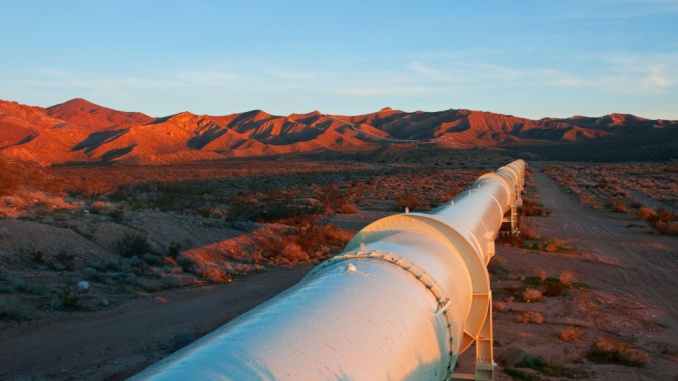
The new 42-inch pipeline, kept pressurized by nine compression stations, will span 516 miles across Texas, New Mexico, and Arizona. It will carry 1.5 billion cubic feet per day of natural gas. It is expected to come online in 2029.
AZBigMedia reported that the project is expected to cost approximately $5.3 billion, including about $600 million of Allowance for Funds Used During Construction (AFUDC)
“With this new natural gas pipeline, Arizona will be well positioned to have reliable baseload power to meet the growing demands of our economy,” said Arizona Corporation Commissioner Rachel Walden in a statement. “I’m pleased to see that the City of Mesa is participating in this project, serving as an example of Arizona’s ability to attract new commerce with affordable power while innovating in water conservation.”
In a post to X, Commissioner Nick Myers noted that this annoucement came alongside the recent accouncement that APS is rolling back its Biden-era zero-carbon goals. He said, “On the same day it was announced that APS is backing off their Green New Deal style policies, further proof that this commission has not been friendly to those policies, it was announced that Transwestern will be putting in another natural gas pipeline into Arizona. Energy dominance at its best!”
According to the Arizona Chamber of Commerce and Industry, “The project will help ensure that Arizona remains competitive with other high-growth states by providing the reliable, cost-effective energy necessary for economic development and job creation, particularly as energy demand is projected to soar.”
The Chamber added in a press release, “Natural gas is a cornerstone of Arizona’s energy system, generating 45% of the state’s electricity. It plays a critical role in supporting Arizona’s modern electricity grid, helping utilities meet peak demand during extreme summer weather and enabling the deployment of renewable energy resources like solar and wind year-round. Additionally, more than 1.4 million residential, commercial, and industrial customers count on the natural gas distribution system for their home comfort and business needs, including in sectors like semiconductors, EV batteries, and other advanced manufacturing.”
APS director of Resource Integration and Fuels Jill Freret told KJZZ, “This expansion for APS and for some of our peer utilities really allows us to bring in more natural gas to fuel existing facilities with growing demand and position us to have additional gas on our system out into the future.” Freret observed that the energy demand of APS is expected to increase by over 60% in the next 13 years.
The benefits of the project are not limited to the energy industry, however. Patrick Bray, Executive Vice President of Arizona Farm and Ranch Group, explained, “Access to natural gas supply is essential for our farmers and ranchers to power critical operations. This pipeline is a smart investment that will ensure the continued success and competitiveness of Arizona’s agriculture industry, allowing us to produce the food that sustains our communities and contributes significantly to our economy.”
In addition to dozens of Chambers of Commerce across the state, from Flagstaff to Sahuarita, industry organizations including the Arizona Cattle Feeders Association, Arizona Lodging & Tourism Association, Arizona Manufacturers Council, Arizona Multi-housing Association, Arizona Restaurant Association, Arizona Rock Product Association, Arizona Small Business Association, Arizona Trucking Association, and the United Dairymen of Arizona, all expressed support for the pipeline.
Matthew Holloway is a senior reporter for AZ Free News. Follow him on X for his latest stories, or email tips to Matthew@azfreenews.com.
by Jonathan Eberle | Aug 9, 2025 | News
By Jonathan Eberle |
Arizona Public Service (APS), the state’s largest electric utility, announced Wednesday it will no longer pursue its previous pledge to achieve zero carbon emissions by 2050. The company also scrapped its interim emission reduction targets and removed a commitment to end coal-fired generation by 2031 from its website. The utility now aims to be “carbon neutral” by 2050 — a less stringent target that allows for continued fossil fuel use if emissions are offset through technology such as carbon capture.
“Our aspiration has evolved based on changes to energy markets and customer needs, and our plans are built around doing what’s right for the people and prosperity of Arizona,” said APS spokeswoman Jill Hanks in a statement to 12News.
The announcement quickly drew sharp criticism from environmental advocates, who accused the company of backing away from its public commitments. “APS is walking away from every clean energy promise it made to the public, to regulators, to shareholders, and to the communities it serves,” said Autumn Johnson, Executive Director of the Arizona Solar Energy Industries Association. “We are left with vague intentions and zero accountability.”
A free-market advocacy group also voiced concerns, though from a different perspective. The Arizona Free Enterprise Club argued that the new plan still comes with a heavy cost to consumers. “While this is modestly better than the carbon-free plan they have been pushing for the last five years, APS’ new ‘carbon neutral’ plan will still cost ratepayers billions,” said Scot Mussi, the group’s president. “The priority should be reliable and affordable baseload power for Arizonans, not meeting arbitrary carbon goals that require massive amounts of expensive wind and solar that will degrade the grid.”
Some of Arizona’s elected officials also weighed in. Arizona Governor Katie Hobbs criticized the decision on X, writing, “Arizona needs an abundance of energy, with a strong, and reliable grid to keep our communities safe and to continue our economic growth. This decision sets us back. It makes our air dirtier, hurts our growing clean energy economy, and forfeits the cost savings of renewable options.”
She continued, “I’ll be reaching out to APS to discuss their decision and reiterate that we must continue investing in new energy technologies and diversify our energy portfolio at the fastest rate possible.”
Hobbs’ response is interesting given her history with APS. After her inauguration, it was revealed that Pinnacle West Capital Corp., the owner of APS, donated $250,000 to Hobbs’ inaugural fund. The group also made a $100,000 donation in 2024 to Hobbs’ secret litigation fund.
Republican gubernatorial candidate, and sitting U.S. Representative, Andy Biggs offered a sharply different take than Hobbs, posting, “Every utility in our state should be prioritizing reliable and affordable energy for Arizonans, not trying to meet the demands of environmentalists pushing the Green New Scam that hurts Arizona businesses and families. As Governor, I’ll make sure Arizona aligns with President Trump’s energy agenda to help our economy flourish.”
APS data shows most of the state’s surging energy demand is coming from the expansion of data centers rather than residential growth. The company and its investors view the sector as a major opportunity for revenue.
While APS maintains it remains committed to expanding cost-competitive clean energy, the rollback represents a significant departure from the 2020 pledge.
Jonathan Eberle is a reporter for AZ Free News. You can send him news tips using this link.
by AZ Free Enterprise Club | Jul 16, 2025 | Opinion
By the Arizona Free Enterprise Club |
Attorney General Kris Mayes has long fancied herself as a champion for ratepayers. After another round of rate hikes rolled in at the Arizona Corporation Commission (ACC), this time a proposed 14% increase by both APS and TEP, AG Mayes fired off a press release announcing that she will “vigorously oppose” these requests as “Arizona residents struggle to keep up with ever-increasing electricity bills.”
Setting aside the fact that the AG has little purview over ACC affairs, Mayes seems to think that her own time serving on the Commission back in the 2000s makes her uniquely qualified to stop what seems like an endless barrage of double-digit rate hikes by our public utilities. Unfortunately for ratepayers, having Kris Mayes involved will only pour fuel on the Net Zero fire currently raging at the Corporation Commission.
You see, Kris Mayes is the one that laid the foundation for the Green Scam rate hikes Arizonans are suffering through today. In fact, the biggest irony about having Kris Mayes jump into the rate hike fray is that it highlights the dangerous parallels between the Commission she served on in 2006 and the one that we have today…
>>> CONTINUE READING >>>