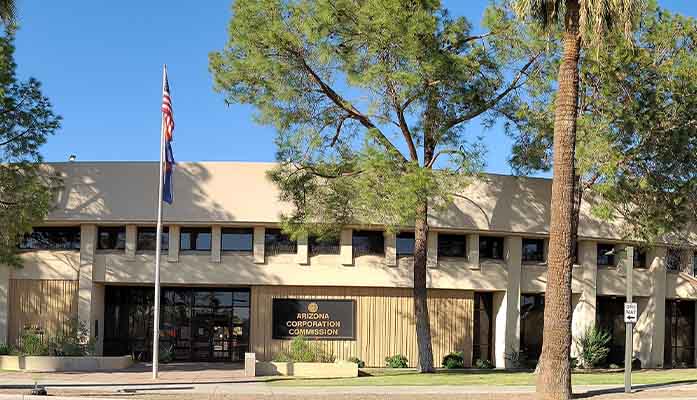
by AZ Free Enterprise Club | Nov 14, 2025 | Opinion
By the Arizona Free Enterprise Club |
Two months ago, Arizona’s monopoly utilities and their political allies were patting themselves on the back about the expansion and development of a couple of new natural gas projects that they claim will help the Grand Canyon state keep up with growing energy demand.
On the surface, an announcement of new projects like the Transwestern Expansion should have been great news for Arizona ratepayers. Our state is in desperate need of more reliable, dispatchable power; especially after years of reckless green new deal investments that have raised costs and reduced reliability.
But sadly, it turns out that SRP’s enthusiasm for gas isn’t about expanding baseload power on the grid after all. The new gas capacity is instead being used to replace existing coal power generation that SRP has pledged to shut down in Arizona. All to meet ridiculous self-imposed carbon reduction goals and climate commitments that should have been junked a long time ago…
>>> CONTINUE READING >>>
by Staff Reporter | Nov 6, 2025 | News
By Staff Reporter |
The newest member of the Tucson City Council is further left than the rest of the council’s Democrats.
That’s because newly elected Tucson Councilwoman Miranda Schubert is a socialist. Schubert’s victory can be credited in part to several powerful national players in progressive politics.
One of those key players is the Democratic Socialists of America (DSA). The DSA endorsed Schubert; she is also a member of their Tucson chapter.
The DSA platform is the furthest to the left, policywise, on every issue.
The DSA advocates for:
- making all healthcare, college, and childcare free;
- cancelling all student loan debts;
- decriminalizing all drugs;
- abolishing prisons, mandatory minimum sentencing, and cash bail;
- stripping police departments of military-grade weapons and equipment;
- establishing universal rent control;
- providing free counsel for all tenants;
- expanding subsidized housing;
- mandating paid family leave for all workers;
- reducing the regular workweek to 32 hours;
- establishing more unions in the workforce;
- eliminating fossil fuels;
- transferring ownership of transportation and energy infrastructure to the public;
- raising taxes on wealthier families, corporations, and private colleges and universities;
- mandating a permanent ceasefire in Gaza;
- ending military support and commerce to Israel;
- closing overseas bases and reducing the military budget;
- abolishing borders and immigration enforcement;
- ending economic sanctions on foreign countries;
- restoring voting rights to felons;
- granting voting rights to noncitizens;
- establishing statehood for Washington, D.C.;
- abolishing the electoral college;
- adding more House seats;
- ending the Senate filibuster;
- and limiting the Supreme Court’s powers
Schubert’s local DSA in Tucson aligns with this platform, and also supports progressive causes like allowing gender transitions for minors.
Another key player integral to Schubert’s victory was Run For Something (RFS), a political action committee devoted to recruiting and providing campaign assistance to progressive candidates across all 50 states. A former staffer from Hillary Clinton’s 2016 presidential campaign, Amanda Litman, and a Democratic Party consultant, Ross Morales Rocketto, launched RFS in 2017.
Schubert was one of two 2025 candidates in Arizona to receive support from RFS. They also provided Schubert support for her unsuccessful council run in 2021; that year she was their only endorsed candidate for Arizona.
IRS records show the social welfare nonprofit arm for RFS — formed in 2020 with the same name as its parent organization — reported over $6 million in revenue, over $9 million in expenditures, and nearly $7 million in total assets in the last available reporting (2023).
Another DSA member won a significant seat across the country on Tuesday night: Zohran Mamdani for New York City mayor.
Along with the strength of progressive powerhouses DSA and RFS, Schubert had significant support from the corporate sector: specifically, those assisting in transitioning the state to “clean” energy.
Schubert’s partner, Amanda Maass, is senior managing consultant at Illume Advising, a progressive research and advisory firm with headquarters in Tucson and Madison, Wisconsin. Illume assists utilities, states, and governments with the adoption of “clean” and “green” initiatives such as decarbonization and renewable energy.
Both Arizona Public Service (APS) and Tucson Electric Power (TEP) have been Illume clients. In recent years, Illume worked with both to craft a DEI-driven plan to electrify transportation across Arizona.
Illume has close ties to local and state leaders, including Tucson Mayor Regina Romero, Pima County Deputy Administrator Steve Holmes, Phoenix Mayor Kate Gallego, and Attorney General Kris Mayes. Romero’s communications and policy advisor, Victor Mercado, was Illume’s marketing and business development principal.
Illume founder and co-owner Anne Dougherty is board chair of the LGBTQ+ Alliance Fund of Southern Arizona, and director for the Arizona Technology Council as well as Groundswell Capital.
Prior to running for council, Schubert founded a labor union for Arizona’s public universities and some community colleges, CWA Local 7065 United Campus Workers of Arizona, and a local housing and transit advocacy group, Tucson for Everyone.
Schubert also served on two city commissions, the Complete Streets Coordinating Council and the Board of Adjustment.
AZ Free News is your #1 source for Arizona news and politics. You can send us news tips using this link.
by AZ Free Enterprise Club | Oct 31, 2025 | Opinion
By the Arizona Free Enterprise Club |
The Green New Scam got its start in Arizona two decades ago when a 5-0 Republican Commission (including then Republican Kris Mayes) adopted the Renewable Energy Standard and Tarriff Rules, or the REST Rules. Among other things, most significantly it ushered in the first “renewable” mandates in our state, forcing utilities to obtain at least 15% of their power from “renewables.” Ratepayers have been paying the costs (over $2 billion) ever since.
The REST Rules had a target date: 2025. Well, it’s now 2025, and the utilities have not only met that mandate, but they have also voluntarily exceeded it. Now our current 5-0 Republican Commission has started the process of repealing them.
Repealing the REST Rules is important, but the targets have already been met, and the price has already been paid. Substantively, the repeal won’t really affect ratepayers all that much. Why? Because mandate or no mandate, our utilities are completely committed to going “Net Zero” by 2050, and so far, they’ve been allowed to do it…
>>> CONTINUE READING >>>
by Jonathan Eberle | Oct 25, 2025 | News
By Jonathan Eberle |
Arizona Public Service (APS) is seeking to raise electricity rates by 14% starting in 2026 — a move the Arizona Free Enterprise Club (AZFEC) argues would unfairly burden Arizona families while subsidizing costly “green energy” initiatives and the early closure of a key coal plant.
According to filings with the Arizona Corporation Commission, APS attributes the proposed rate increase largely to battery storage projects and the early retirement of the Cholla Power Plant. The Arizona Free Enterprise Club filed an official response criticizing APS for attempting to block the organization’s intervention in the case, while allowing environmental groups such as the Sierra Club to participate. “APS has no issue letting radical groups like the Sierra Club into their hearings, but they’re trying to block the one organization fighting for Arizona families,” said AZFEC President Scot Mussi.
Mussi contends APS’s “carbon free” and “carbon neutral” commitments over the past five years have shaped their energy plans — including their Integrated Resource Plans and large-scale renewable energy projects — resulting in higher costs for consumers. “For years, their voluntary commitments have very likely increased costs for Arizona ratepayers,” the organization said in its filing.
Two days after filing its response, the Arizona Free Enterprise Club announced it had been officially granted intervention in the APS case. This designation allows AZFEC to participate directly in proceedings, making it the only organization representing ratepayers who oppose the rate hike.
In the ruling, the Administrative Law Judge overseeing the case described the Club as “the lone proponent” of an energy approach emphasizing reliability, affordability, and independence — priorities the group says align with President Trump’s “American Energy Dominance” agenda.
“While others are lobbying to shut down Arizona’s coal plants and pour billions into unreliable Green New Scam projects, we’re standing up for the ratepayers who will be left to foot the bill,” Mussi said. “We’re proud to be the only organization in this case fighting to keep Arizona’s energy secure, affordable, and free from political interference.”
The Club’s participation ensures that Arizona ratepayers have a voice during the proceedings, according to Mussi and AZFEC Deputy Policy Director Greg Blackie. “This isn’t about politics — it’s about protecting Arizona families and ensuring that our state doesn’t fall victim to the same radical energy policies destroying affordability across the country,” said Blackie. “We intend to shine a light on the real costs, the real numbers, and the real consequences of this so-called green transition.”
The case before the Arizona Corporation Commission will determine whether APS can move forward with its proposed rate hike. The Arizona Free Enterprise Club says it plans to continue pressing for “transparency, accountability, and energy freedom,” ensuring that “ratepayers are not forced to fund reckless green energy policies.”
Jonathan Eberle is a reporter for AZ Free News. You can send him news tips using this link.
by Matthew Holloway | Oct 20, 2025 | News
By Matthew Holloway |
Arizona Corporation Commissioner (ACC) Rachel Walden brought an amendment during the commission’s Wednesday meeting to require detailed, extensive oversight over electrical utilities. Gaining unanimous approval in a 5-0 vote, Walden pushed to ensure Arizona’s electrical grid doesn’t become a ratepayer-funded venue for green projects.
At the October 15th open meeting, Walden pushed through an amendment demanding a more granular kind of report than the industry has provided for the past 26 years, exceeding what is required under Arizona Revised Statutes. Utilities like APS and SRP already owe the ACC their ten-year forecasts under state law, but Walden’s call for more detail: business confidential filings on line congestion, load-growth hotspots, and every grid-hardening method from reconductoring to storm-proofing—are a seismic departure from the more hands-off era that preceded.
“Finding the least cost, most reliable model includes transmission, not just electricity generation. None of the answers from our state utilities today inspired any confidence in me that these issues are a priority,” Commissioner Walden told the meeting. “I am not convinced that additional build out of renewables, while also having to add firm capacity as well as back up generation, is saving Arizonans money. I know that Arizonans are concerned with these issues, especially as we head into accelerated growth in our state. The Commissioners, as elected by the public, are faced with these questions and comments almost daily, and our actions are held accountable to the public.”
The move from Walden and the ACC seems to have been carefully timed. The Thirteenth Biennial Transmission Assessment projects a 3 percent annual growth surge through 2033, significantly faster than previous forecasts, reflecting Arizona’s population boom colliding with a deluge of intermittent ‘renewable’ sources. With solar and wind flooding the system, utilities are rerouting power across state lines, inviting operational headaches from California’s aggressive decarbonization push.
“Arizonans will not bear the costs and impacts of supporting neighboring states’ Green New Deal policies,” Walden said.
Walden’s amendment mandates confidential reports on congestion and bottlenecks, where new solar farms fail to provide a consistent load or data centers increase demand, along with projections to gauge how interconnection requests ripple through the system. Supporting Commissioner Lea Márquez-Peterson’s additions, Walden is requiring complete disclosures on enhancement efforts, ensuring the ACC can vet if utilities are truly fortifying the state’s transmission system.
With major data centers like Microsoft and Google cropping up in Maricopa County, pulling gigawatts from an already strained grid, peak demand strains are a genuine concern. The disastrous 2023 heat wave that had Texas utilities scrambling is fresh in mind. Arizona is hardly immune to such issues. As renewables providers require load balancing and battery installations, the costs are passed on to ratepayers, and Walden is questioning the utilities’ math.
“Ensuring our utilities have sufficient generation capacity to serve our customers during peak demand along with a reliable transmission grid to handle that capacity is paramount,” she said. “The Commission must ensure that any transmission or generation solutions to mitigate grid concerns, such as line congestion created by the interconnections from new generation sources, or offtakes from the grid by large customers such as data centers and hyperscalers, are borne by the creators of those grid concerns, not Arizona ratepayers.”
Walden pledged to scrutinize future Biennial Assessments and Integrated Resource Plans in a distinct pivot from the ACC’s historically more hands-off stance.
“I will be watching the Biennial Transmission Assessments and Integrated Resource Plans closely, and investigating these issues in all future rate cases,” Walden concluded.
Matthew Holloway is a senior reporter for AZ Free News. Follow him on X for his latest stories, or email tips to Matthew@azfreenews.com.